Kenan-Flagler Application Essay Tips for 2026-2027
The UNC Kenan-Flagler application asks for two 250-word essays, an optional essay, and, new this cycle, a timed video essay. Together, they give UNC admissions readers a picture of your goals, values, and the perspective you’d bring to Chapel Hill beyond your resume and test scores.
Quick Summary
- Ground every response in specifics from your own life and career. The admissions readers use these short essays to learn what only you can tell them.
- Treat the video essay as a conversation. Use the 20-second prep to organize your thoughts, then speak naturally rather than reciting a script.
- For the core-values essay, choose the one value you can prove with a single vivid story, and spend most of your words on what you did and what it taught you.
UNC Kenan-Flagler Business School is one of the country’s top public MBA programs, known for academic rigor paired with a collaborative culture and a real focus on leadership development. It sits in the Research Triangle, a magnet for global corporations, startups, and nonprofits across software, life sciences, consumer goods, and design, and Chapel Hill’s easygoing college-town energy gives you a place to recharge between the program’s demands.
The school leans hard on experiential learning and a global outlook, from international immersions to hands-on consulting projects, all in service of its four guiding values of impact, innovation, inclusion, and integrity. Your essays and video are where the admissions committee gets to know the person those values will run through.
Curious about your odds at a top MBA program? Contact us for a free 15-minute advising session to talk strategy with an SBC Principal Consultant.
What does the UNC Kenan-Flagler application ask for?
The written portion is two required essays of 250 words each, plus an optional essay of the same length and a 100-word reapplicant essay for returning candidates. New this cycle, there’s also a short video essay. Kenan-Flagler’s admissions team frames the written responses as a way to learn about your motivations and aspirations, and asks that they be concise, clear, and introspective. Keep that in mind across the whole set. These are compact, so specificity and self-awareness do the heavy lifting.
How should you approach Required Essay 1 (your goals)?
We value the different paths and aspirations that each student brings to the UNC Kenan-Flagler community. Please share your goals for pursuing an MBA, or the path you’re considering, and how they reflect your unique background or perspective. (250 words max.)
This prompt does three jobs in 250 words, and applicants tend to nail the first and give short shrift to the latter. It asks for your goals, but it also asks how those goals reflect your unique background and perspective. That second part is what separates you from every other candidate chasing the same post-MBA role, so give it real room.
Open with the part of your story that explains why this goal is yours. A single decision, a turning point, or a pattern in your work does more here than a list of accomplishments. Then state your short-term goal, or the path you’re weighing. Notice that Kenan-Flagler explicitly welcomes “the path you’re considering,” so an honest, well-reasoned direction is fine even if you haven’t locked every detail. That’s more latitude than most goals essays give you, and it rewards candor over a manufactured five-year plan.
With only 250 words available, be willing to trim aggressively. Your long-term vision and a generic case for why you need an MBA can usually go. Use the words instead to show the throughline from your background to your goal, and to make a concrete Kenan-Flagler connection. Name something real that maps to your direction, whether that’s a STAR consulting project, one of the school’s career-focused concentrations such as consulting, real estate, healthcare, or sustainable enterprise, a Global Immersion Elective, or a professional club tied to your track. One well-chosen resource that fits your goal beats three dropped in passing.
How should you approach Required Essay 2 (core values)?
UNC Kenan-Flagler is guided by four core values that shape who we are: impact, innovation, inclusion, and integrity. Which one of these Core Values resonates most deeply with your professional journey? Please share an example that demonstrates how this value has influenced your actions or decisions. (250 words max.)
Read the wording closely. Kenan-Flagler asks which value resonates with your professional journey and wants an example of how it has influenced your actions or decisions. That makes this a decision essay. It’s asking for a moment when a value drove a real choice, so an abstract paragraph about what integrity means to you will fall flat. What earns attention is a moment when a value cost you something or forced a trade-off.
Pick the value you can back with the most convincing story. That might be the boldness of innovation, the responsibility of impact, the empathy of inclusion, or the steadiness of integrity. Because the prompt points to your professional journey, a work example is the safest bet, though a personal one can work if it’s genuinely revealing. The strongest examples often come from moments when two values collided or doing the right thing was expensive, because they show conviction under pressure.
Structure it tightly with a situation-task-action-result approach so a 250-word story stays clean. Set the context, define your role, walk through what you did, and land the outcome. Then reflect. Explain what the moment taught you and how it shaped the leader you’re becoming. Kenan-Flagler builds these same four values into many of its programs, so a brief, concrete sense of how you’ll carry your value into that community gives the reader something to picture.
For more on what the school values in applicants, this Q&A with Kenan-Flagler’s Senior Associate Dean of MBA Programs is worth a read.

What is the Kenan-Flagler video essay, and how do you prepare?
New this cycle, Kenan-Flagler adds a timed video essay. You’ll answer two questions within a total of two minutes. Both prompts appear on screen at once, and after a 20-second preparation period, you can divide your time between them however you like. Both questions share one 120-second recording, with no separate recording for each prompt, and while you don’t have to use the full two minutes, the school recommends taking the time to answer both thoroughly. You can re-record once, but a second take automatically deletes the first, so the re-record replaces your original rather than giving you two versions to choose between.
A few habits make this easier. Use the 20 seconds to read both prompts and sketch the shape of each answer, along with a rough sense of how to split your time. Answer both questions, since it’s easy to pour everything into the first one and leave the second rushed. For each answer, aim for a simple shape: make one clear point, back it with a concrete example, and close with a quick takeaway. Speak the way you would with a recruiter over coffee, because the camera rewards warmth and clarity far more than a polished script.
Handle the basics people still fumble, like looking into the camera lens instead of your own image, and record somewhere quiet and reasonably lit. You can re-record only once, and a second take automatically erases the first, so treat your recording as the real thing rather than a throwaway rehearsal. Because the prompts appear when the exercise begins, the best preparation is practicing out loud on the topics MBA programs tend to ask about, such as why you want the degree, a time you led through a challenge, or what you do outside of work.
Should you write the optional essay?
We encourage you to tell us more about who you are so we can get to know you as a person and potential member of the Carolina community. Use this essay to convey information that you may not have otherwise been able to in the application. (250 words max.)
Write it if you have something worth saying, and skip it if you’d only be padding. The optional essay does one of two jobs well. If you have a red flag, an academic dip, an employment gap, or an unusual recommender choice, use the space to give context and show how you handled it. Keep the tone matter-of-fact and land on what you learned.
One of Kenan-Flagler’s listed topics gets overlooked, and it can quietly help you. If your recommendation isn’t coming from your current direct manager, use the recommender-context option to head off the obvious question, whether the reason is a startup with no traditional boss, a manager you couldn’t tell you’re applying, or a family business. A sentence or two keeps a reader from reading anything into the gap.
If you have no red flags, use the space to add a dimension your other answers can’t reach, whether that’s a passion that shows discipline, an international chapter that shaped how you think, or a detail that makes you memorable. Stay concrete and keep it purposeful. Kenan-Flagler lists the full menu of options: personal or professional accomplishments, interests and passions, gaps or inconsistent academic performance, context for recommender selection, or a fun fact.
What should reapplicants know?
If you are re-applying to the program, we require a brief essay that describes how your application differs from your previous submission and alerts us to new test scores, a recent promotion, or other areas that demonstrate how you have strengthened your candidacy. (100 words max.)
With only 100 words, lead with your single biggest change and let the smaller updates support it. A reapplicant essay that lists five minor tweaks makes you look like a candidate hoping volume adds up to progress. One clear, meaningful development—a promotion, a new role, a much stronger test score, or sharper goals—tells a better story. Name it first, show what it proves about your readiness, and use any remaining words for supporting updates like a stretch assignment or new leadership in a volunteer role. The impression you want to leave is momentum, a candidate who has kept growing since the last application.

How should you use AI in your Kenan-Flagler MBA essays?
Kenan-Flagler expects your application to reflect your own thinking and voice. AI tools can help you brainstorm angles, organize a rough outline, or tighten your grammar. But the ideas, the stories, and the reflection need to come from you. That matters most in the video essay, where a memorized or over-produced answer tends to sound stiff and impersonal. Use AI the way you’d use a thoughtful friend who reads a draft and asks good questions, then do the actual writing and speaking yourself.
Frequently Asked Questions About the Kenan-Flagler Application
Do you need a fully mapped-out career plan for Essay 1?
Readers aren’t after a rigid five-year plan. What lands is a clear, realistic direction that grows out of your experience. If your goals are still evolving, name the path you’re weighing and show why it makes sense given where you’ve been. Conviction and logic matter more than false precision.
Should you memorize your video essay answers?
Memorizing works against you here. Part of what the video essay is built to reveal is whether you can think on your feet and let your personality through. Attempting to follow a word-for-word script buries both under a stiff delivery. Use the 20-second prep to jot the two or three points you want to hit, then talk through them the way you’d explain yourself to a colleague. The goal is to sound prepared and like yourself at the same time.
Is the optional essay actually optional?
Skip it only if adding it would mean padding. If you have a genuine red flag to explain or a meaningful part of your story the rest of the application misses, the optional essay is the place for it. Treat it as a real opportunity whenever you have something worth saying.
Does choosing a particular core value in Essay 2 impress the committee more?
No value is inherently better; readers care about the evidence behind your choice. So, pick the one you can back with a believable story from your own life. A well-told example of integrity beats a vague nod to innovation every time.
Get Expert Help With Your Kenan-Flagler Application
We’ve helped thousands of applicants earn admits to top MBA programs, including UNC Kenan-Flagler. Whether you want start-to-finish support through our All-In Partnership or targeted essay and resume reviews, there’s a service to match where you are. Contact us to book a free 15-minute strategy session with a Principal Consultant and take the first step toward your UNC MBA dreams.
MBA Launchpad
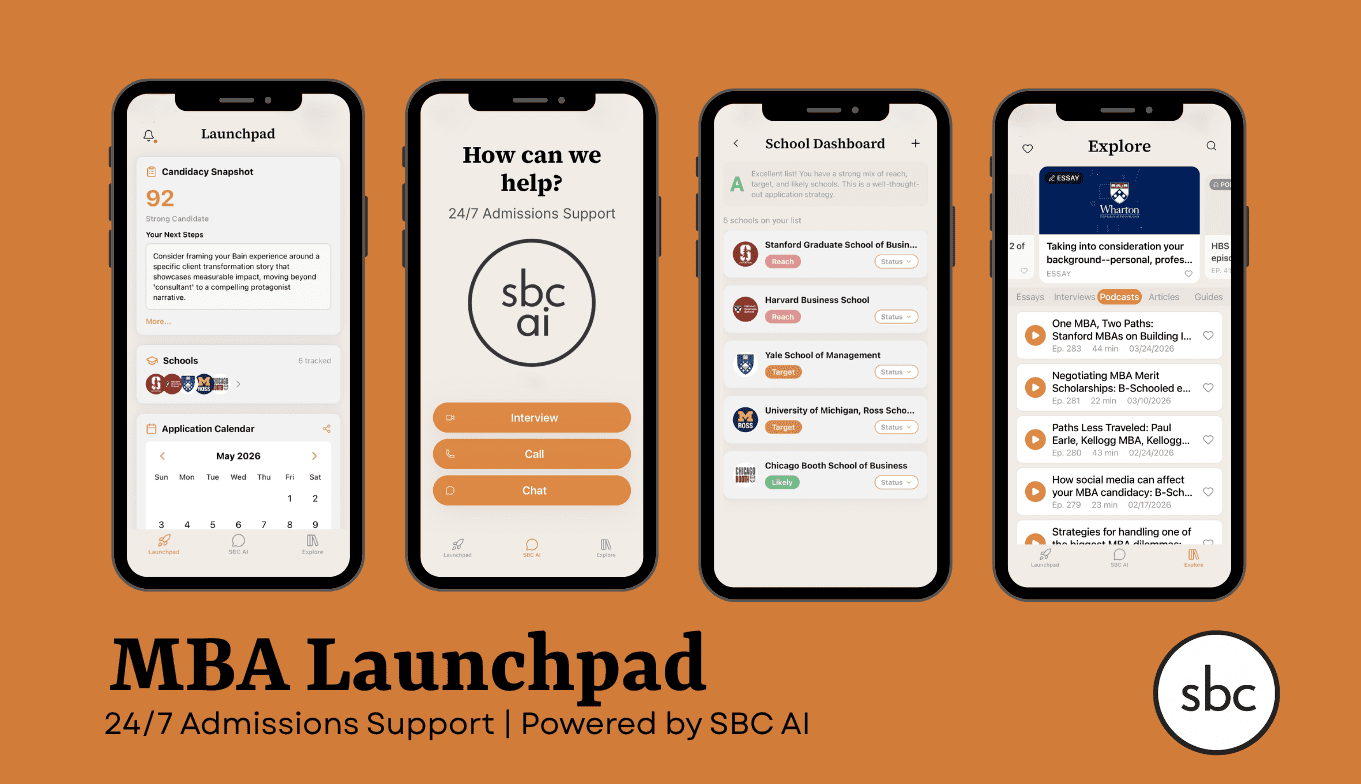
Don’t sleep on our latest product, MBA Launchpad by SBC! It’s an AI-powered admissions assistant built on 25+ years of real SBC admissions data. Get a candidacy assessment, build a balanced school list, and pressure-test your essay strategy with guidance available 24/7. Premium features are currently free. Download it on the App Store or Google Play.
Here’s a snapshot of the caliber of expertise on our SBC team.








Ashley
Ashley is a former MBA Admissions Board Member for Harvard Business School (HBS), where she interviewed and evaluated thousands of business school applicants for over a six year tenure. Ashley holds an MBA from HBS. During her HBS years, Ashley was the Sports Editor for the Harbus and a member of the B-School Blades Ice Hockey Team. After HBS, she worked in Marketing at the Gillette Company on Male and Female shaving ...
×Pauline
A former associate director of admissions at Harvard Business School, Pauline served on the HBS MBA Admissions Board full-time for four years. She evaluated and interviewed HBS applicants, both on-campus and globally. Pauline's career has included sales and marketing management roles with Coca-Cola, Gillette, Procter & Gamble, and IBM. For over 10 years, Pauline has expertly guided MBA applicants, and her clients h ...
×Laura
Laura comes from the MBA Admissions Board at Harvard Business School (HBS) and is an HBS MBA alumnus. In her HBS Admissions role, she evaluated and interviewed hundreds of business school candidates, including internationals, women, military and other applicant pools, for five years. Prior to her time as a student at HBS, Laura began her career in advertising and marketing in Chicago at Leo Burnett where she worked on th ...
×Andrea
Andrea served as the Associate Director of MBA Admissions at Harvard Business School (HBS) for over five years. In this role, she provided strategic direction for student yield-management activities and also served as a full member of the admissions committee. In 2007, Andrea launched the new 2+2 Program at Harvard Business School – a program targeted at college junior applicants to Harvard Business School. Andrea has also served as a Career Coach for Harvard Business School for both cu ...
×Jennifer
Jennifer served as Admissions Officer at the Stanford (GSB) for five years. She holds an MBA from Stanford (GSB) and a B.S. in Chemical Engineering from University of Illinois Urbana-Champaign. Jennifer has over 15 years experience in guiding applicants through the increasingly competitive admissions process into top MBA programs. Having read thousands and thousands of essays and applications while at Stanford (GSB) Admiss ...
×Davina
Davina received her MBA from Stanford's Graduate School of Business (GSB), with a certificate in Public Management, and her BA in Psychology from UC Berkeley. Davina is an experienced strategic planning leader, facilitator, and business case writer who spent more than 15 years building culture, entrepreneurship, and leadership initiatives across Stanford University and the Stanford Graduate School of Business. She designed ...
×Erin K.
Erin served in key roles in MBA Admissions--as Director at Haas School of Business at UC Berkeley and Assistant Director at Stanford's Graduate School of Business (GSB). Erin served on the admissions committee at each school and has read thousands of applications in her career. At Haas, she served for seven years in roles that encompassed evaluation, outreach, and diversity and inclusion. During her tenure in Admissions at GSB, she was responsible for candidate evaluation, applicant outreach, ...
×Susie
Susie comes from the Admissions Office of the Stanford Graduate School of Business where she reviewed and evaluated hundreds of prospective students’ applications. She holds an MBA from Stanford’s GSB and a BA from Stanford in Economics. Prior to advising MBA applicants, Susie held a variety of roles over a 15-year period in capital markets, finance, and real estate, including as partner in one of the nation’s most innovative finance and real estate investment organizations. In that r ...
×Dione
Dione holds an MBA degree from Stanford Business School (GSB) and a BA degree from Stanford University, where she double majored in Economics and Communication with concentrations in journalism and sociology. Dione has served as an Admissions reader and member of the Minority Admissions Advisory Committee at Stanford. Dione is an accomplished and respected advocate and thought leader on education and diversity. She is ...
×Anthony
Anthony served as the Associate Director of MBA Admissions at the Wharton School at the University of Pennsylvania, where he dedicated over 10 years of expertise. During his time as a Wharton Admissions Officer, he read and reviewed thousands of applications and helped bring in a class of 800+ students a year. Anthony has traveled both domestically and internationally to recruit a ...
×Meghan
Meghan served as the Associate Director of Admissions and Marketing at the Wharton MBA’s Lauder Institute, a joint degree program combining the Wharton MBA with an MA in International Studies. In her role on the Wharton MBA admissions committee, Meghan advised domestic and international applicants; conducted interviews and information sessions domestically and overseas in Asia, Central and South America, and Europe; and evaluated applicants for admission to the program. Meghan also managed ...
×Amy
Amy comes from the Wharton School of the University of Pennsylvania where she was Associate Director. Amy devoted 12 years at the Wharton School, working closely with MBA students and supporting the admissions team. During her tenure at Wharton, Amy served as a trusted adviser to prospective applicants as well as admitted and matriculated students. She conducted admissions chats with applicants early in the admissions ...
×Ally
Ally brings six years of admissions experience to the SBC team, most recently as an Assistant Director of Admission for the full-time MBA program at Columbia Business School (CBS). During her time at Columbia, Ally was responsible for reviewing applications, planning recruitment events, and interviewing candidates for both the full-time MBA program and the Executive MBA program. She traveled both internationally and dome ...
×Emma
Emma comes from the MBA Admissions Office at Columbia Business School (CBS), where she was Associate Director. Emma conducted dozens of interviews each cycle for the MBA and EMBA programs, as well as coordinating the alumni ambassador interview program. She read and evaluated hundreds of applications each cycle, delivered information sessions to audiences across the globe, and advised countless waitlisted applicants. ×
Dana
Dana served as Assistant Director of Admissions at Columbia Business School for the Full-Time MBA program and has over 10 years of experience working in higher education. Known as a scrupulous file reader, Dana reviewed countless applications and assisted in rendering final decisions for the Admissions Committee at CBS. While leading information sessions at Columbia and on the road, Dana met and advised myriad applicants� ...
×Holly
Holly worked as a member of the NYU Stern MBA Admissions team for seven years and holds an MBA from NYU Stern. In her tenure as Director of NYU MBA Admissions, Holly worked closely with admissions teams from Columbia, Michigan Ross, UVA Darden, Cornell Johnson, Berkeley Haas, Yale SOM, and Duke Fuqua on recruiting events domestically and internationally. On the NYU Stern admissions committee, Holly conducted interviews, planned and hosted events, and trained staff on reading and interviewi ...
×Written by SBC Consultant Amy. Reviewed by Stacy Blackman. Learn more about our former admissions officers on the SBC admissions team page.