Booth MBA Essay Tips for the 2026-2027 Admissions Season
These new Booth MBA essay tips respond to a major shift: Chicago Booth traded its narrative essays for four short-answer prompts capped at 300 characters each. It’s a striking reversal from last cycle, when Booth set word minimums rather than maximums and left the length judgment call to applicants. There’s no room to write around a fuzzy goal or a borrowed value now, so what shows up in each answer has to be the real deal. Here’s what the Chicago Booth School of Business‘s new Class of 2029 essays ask, and how to make every character count.
Quick Summary
- Booth replaced its two long-form essays with four 300-character prompts covering career goals, an image that matters to you, and a fun fact
- The compressed format leaves no space for narrative scaffolding, so precision and self-awareness matter more than polished prose
- Optional and reapplicant essays keep their full 300-word length, so save the fuller storytelling for those sections
What are the Booth MBA essay tips for the post-MBA goals prompts?
Booth’s goals prompts arrive in two parts, each capped at 300 characters.
Immediate post-MBA career goal: State your target role, function, and industry in one clean sentence. There’s no room to justify the goal here, only to name it precisely. “Product management, consumer tech” beats “a role where I can leverage my analytical background to drive impact” every time. If your immediate goal reads generically, the problem usually isn’t the character limit; it’s that you haven’t yet landed on a specific goal.
Long-term post-MBA career goal: The same discipline applies to your 5-10-year vision. Name the destination, not the journey. Booth’s admissions readers aren’t looking for a strategic plan in 300 characters; they’re checking whether your long-term goal follows logically from your immediate one. If the two goals feel disconnected, that’s worth solving before you write either answer.
Because there’s no space to explain your reasoning, the connective tissue between past experience, immediate goal, and long-term vision has to live somewhere else in your application, your resume, your recommendations, the story your whole file tells. These two answers are the destination points on that map, not the map itself.
Curious how a Booth admissions officer would read your specific goals? Contact SBC for a free 15-minute advising session with a Principal Consultant.
How should you approach Booth’s image and fun fact prompts?
These two “About You” prompts ask for very different things, and treating them as interchangeable is the most common mistake applicants will make with this format.
Upload an image and explain its significance.
Start by brainstorming three or four candidate images before you commit to one. The first image that comes to mind is often the most obvious: a diploma, a team photo, a landscape from a trip, and obvious images tend to produce obvious explanations.
Push past that first instinct and look for something smaller and more specific: an object, a place, or a moment that’s meaningful to you personally rather than one you assume Booth wants to see. Choose an image a stranger could read at a glance, since you won’t have space to set the scene.
Then use your 300 characters to explain significance, not to describe what’s in the frame. Booth already sees the photo; what they can’t see is why it matters. A photo of a well-worn notebook explained as “the field notes from my first startup failure, the reason I trust process over instinct now” does more work than a scenic photo captioned “this trip changed my perspective,” because the first one names a specific belief and where it came from, and the second one names a feeling without ever landing on what it produced.
If your draft explanation could be swapped onto a different photo without changing much, the image and the explanation aren’t actually connected yet, and that’s worth fixing before you submit.
Share a fun fact or something unique about yourself.
Resist writing down the first thing that comes to mind, since it’s usually a generic category dressed up as a fact, “I love to travel” or “I’m a foodie,” and those describe millions of applicants without revealing anything about you specifically. Give yourself three or four real candidates before you pick one, and look for the detail that’s genuinely yours: an odd skill you’ve built over years, a niche interest most people don’t share, a fact about your life that reliably gets a follow-up question when you mention it at a dinner party.
Specificity is what does the work here, not novelty for its own sake. “I’ve competed in three national trivia championships” tells a reader more than “I know a lot of random facts,” because the first is concrete and verifiable, while the second is a vague self-description. Run your draft through this test: if an admissions reader repeated it back to a colleague later that day, would it land, or would it need explaining?
If it needs explaining, it’s still a category, not a fact. And once you’ve landed on the right one, resist the urge to justify it or connect it to your candidacy. This prompt isn’t asking for relevance; it’s asking for personality, so let it stand on its own rather than dressing it up as another leadership story.
Together, these two answers should give Booth two different windows into who you are, one values-driven and reflective, one lighter and distinctive. If both land in the same emotional register, one of them isn’t doing its job.
What should you cover in Booth’s optional essay?
Is there any unclear information in your application that needs further explanation or additional details you would like to share with the Admissions Committee? (Maximum 300 words)
This prompt actually serves two distinct purposes, and conflating them is a common mistake.
When the optional essay is for clarifying
The first purpose is damage control: clarifying a gap or concern, an academic dip, a career break, an unconventional path, so the admissions committee isn’t left guessing. If that’s your situation, keep it factual and brief, and resolve the question rather than over-explaining it.
When the optional essay is for adding value
The second purpose is easy to overlook, especially for strong applicants without red flags: Booth is also inviting you to add anything valuable that didn’t fit elsewhere. Given how compressed the rest of this application is, that’s a real opportunity, not a formality. With only two goals answers, one image, and one fun fact carrying your entire personal and professional story, plenty of substantive material has nowhere else to go. A few things worth considering for this space:
- A specific leadership moment or accomplishment that shows scope or impact your resume can’t fully capture in bullet points
- Community involvement or volunteer work that reveals values you didn’t get to address anywhere else in the application
- Context on an unusual career pivot or non-linear path, framed as a strength rather than an explanation
- A second, smaller story that complements your image or fun fact answer without duplicating it, giving the committee one more genuine data point on who you are
The test, either way, is the same: does this add insight that the rest of your application doesn’t already provide? If you’re using this space to clarify, be economical. If you’re using it to add, make sure what you’re adding actually earns its place rather than restating your resume in paragraph form. Given the sparse format of this year’s application, strong applicants have real reason to use this section rather than skip it by default.
What has changed for Booth reapplicants?
Upon reflection, how has your perspective regarding your future, Chicago Booth, and/or getting an MBA changed since the time of your last application? (Maximum 300 words)
Notice what this prompt isn’t asking: it’s not asking how your candidacy has improved. A better test score or a promotion is worth mentioning if it’s relevant, but the real subject here is how your thinking has evolved. Have your goals sharpened? Has new experience reshaped your plan? Has your understanding of what Booth offers, and why you need it, gotten more specific?
Reread your prior application before drafting this one, and identify what was missing or underdeveloped in how you described your future, not just what’s changed on your resume since then. The strongest reapplicant essays show growth in self-awareness and clarity, and a realistic, updated sense of how a Booth MBA fits into that future.
How should you use AI in your Booth MBA essays?
Booth’s 300-character format changes what AI is actually useful for. In a traditional essay, AI tempts you to generate content. Here, there’s barely room for content to generate: the real work is deciding what to say, not finding words to say it.
That makes AI’s best use in this application editorial rather than generative. Once you’ve drafted an honest 400-character version of an answer, AI can help you cut it to 300 without losing the point, testing which words are doing real work and which are just filler. That’s a legitimate, useful pass. What it can’t do is choose your goal, pick the image that means something to you, or surface a fun fact that’s actually yours. Those decisions happen before you type a single character, and no tool can make them for you.
There’s also a sharper risk here than in a longer essay. A generic AI-written paragraph can hide inside 250 words of otherwise decent writing. It can’t hide inside a single 300-character sentence. Compression exposes vague thinking faster than length does, so if an answer still sounds like it could belong to anyone after you’ve cut it down, the problem isn’t the editing pass; it’s that the underlying idea wasn’t specific enough to begin with.
If you use AI anywhere in this application, use it to sharpen a real answer, not to produce one from scratch.
Frequently Asked Questions About Booth MBA Essays
How many essays does Chicago Booth require for the Class of 2029? Booth requires four short-answer prompts, each capped at 300 characters, covering your immediate and long-term post-MBA career goals, an image with its significance, and a fun fact about yourself. An optional 300-word essay is available to all applicants, and a separate 300-word essay is required for reapplicants.
Why did Chicago Booth shorten its MBA essays? Booth hasn’t stated a reason publicly, but the shift rewards clarity over polish. A 300-character limit leaves no room for narrative scaffolding, so what an applicant writes has to reflect real, specific thinking rather than well-constructed prose.
Can I still show depth and personality in such short answers? Yes, though it takes a different kind of preparation than a traditional essay. Specificity does the work that length used to do. Having a precise goal, a meaningful image, and a genuinely distinctive fact will stand out far more than a generic answer stretched to fill the space.
Should I skip Booth’s optional essay if I don’t have anything to explain? Not necessarily. The prompt also invites additional details that add value, which is a real opportunity given how little space the rest of the application provides. Strong applicants without red flags can still use this space well if they have a substantive story or accomplishment that didn’t fit elsewhere.
Making Your Chicago Booth Essays Count
Ready to make every character count in your Booth application? Contact SBC today for a free 15-minute advising session with a Principal Consultant, and put our former Booth admissions officer’s insight to work for you.
MBA Lauchpad
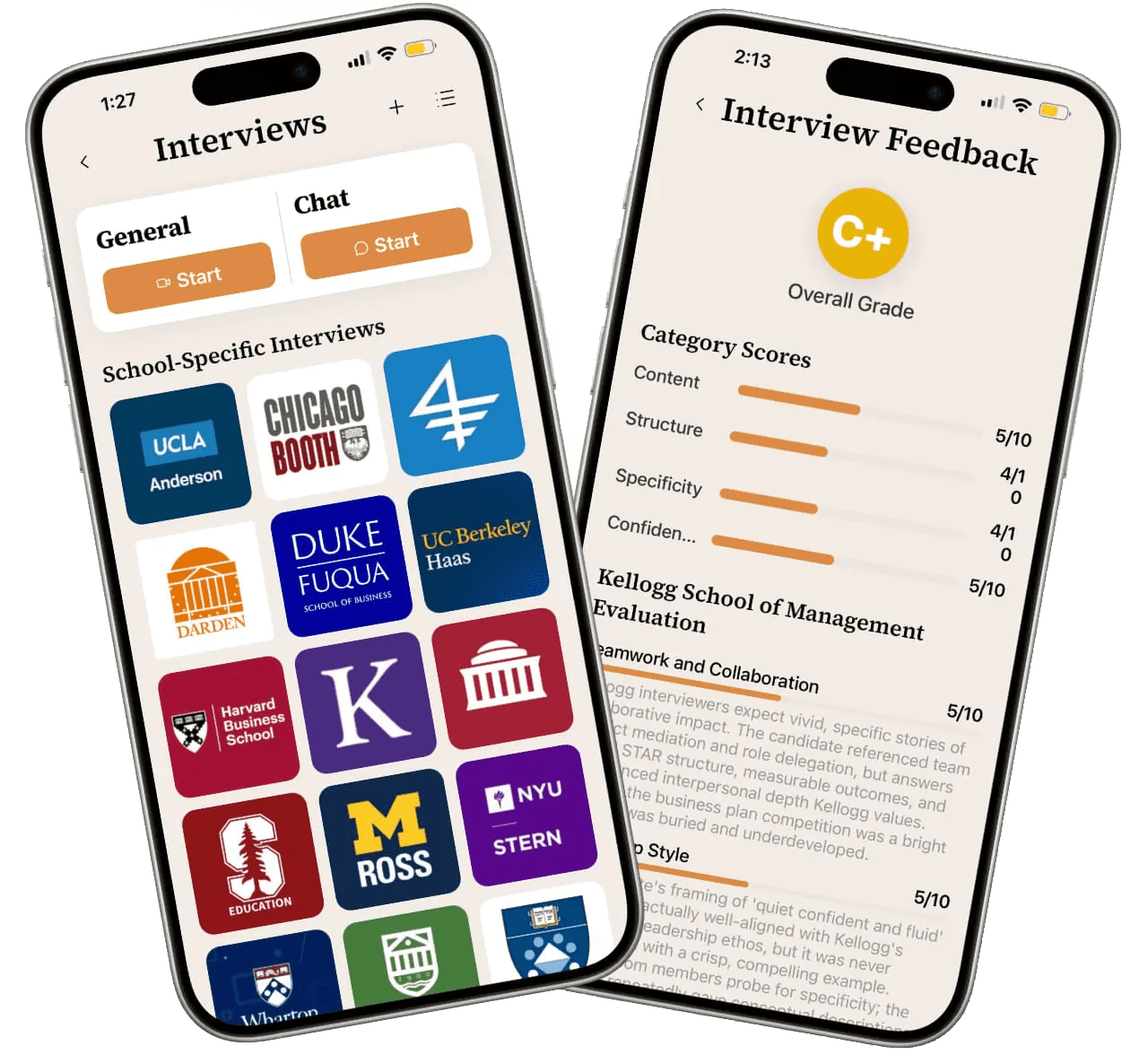
Don’t sleep on our latest product, MBA Launchpad by SBC. It’s your AI-powered admissions assistant, built on 25+ years of real SBC data. Candidacy assessment, school list strategy, essay guidance, and more are available 24/7 in your pocket. Download now on the App Store and Google Play.
Here’s a snapshot of the caliber of expertise on our SBC team.






Ashley
Ashley is a former MBA Admissions Board Member for Harvard Business School (HBS), where she interviewed and evaluated thousands of business school applicants for over a six year tenure. Ashley holds an MBA from HBS. During her HBS years, Ashley was the Sports Editor for the Harbus and a member of the B-School Blades Ice Hockey Team. After HBS, she worked in Marketing at the Gillette Company on Male and Female shaving ...
×Pauline
A former associate director of admissions at Harvard Business School, Pauline served on the HBS MBA Admissions Board full-time for four years. She evaluated and interviewed HBS applicants, both on-campus and globally. Pauline's career has included sales and marketing management roles with Coca-Cola, Gillette, Procter & Gamble, and IBM. For over 10 years, Pauline has expertly guided MBA applicants, and her clients h ...
×Laura
Laura comes from the MBA Admissions Board at Harvard Business School (HBS) and is an HBS MBA alumnus. In her HBS Admissions role, she evaluated and interviewed hundreds of business school candidates, including internationals, women, military and other applicant pools, for five years. Prior to her time as a student at HBS, Laura began her career in advertising and marketing in Chicago at Leo Burnett where she worked on th ...
×Andrea
Andrea served as the Associate Director of MBA Admissions at Harvard Business School (HBS) for over five years. In this role, she provided strategic direction for student yield-management activities and also served as a full member of the admissions committee. In 2007, Andrea launched the new 2+2 Program at Harvard Business School – a program targeted at college junior applicants to Harvard Business School. Andrea has also served as a Career Coach for Harvard Business School for both cu ...
×Jennifer
Jennifer served as Admissions Officer at the Stanford (GSB) for five years. She holds an MBA from Stanford (GSB) and a B.S. in Chemical Engineering from University of Illinois Urbana-Champaign. Jennifer has over 15 years experience in guiding applicants through the increasingly competitive admissions process into top MBA programs. Having read thousands and thousands of essays and applications while at Stanford (GSB) Admiss ...
×Davina
Davina received her MBA from Stanford's Graduate School of Business (GSB), with a certificate in Public Management, and her BA in Psychology from UC Berkeley. Davina is an experienced strategic planning leader, facilitator, and business case writer who spent more than 15 years building culture, entrepreneurship, and leadership initiatives across Stanford University and the Stanford Graduate School of Business. She designed ...
×Erin K.
Erin served in key roles in MBA Admissions--as Director at Haas School of Business at UC Berkeley and Assistant Director at Stanford's Graduate School of Business (GSB). Erin served on the admissions committee at each school and has read thousands of applications in her career. At Haas, she served for seven years in roles that encompassed evaluation, outreach, and diversity and inclusion. During her tenure in Admissions at GSB, she was responsible for candidate evaluation, applicant outreach, ...
×Susie
Susie comes from the Admissions Office of the Stanford Graduate School of Business where she reviewed and evaluated hundreds of prospective students’ applications. She holds an MBA from Stanford’s GSB and a BA from Stanford in Economics. Prior to advising MBA applicants, Susie held a variety of roles over a 15-year period in capital markets, finance, and real estate, including as partner in one of the nation’s most innovative finance and real estate investment organizations. In that r ...
×Dione
Dione holds an MBA degree from Stanford Business School (GSB) and a BA degree from Stanford University, where she double majored in Economics and Communication with concentrations in journalism and sociology. Dione has served as an Admissions reader and member of the Minority Admissions Advisory Committee at Stanford. Dione is an accomplished and respected advocate and thought leader on education and diversity. She is ...
×Anthony
Anthony served as the Associate Director of MBA Admissions at the Wharton School at the University of Pennsylvania, where he dedicated over 10 years of expertise. During his time as a Wharton Admissions Officer, he read and reviewed thousands of applications and helped bring in a class of 800+ students a year. Anthony has traveled both domestically and internationally to recruit a ...
×Meghan
Meghan served as the Associate Director of Admissions and Marketing at the Wharton MBA’s Lauder Institute, a joint degree program combining the Wharton MBA with an MA in International Studies. In her role on the Wharton MBA admissions committee, Meghan advised domestic and international applicants; conducted interviews and information sessions domestically and overseas in Asia, Central and South America, and Europe; and evaluated applicants for admission to the program. Meghan also managed ...
×Amy
Amy comes from the Wharton School of the University of Pennsylvania where she was Associate Director. Amy devoted 12 years at the Wharton School, working closely with MBA students and supporting the admissions team. During her tenure at Wharton, Amy served as a trusted adviser to prospective applicants as well as admitted and matriculated students. She conducted admissions chats with applicants early in the admissions ...
×Ally
Ally brings six years of admissions experience to the SBC team, most recently as an Assistant Director of Admission for the full-time MBA program at Columbia Business School (CBS). During her time at Columbia, Ally was responsible for reviewing applications, planning recruitment events, and interviewing candidates for both the full-time MBA program and the Executive MBA program. She traveled both internationally and dome ...
×Emma
Emma comes from the MBA Admissions Office at Columbia Business School (CBS), where she was Associate Director. Emma conducted dozens of interviews each cycle for the MBA and EMBA programs, as well as coordinating the alumni ambassador interview program. She read and evaluated hundreds of applications each cycle, delivered information sessions to audiences across the globe, and advised countless waitlisted applicants. ×
Dana
Dana served as Assistant Director of Admissions at Columbia Business School for the Full-Time MBA program and has over 10 years of experience working in higher education. Known as a scrupulous file reader, Dana reviewed countless applications and assisted in rendering final decisions for the Admissions Committee at CBS. While leading information sessions at Columbia and on the road, Dana met and advised myriad applicants� ...
×Holly
Holly worked as a member of the NYU Stern MBA Admissions team for seven years and holds an MBA from NYU Stern. In her tenure as Director of NYU MBA Admissions, Holly worked closely with admissions teams from Columbia, Michigan Ross, UVA Darden, Cornell Johnson, Berkeley Haas, Yale SOM, and Duke Fuqua on recruiting events domestically and internationally. On the NYU Stern admissions committee, Holly conducted interviews, planned and hosted events, and trained staff on reading and interviewi ...
×Written by SBC Consultant Amy. Reviewed by Stacy Blackman. Learn more about our former admissions officers on the SBC admissions team page.


