MIT Sloan Cover Letter and Video Advice for 2026-2027
The MIT Sloan School of Management application for the Class of 2029 includes a 300-word cover letter and two videos: one, a 90-second introduction that now covers background and origin; one, spontaneous and 60 seconds long. The MIT Sloan cover letter prompt itself hasn’t changed, but the standard it’s held to has gotten sharper.
Quick Summary
- Write the cover letter like a pitch for your dream job, not an MBA essay: one or two examples of independent, high-impact problem-solving, in standard business-letter form.
- Video 1’s extra runtime gives you room to go past a hobby and speak to what’s actually shaped how you see the world.
- Prepare for the format of both videos, not a script; genuine, on-the-spot delivery matters more than polish.
What Is the MIT Sloan Cover Letter Prompt?
MIT Sloan seeks students whose personal characteristics demonstrate that they will make the most of the incredible opportunities at MIT, both academic and non-academic. We are on a quest to find those whose presence will enhance the experience of other students. We seek thoughtful leaders with exceptional intellectual abilities and the drive and determination to put their stamp on the world. We welcome people who are independent, authentic, and fearlessly creative, true doers. We want people who can redefine solutions to conventional problems, and strive to preempt unconventional dilemmas with cutting-edge ideas. We demand integrity and respect passion.
Taking the above into consideration, please submit a cover letter seeking a place in the MIT Sloan MBA program. Your letter should conform to a standard business correspondence, include one or more professional examples that illustrate why you meet the desired criteria above, and be addressed to the Admissions Committee (300 words or fewer, excluding address and salutation).
Unlike most MBA programs, MIT Sloan doesn’t have a traditional required essay prompt. Rather, it asks for a cover letter, the kind you’d send for your dream job, because in many ways, that’s exactly what this is.
How Do You Write a Strong MIT Sloan Cover Letter?
Treat this less like an essay and more like a test, says SBC founder Stacy Blackman. Applicants who write it as a typical MBA essay undersell themselves. They lead with context and reflection when Sloan wants to see output. Write your letter like a pitch from someone already operating at an elite level.
How Should You Structure Each Cover Letter Example?
Be disciplined about your examples. Pick one, or at most two, heavy-hitting moments where you solved an unconventional problem or drove measurable impact. If you try to cram in three or four smaller stories to seem well-rounded, the letter will read as scattered rather than substantive.
Next, structure each example the way a strong resume bullet works, but expanded: name the problem in concrete terms (not “our team faced challenges” but what the challenge actually was), describe the specific action you took that someone else in your position might not have taken, and close with a measurable or observable result. If you can attach a number, a percentage, a timeline, or a scale, use it. Vague claims of impact (“I helped improve efficiency”) read as filler next to a number (“I cut onboarding time from six weeks to ten days”).
What Kind of Problem Should You Choose?
Also be deliberate about which kind of unconventional problem you choose. Sloan’s language about “problems of progressive complexity” and preempting “unconventional dilemmas” signals they want to see judgment under ambiguity, not just execution on a known problem. A story where you solved something with a clear playbook is weaker than one where you had to define the problem yourself before solving it.
How Do You Show Collaboration and Respect the Format?
Don’t lose sight of the collaborative piece. Sloan is also looking for candidates who elevate the people around them. So, if your examples are all about individual achievement, look for a way to show how you brought others along, credited a teammate, or changed how a group worked, not just what you personally accomplished.
Finally, treat the business-letter format as a real constraint, not a formality. Address it properly to the Admissions Committee, keep the tone professional rather than conversational, and resist the instinct to open with a hook borrowed from personal essay writing. The format itself is part of what Sloan is testing.
What Are the MIT Sloan Video Statement Requirements?
Applicants now complete two video components:
Video 1: Every applicant has a story that can’t be captured in a resume. Take up to 90 seconds to share yours: who you are, where you come from, and what’s shaped the person you are today. Be conversational, be yourself. We can’t wait to meet you.
Video 2: All MBA applicants will be prompted to respond to a randomly generated, open-ended question. We want to hear how you think and communicate in your own words. No prior preparation is required.
Advice for Video 1
Video 1 is the familiar introduction: a 90-second, single-take, unedited video where you introduce yourself directly to the camera. No background music, no subtitles, no retakes. Sloan has said the goal isn’t a polished monologue; it’s a real sense of who you are.
Because you only get one take, you have to do the prep work before you hit record. Start by picking two or three personal stories, not professional ones (this isn’t a place to repeat your cover letter). Think about what you’d tell a new roommate in your first week, not what you’d tell a hiring manager. A hobby that’s turned into something slightly obsessive, a family tradition, a running joke about your terrible sense of direction, the kind of detail that makes you memorable rather than impressive.
Once you have your material, write down a loose order of the three or four beats you want to hit. Say it out loud a few times so the transitions feel natural, but stop rehearsing once you start sounding like you’re reciting it; that’s the opposite of what Sloan is after. Record a couple of practice takes on your phone before the one that counts, and watch them back with the sound off first. That’s often the fastest way to catch stiffness, since posture and expression tell you more about how natural you look than the words do.
Keep an eye on pacing too. Ninety seconds go by faster than it sounds, so if your practice takes are running long, cut a story rather than rushing through all of them. One or two beats delivered at a normal, conversational pace will land better than three beats crammed in and rushed.

Advice for Video 2
Video 2 is a randomly generated, open-ended question that appears once you complete the rest of your application. Once you see the video statement question, you get 5 seconds to prepare and 60 seconds to record your answer. Sample questions include the achievement you’re most proud of, or how you handled a teammate who wasn’t pulling their weight.
You can’t know the question in advance, but the format is entirely predictable. So, that’s what you should be rehearsing. Pull a list of common behavioral and getting-to-know-you questions and run through them on your own camera with a real 5-second countdown and 60-second timer. The goal isn’t to memorize responses; it’s to build a reflex for organizing a thought that fast.
Try answering out loud before you plan the words. Name what you’re going to talk about in a single phrase, tell the moment, then say what it meant. Most people try to figure out what to say and how to say it at the same time. Separating those two steps—choosing your topic in the first few seconds, then narrating from there—keeps you on track once the timer starts.
Here’s what that looks like with a question like “What achievement are you most proud of?” During those 5 seconds, don’t draft sentences in your mind. Just land on a topic: “the product launch I ran solo.” That’s it, that’s your whole prep. Then when the clock starts, narrate outward from there: what the situation was, what you actually did, why it mattered to you.
You’re not reciting a memorized paragraph; you’re talking through something you’ve already decided to discuss. Run this drill enough times on different random questions and the actual prompt, whatever it turns out to be, will feel like one more rep instead of a cold open.
What Other Application Materials Does MIT Sloan Require?
Beyond the cover letter, short answer, and videos, Sloan asks for two additional professional references (separate from your recommender) who can speak to your professional or academic background. You’ll also upload an organizational chart that maps your department and the company structure, which gives the committee context for your role and scope of impact.
One more change worth flagging: Sloan has moved to two application rounds this cycle, down from three. So, build your timeline accordingly.
Should You Use AI to Write Your MIT Sloan Cover Letter?
AI tools can help you organize your thinking, tighten a 300-word draft, or stress-test whether your examples actually answer the prompt. What they can’t do is provide the specificity Sloan wants. The exact moment you solved a problem, the exact number that moved, the exact way you brought a team along. And with two video components now in the mix, a cover letter that sounds like everyone else’s will stand out for the wrong reasons the moment you’re on camera answering a question you didn’t prep for. Use AI as an editor, not an author.
Frequently Asked Questions About MIT Sloan MBA Essays
Should my MIT Sloan cover letter read like a personal essay? No, it should read like a standard business letter: direct, professional, addressed to the Admissions Committee, 300 words or fewer. Save essay-style flourishes for schools that ask for a personal statement.
How is Video 1 different from the cover letter? The cover letter covers professional impact; Video 1 covers background and origin. Keep the two focused on different territory.
What should I actually talk about in Video 1? Go past a hobby or a job title. Pick one thread from your background (a place, a family dynamic, a community) and connect it to how it shapes your thinking today.
Can I just wing my MIT Sloan videos so I come across as more natural and spontaneous? No, winging it usually reads as unprepared. Know your stories for Video 1, and drill the 5-second prep, 60-second answer structure for Video 2.
Ready to tackle your MIT Sloan cover letter and application with a strategy tailored to your strengths? From our 2-hour deep-dive sessions to comprehensive packages, Stacy Blackman Consulting offers expert guidance every step of the way. Contact us today for a free 15-minute advising session with a Principal SBC Consultant.
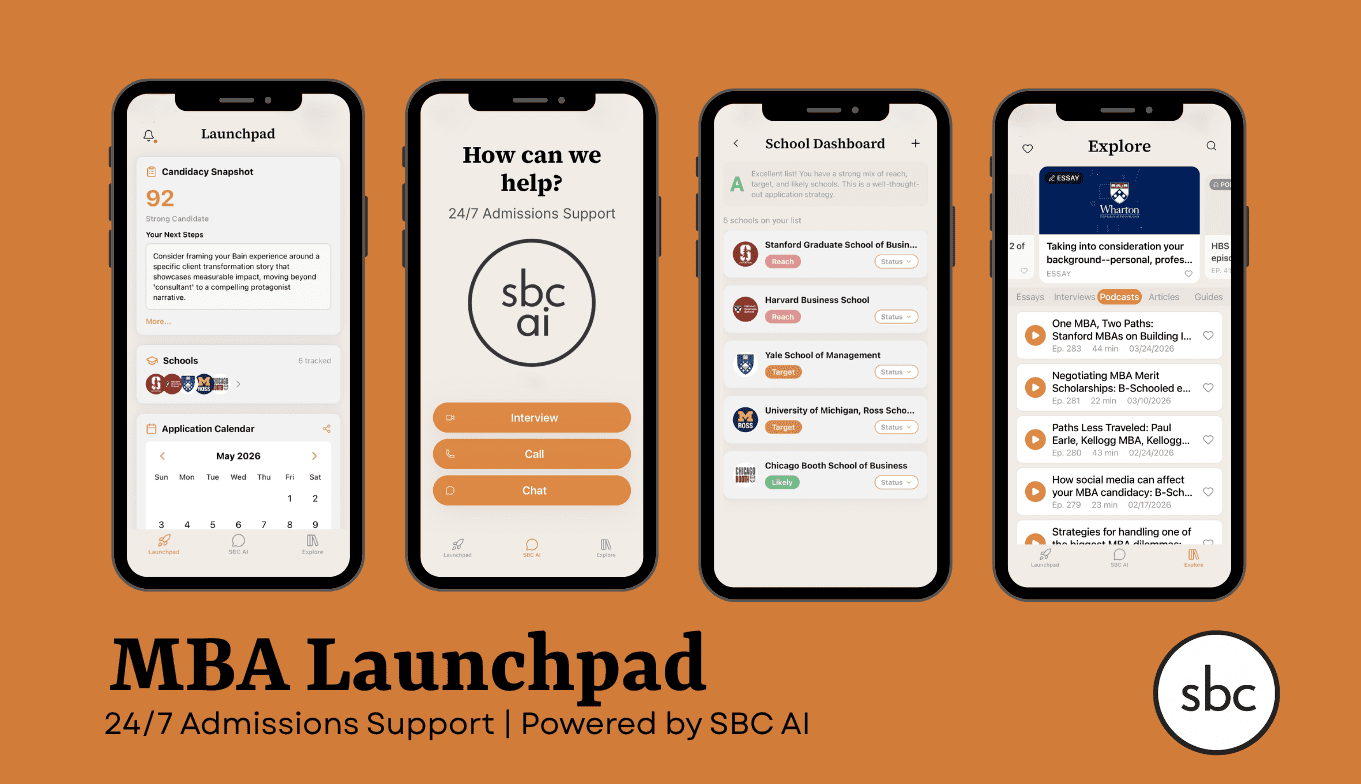
Don’t sleep on our latest product, MBA Launchpad by SBC. It’s your AI-powered admissions assistant, built on 25+ years of real SBC data. Candidacy assessment, school list strategy, essay guidance, and more are available 24/7 in your pocket. Download now on the App Store and Google Play.
Here’s a snapshot of the caliber of expertise on our SBC team.







Ashley
Ashley is a former MBA Admissions Board Member for Harvard Business School (HBS), where she interviewed and evaluated thousands of business school applicants for over a six year tenure. Ashley holds an MBA from HBS. During her HBS years, Ashley was the Sports Editor for the Harbus and a member of the B-School Blades Ice Hockey Team. After HBS, she worked in Marketing at the Gillette Company on Male and Female shaving ...
×Pauline
A former associate director of admissions at Harvard Business School, Pauline served on the HBS MBA Admissions Board full-time for four years. She evaluated and interviewed HBS applicants, both on-campus and globally. Pauline's career has included sales and marketing management roles with Coca-Cola, Gillette, Procter & Gamble, and IBM. For over 10 years, Pauline has expertly guided MBA applicants, and her clients h ...
×Laura
Laura comes from the MBA Admissions Board at Harvard Business School (HBS) and is an HBS MBA alumnus. In her HBS Admissions role, she evaluated and interviewed hundreds of business school candidates, including internationals, women, military and other applicant pools, for five years. Prior to her time as a student at HBS, Laura began her career in advertising and marketing in Chicago at Leo Burnett where she worked on th ...
×Andrea
Andrea served as the Associate Director of MBA Admissions at Harvard Business School (HBS) for over five years. In this role, she provided strategic direction for student yield-management activities and also served as a full member of the admissions committee. In 2007, Andrea launched the new 2+2 Program at Harvard Business School – a program targeted at college junior applicants to Harvard Business School. Andrea has also served as a Career Coach for Harvard Business School for both cu ...
×Jennifer
Jennifer served as Admissions Officer at the Stanford (GSB) for five years. She holds an MBA from Stanford (GSB) and a B.S. in Chemical Engineering from University of Illinois Urbana-Champaign. Jennifer has over 15 years experience in guiding applicants through the increasingly competitive admissions process into top MBA programs. Having read thousands and thousands of essays and applications while at Stanford (GSB) Admiss ...
×Davina
Davina received her MBA from Stanford's Graduate School of Business (GSB), with a certificate in Public Management, and her BA in Psychology from UC Berkeley. Davina is an experienced strategic planning leader, facilitator, and business case writer who spent more than 15 years building culture, entrepreneurship, and leadership initiatives across Stanford University and the Stanford Graduate School of Business. She designed ...
×Erin K.
Erin served in key roles in MBA Admissions--as Director at Haas School of Business at UC Berkeley and Assistant Director at Stanford's Graduate School of Business (GSB). Erin served on the admissions committee at each school and has read thousands of applications in her career. At Haas, she served for seven years in roles that encompassed evaluation, outreach, and diversity and inclusion. During her tenure in Admissions at GSB, she was responsible for candidate evaluation, applicant outreach, ...
×Susie
Susie comes from the Admissions Office of the Stanford Graduate School of Business where she reviewed and evaluated hundreds of prospective students’ applications. She holds an MBA from Stanford’s GSB and a BA from Stanford in Economics. Prior to advising MBA applicants, Susie held a variety of roles over a 15-year period in capital markets, finance, and real estate, including as partner in one of the nation’s most innovative finance and real estate investment organizations. In that r ...
×Dione
Dione holds an MBA degree from Stanford Business School (GSB) and a BA degree from Stanford University, where she double majored in Economics and Communication with concentrations in journalism and sociology. Dione has served as an Admissions reader and member of the Minority Admissions Advisory Committee at Stanford. Dione is an accomplished and respected advocate and thought leader on education and diversity. She is ...
×Anthony
Anthony served as the Associate Director of MBA Admissions at the Wharton School at the University of Pennsylvania, where he dedicated over 10 years of expertise. During his time as a Wharton Admissions Officer, he read and reviewed thousands of applications and helped bring in a class of 800+ students a year. Anthony has traveled both domestically and internationally to recruit a ...
×Meghan
Meghan served as the Associate Director of Admissions and Marketing at the Wharton MBA’s Lauder Institute, a joint degree program combining the Wharton MBA with an MA in International Studies. In her role on the Wharton MBA admissions committee, Meghan advised domestic and international applicants; conducted interviews and information sessions domestically and overseas in Asia, Central and South America, and Europe; and evaluated applicants for admission to the program. Meghan also managed ...
×Amy
Amy comes from the Wharton School of the University of Pennsylvania where she was Associate Director. Amy devoted 12 years at the Wharton School, working closely with MBA students and supporting the admissions team. During her tenure at Wharton, Amy served as a trusted adviser to prospective applicants as well as admitted and matriculated students. She conducted admissions chats with applicants early in the admissions ...
×Ally
Ally brings six years of admissions experience to the SBC team, most recently as an Assistant Director of Admission for the full-time MBA program at Columbia Business School (CBS). During her time at Columbia, Ally was responsible for reviewing applications, planning recruitment events, and interviewing candidates for both the full-time MBA program and the Executive MBA program. She traveled both internationally and dome ...
×Emma
Emma comes from the MBA Admissions Office at Columbia Business School (CBS), where she was Associate Director. Emma conducted dozens of interviews each cycle for the MBA and EMBA programs, as well as coordinating the alumni ambassador interview program. She read and evaluated hundreds of applications each cycle, delivered information sessions to audiences across the globe, and advised countless waitlisted applicants. ×
Dana
Dana served as Assistant Director of Admissions at Columbia Business School for the Full-Time MBA program and has over 10 years of experience working in higher education. Known as a scrupulous file reader, Dana reviewed countless applications and assisted in rendering final decisions for the Admissions Committee at CBS. While leading information sessions at Columbia and on the road, Dana met and advised myriad applicants� ...
×Holly
Holly worked as a member of the NYU Stern MBA Admissions team for seven years and holds an MBA from NYU Stern. In her tenure as Director of NYU MBA Admissions, Holly worked closely with admissions teams from Columbia, Michigan Ross, UVA Darden, Cornell Johnson, Berkeley Haas, Yale SOM, and Duke Fuqua on recruiting events domestically and internationally. On the NYU Stern admissions committee, Holly conducted interviews, planned and hosted events, and trained staff on reading and interviewi ...
×Written by SBC Consultant Amy | Reviewed by Stacy Blackman. Visit our admissions team page to learn more about SBC’s consultants.