Wharton MBA Acceptance Rate, Deconstructed
What is the Wharton MBA acceptance rate?
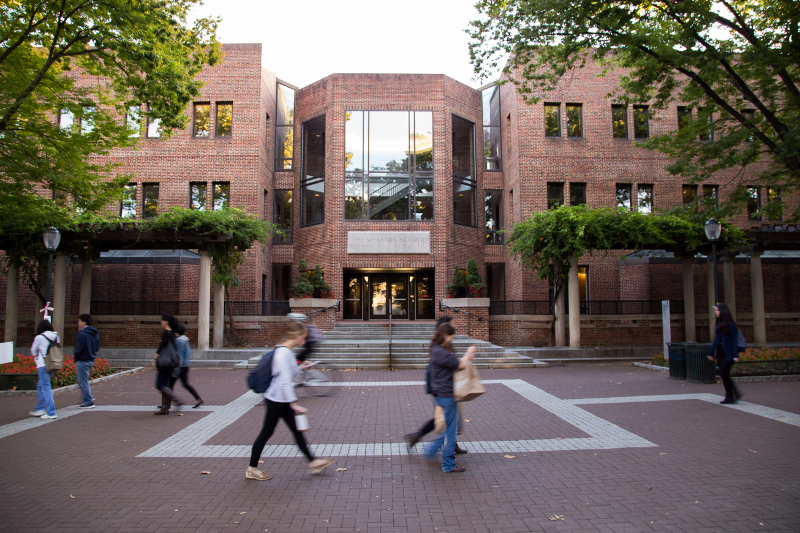
The Wharton MBA acceptance rate is about 20%. Wharton received 7,613 applications for the Class of 2027 and enrolled 888 students, and estimates put its acceptance rate at roughly 20 to 21%.
The University of Pennsylvania’s Wharton School consistently ranks among the handful of top MBA programs worldwide. In fact, it clinched the top spot in the latest US News & World Report ranking of the best business schools. As far as class size goes, Wharton is on the larger end of the spectrum, and the Class of 2027 is its largest in five years. Though top-ranked, admission is less competitive than at HBS or Stanford GSB, whose acceptance rates are estimated at about 11% and 7%.
The Wharton acceptance rate has tightened, though. It fell from 25% for the Classes of 2024 and 2025 to 20.5% for the Class of 2026, and has held near that level since. Wharton doesn’t publish an official acceptance rate, so all of these figures are estimates.
Quick Summary
- About 1 in 5 applicants gets in. The Wharton acceptance rate is roughly 20%: less selective than HBS or Stanford GSB, but tighter than it was a few years ago.
- Stats open the door; your story gets you in. Recent Wharton admits stood out for fast career progression, a memorable personal story and real community leadership.
- No single piece decides your fate. Wharton reviews every application holistically, and no one is rejected on the team-based discussion interview alone.
What does the Wharton Class of 2027 look like?
The University of Pennsylvania’s Wharton School consistently ranks among the handful of top MBA programs worldwide. In fact, it clinched the top spot in the latest US News & World Report ranking of the best business schools. As far as class size goes, Wharton is on the larger end of the spectrum, with 866 students in the MBA class of 2026. Though top-ranked, admission is less competitive than at HBS or Stanford GSB. The Wharton MBA acceptance rate for the Class of 2026 was 20.5%.
The strength of the Wharton MBA has traditionally been finance. But these days, Wharton students come from a broad range of professional backgrounds. Consulting is the largest single group at 28%, followed by PE/VC at 15% and Non-Profit/Gov’t at 11%. Tech backgrounds edged ahead of investment banking by 10% to 9%. All this reflects the school’s interest in having a more diversified MBA class.
Regardless of the industry an applicant comes from, Wharton is looking for proven work experience, strong quantitative proficiency, and a clear career trajectory, as a strong work history is a key predictor of successful recruitment post-MBA. SBC consultant Meghan, a former Wharton Admissions Officer on our team, says:
Wharton looks for people from a broad variety of industries and demographics who have certain qualities in common: demonstrated strong career performance, fast promotions, and a prominent profile on their team or organization—in other words, superstars. At the same time, we are seeking multidimensional students who will be active and engaged on campus.

Understanding the Wharton MBA Acceptance Rate
To help demystify the factors influencing Wharton MBA acceptance rates, we analyzed SBC client data from the past two seasons. Our findings show that although Wharton’s admission patterns, like all top schools, make high demands on quantifiables such as GMAT/GRE, GPA, and years of work experience, they have become increasingly reliant on other factors. Things like demographic and experiential diversity and extracurricular commitment are qualities that make Wharton such an inspiring community to be a part of.
Listen to B-Schooled Podcast #80: Spotlight on Wharton
Recent SBC Clients Admitted to Wharton
To preserve anonymity for our client pool, we’ve deconstructed each of our client profiles across these criteria:
- Nationality
- Industry
- Employer
- College
- GPA
- Test scores
- Other distinguishing factors
Our consultants have shared client attributes for each of these criteria, and we’ve aggregated the outcomes for Wharton admits according to personal, extracurricular, and professional domains.
These visuals showcase the kaleidoscope of qualities found in Wharton admits across a sampling of recent SBC clients.


How does the Wharton admissions committee decide who gets in?
A roughly 20% acceptance rate can make the process feel like a black box. Pena, who read and decided thousands of applications and helped design Wharton’s team-based discussion interview, describes a process that is holistic but grounded in data.
- Data first, then fit. The committee relies on data wherever it can, then weighs quantitative measures alongside the softer parts of the application to judge fit with the class it is building.
- Depth of experience beats years of experience. Reviewers look at the depth and breadth of your role, your contributions, your level of responsibility and how quickly you’ve progressed.
- Professional maturity matters. It’s one of the qualities the committee explicitly looks for.
- Decisions are collective. Beyond individual reads, the committee discusses applicants together to make sure each decision is the right one.
“They really do take a holistic approach to evaluating the applicants,” Pena says. “Like all business schools, they are looking to create a diverse cohort each year.”
What should your Wharton essays and recommendation show?
For the 2026-2027 cycle (Class of 2029), Wharton requires three short written responses totaling 550 words.
| Prompt | Word limit |
|---|---|
| Essay 1a: What is your immediate post-MBA professional goal? | 50 |
| Essay 1b: Describe your medium- and long-term professional goals after your Wharton MBA. | 150 |
| Essay 2: Taking into consideration your background – personal, professional, and/or academic – how do you plan to add meaningful value to the Wharton community? | 350 |
Pena offers a simple way to think about the set: the first essay covers what you’ll get from Wharton, and the second covers what Wharton gets from you. Because the Wharton experience is team-based and community-driven, Essay 2 should show how your experiences will shape your classmates’ experience, not just your own. And since your goals are covered in Essay 1, don’t be afraid to go personal in Essay 2. “This really gives the adcom an opportunity to get to know you on a deeper level,” Pena says. Wharton now asks for a single letter of recommendation, using a standard form with two general questions rather than Wharton-specific prompts. With only one letter, the choice matters more. In Pena’s experience, Wharton values a direct supervisor’s perspective, but use your judgment to choose the person who can speak most specifically to your impact.
For tips on each prompt, see our full Wharton MBA essay guide.
Frequently Asked Questions
What else do applicants ask about the Wharton acceptance rate?
What is Wharton’s MBA acceptance rate? Wharton doesn’t publish one. Estimates for the Class of 2027 put it at roughly 20 to 21%, based on 7,613 applications and an enrolled class of 888.
Has the Wharton acceptance rate changed over time? Yes. Estimates put it at 21% for the Class of 2023 and 25% for the Classes of 2024 and 2025. It then fell to 20.5% for the Class of 2026 and has stayed near 20% for the Class of 2027.
Is Wharton harder to get into than HBS or Stanford? No. At roughly 20%, the Wharton acceptance rate is higher than estimates for Harvard Business School (about 11%) and Stanford GSB (about 7%). But with nearly 7,600 applicants, admission is still highly competitive.
Does a weak team-based discussion mean I’ll be rejected? No. Candidates are evaluated individually, and the committee reviews the TBD notes alongside the full application. No one is rejected on the interview alone.
Is Wharton only for future finance professionals? No. Consulting is the largest pre-MBA industry in the class, and Wharton has invested heavily in entrepreneurship and technology.
How does Wharton evaluate work experience? On depth, not just years: the scope of your role, your contributions, your responsibility and how quickly you’ve progressed.
Who should write my Wharton recommendation? Wharton requires one letter. Choose the person who can speak most specifically to your impact, usually a direct supervisor.
How should you approach your Wharton application this year? Start with fit, not odds. Research the program, attend events, and talk with current students and alumni. Doing so won’t raise your chances on its own, he notes, but it will help you make a better-informed decision about where to spend two years. “An MBA is an investment in yourself, so you really want to make sure that you choose the right school for you,” Anthony Pena says. Just as important: don’t rush. Give yourself enough time to put together the strongest application you can.
Check out our comparison between the Wharton School and Columbia Business School and other school faceoffs here. This chart provides details on MBA program application deadlines.
What do SBC’s Wharton admits say?
Here is a recent SBC client admit announcement:
Dreaming of just one admission to an M7 school. I applied to 6 of them and received acceptances to 4! I am so grateful to SBC and excited to say that I will be matriculating at The Wharton School this fall!
And another one:
With the SBC team’s support, I was accepted to two M7 schools, Wharton and Sloan with significant scholarship offerings from both schools. I would strongly recommend the SBC team for anyone with the goal of being admitted to a top business school!
Check out our comparison between the Wharton School and Columbia Business School and other school faceoffs here. This chart provides details on MBA program application deadlines.
***
Stacy Blackman Consulting offers multiple services to meet your MBA application needs, from our All-In Partnership and Interview Prep to hourly help with essay editing, resume review, and much more! Contact us today for a free 15-minute advising session to talk strategy with a Principal SBC consultant.
Here’s a snapshot of the caliber of expertise on our SBC team.











Ashley
Ashley is a former MBA Admissions Board Member for Harvard Business School (HBS), where she interviewed and evaluated thousands of business school applicants for over a six year tenure. Ashley holds an MBA from HBS. During her HBS years, Ashley was the Sports Editor for the Harbus and a member of the B-School Blades Ice Hockey Team. After HBS, she worked in Marketing at the Gillette Company on Male and Female shaving ...
×Pauline
A former associate director of admissions at Harvard Business School, Pauline served on the HBS MBA Admissions Board full-time for four years. She evaluated and interviewed HBS applicants, both on-campus and globally. Pauline's career has included sales and marketing management roles with Coca-Cola, Gillette, Procter & Gamble, and IBM. For over 10 years, Pauline has expertly guided MBA applicants, and her clients h ...
×Laura
Laura comes from the MBA Admissions Board at Harvard Business School (HBS) and is an HBS MBA alumnus. In her HBS Admissions role, she evaluated and interviewed hundreds of business school candidates, including internationals, women, military and other applicant pools, for five years. Prior to her time as a student at HBS, Laura began her career in advertising and marketing in Chicago at Leo Burnett where she worked on th ...
×Andrea
Andrea served as the Associate Director of MBA Admissions at Harvard Business School (HBS) for over five years. In this role, she provided strategic direction for student yield-management activities and also served as a full member of the admissions committee. In 2007, Andrea launched the new 2+2 Program at Harvard Business School – a program targeted at college junior applicants to Harvard Business School. Andrea has also served as a Career Coach for Harvard Business School for both cu ...
×Jennifer
Jennifer served as Admissions Officer at the Stanford (GSB) for five years. She holds an MBA from Stanford (GSB) and a B.S. in Chemical Engineering from University of Illinois Urbana-Champaign. Jennifer has over 15 years experience in guiding applicants through the increasingly competitive admissions process into top MBA programs. Having read thousands and thousands of essays and applications while at Stanford (GSB) Admiss ...
×Davina
Davina received her MBA from Stanford's Graduate School of Business (GSB), with a certificate in Public Management, and her BA in Psychology from UC Berkeley. Davina is an experienced strategic planning leader, facilitator, and business case writer who spent more than 15 years building culture, entrepreneurship, and leadership initiatives across Stanford University and the Stanford Graduate School of Business. She designed ...
×Erin
Erin served in key roles in MBA Admissions--as Director at Haas School of Business at UC Berkeley and Assistant Director at Stanford's Graduate School of Business (GSB). Erin served on the admissions committee at each school and has read thousands of applications in her career. At Haas, she served for seven years in roles that encompassed evaluation, outreach, and diversity and inclusion. During her tenure in Admissions at GSB, she was responsible for candidate evaluation, applicant outreach, ...
×Susie
Susie comes from the Admissions Office of the Stanford Graduate School of Business where she reviewed and evaluated hundreds of prospective students’ applications. She holds an MBA from Stanford’s GSB and a BA from Stanford in Economics. Prior to advising MBA applicants, Susie held a variety of roles over a 15-year period in capital markets, finance, and real estate, including as partner in one of the nation’s most innovative finance and real estate investment organizations. In that r ...
×Dione
Dione holds an MBA degree from Stanford Business School (GSB) and a BA degree from Stanford University, where she double majored in Economics and Communication with concentrations in journalism and sociology. Dione has served as an Admissions reader and member of the Minority Admissions Advisory Committee at Stanford. Dione is an accomplished and respected advocate and thought leader on education and diversity. She is ...
×Anthony
Anthony served as the Associate Director of MBA Admissions at the Wharton School at the University of Pennsylvania, where he dedicated over 10 years of expertise. During his time as a Wharton Admissions Officer, he read and reviewed thousands of applications and helped bring in a class of 800+ students a year. Anthony has traveled both domestically and internationally to recruit a ...
×Meghan
Meghan served as the Associate Director of Admissions and Marketing at the Wharton MBA’s Lauder Institute, a joint degree program combining the Wharton MBA with an MA in International Studies. In her role on the Wharton MBA admissions committee, Meghan advised domestic and international applicants; conducted interviews and information sessions domestically and overseas in Asia, Central and South America, and Europe; and evaluated applicants for admission to the program. Meghan also managed ...
×Amy
Amy comes from the Wharton School of the University of Pennsylvania where she was Associate Director. Amy devoted 12 years at the Wharton School, working closely with MBA students and supporting the admissions team. During her tenure at Wharton, Amy served as a trusted adviser to prospective applicants as well as admitted and matriculated students. She conducted admissions chats with applicants early in the admissions ...
×Ally
Ally brings six years of admissions experience to the SBC team, most recently as an Assistant Director of Admission for the full-time MBA program at Columbia Business School (CBS). During her time at Columbia, Ally was responsible for reviewing applications, planning recruitment events, and interviewing candidates for both the full-time MBA program and the Executive MBA program. She traveled both internationally and dome ...
×Emma
Emma comes from the MBA Admissions Office at Columbia Business School (CBS), where she was Associate Director. Emma conducted dozens of interviews each cycle for the MBA and EMBA programs, as well as coordinating the alumni ambassador interview program. She read and evaluated hundreds of applications each cycle, delivered information sessions to audiences across the globe, and advised countless waitlisted applicants. ×
Dana
Dana served as Assistant Director of Admissions at Columbia Business School for the Full-Time MBA program and has over 10 years of experience working in higher education. Known as a scrupulous file reader, Dana reviewed countless applications and assisted in rendering final decisions for the Admissions Committee at CBS. While leading information sessions at Columbia and on the road, Dana met and advised myriad applicants� ...
×Holly
Holly worked as a member of the NYU Stern MBA Admissions team for seven years and holds an MBA from NYU Stern. In her tenure as Director of NYU MBA Admissions, Holly worked closely with admissions teams from Columbia, Michigan Ross, UVA Darden, Cornell Johnson, Berkeley Haas, Yale SOM, and Duke Fuqua on recruiting events domestically and internationally. On the NYU Stern admissions committee, Holly conducted interviews, planned and hosted events, and trained staff on reading and interviewi ...
×Written by Esther Magna. Reviewed by Stacy Blackman. Learn more about our former admissions officers on the SBC admissions team page.


