The MBA Edge You Didn’t Know You Needed: Cultural Intelligence

When preparing your MBA application, you’re likely focused on showcasing your strongest assets—an impressive GMAT or GRE score, a polished resume, and compelling essays. But one often-overlooked trait separates the most compelling candidates: cultural intelligence, or CQ—the ability to adapt, communicate, and collaborate across cultural lines. In today’s global business world, that’s a serious differentiator.
We’re drawing from a Big Think excerpt of Brand Global, Act Local by Katherine Melchior Ray and Nataly Kelly, which explores the power of CQ in leadership and marketing. Ray, a lecturer at UC Berkeley’s Haas School of Business, emphasizes:
“To be culturally intelligent, you do not have to be an expert in all cultures… Instead, you must be curious and open-minded about understanding other cultures and interpreting people’s behavior in the context of their culture.”
So, how can you show cultural intelligence in your MBA application—and why should you? Let’s dig in.
If you’re looking for a powerful—and often underused—way to stand out in a global applicant pool, cultural intelligence could be your edge. And we can help you spotlight it. Talk to us today.
Why MBA Programs Value Cultural Intelligence
Top MBA programs are global by design. Full-time cohorts at leading U.S. business schools typically include 30–50% international students. That level of cultural diversity doesn’t happen by accident. Rather, it reflects a deliberate effort to build collaborative classrooms, where learning occurs at the intersection of worldviews.
In that environment, cultural intelligence isn’t merely “nice to have.” It’s what helps you lead a team project, navigate a heated classroom debate, or pitch an idea that resonates across cultures. If nearly half your classmates are coming from outside the U.S., CQ becomes a strategic must. Admissions committees want to ensure that you’ll thrive in that setting. They’re asking:
- Can you build trust across cultural differences?
- Do you understand your own cultural lens?
- Will you contribute meaningfully to a culturally dynamic classroom?
Programs like Yale SOM, Wharton, and Kellogg emphasize teamwork and community as core values. Others, such as the University of Michigan Ross—with its Multidisciplinary Action Projects (MAP)—or Dartmouth’s Tuck School, which requires every student to complete a global course or immersion, prepare students to lead in cross-functional, global business environments.
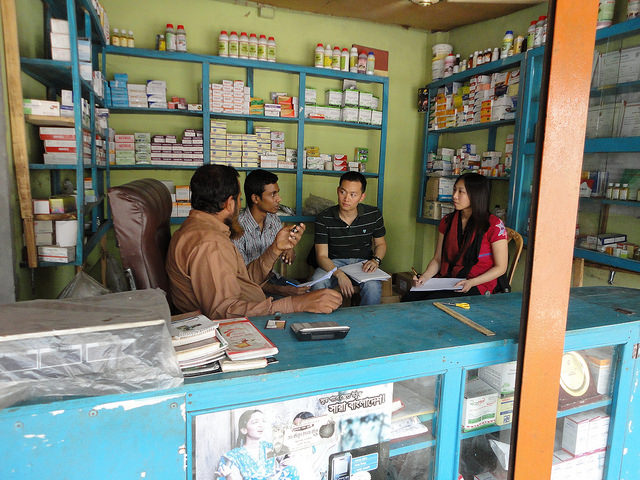
Demonstrating cultural intelligence in MBA settings shows you’re not just aware of these dynamics—you’re equipped to lead in a multicultural, high-collaboration environment.
The Four Skills That Build Your CQ
Professor Ray frames cultural intelligence as a virtuous circle of four interrelated skills. The more you build each one, the stronger your overall CQ becomes—and the more you’ll stand out in a global MBA environment.
Attitude and Values
CQ starts as a mindset. Are you genuinely curious about perspectives that differ from your own? Open to having your assumptions challenged?
This isn’t just about being kind. It’s about being humble enough to listen, even when it’s uncomfortable. That openness signals that you’re coachable, empathetic, and ready to work through ambiguity—traits that business schools and future employers prize.
The good news is that you don’t need to have lived abroad to demonstrate this. You may have led a cross-functional team where conflicting priorities compelled you to pause and ask more probing questions. Or you grew up in a multicultural household and learned early how to navigate contrasting values.
Leading with curiosity often makes for the most compelling essays. Admissions officers notice when applicants write with this kind of mindset. It’s evident in how you discuss collaboration, conflict, and growth. These lived experiences shape your ability to approach differences with respect instead of judgment.

Awareness of Self and Others
Cultural awareness starts with self-awareness. It’s one thing to notice differences—another to recognize how your own background shapes the way you’re perceived. True CQ means understanding how you present yourself in a room and how people from different cultural backgrounds might perceive your words or actions.
In a diverse MBA cohort, people carry unspoken norms about leadership, feedback, time, and even silence. Do you dominate group discussions without realizing it? Do you assume agreement means alignment, even when others are too polite to disagree?
Professor Ray illustrates this dynamic in her own teaching: she deliberately pauses before calling on raised hands, giving non-native English speakers more time to process and respond. That’s not just considerate—it’s inclusive leadership in action.
That’s precisely why the Wharton School moved away from traditional interviews and adopted a Team-Based Discussion format. Observing participants during a TBD reveals how they listen, adapt, and collaborate in real time with people they’ve just met—all skills rooted in cultural intelligence. Yes, the content of your pitch matters. But how you engage with others matters more.
As an applicant, you can highlight this skill by reflecting on moments when you became aware of your own blind spots. You may have realized your approach didn’t land with someone from a different background, and you course-corrected. That kind of insight speaks volumes about your readiness for a global learning environment.
Cultural Knowledge
Cultural knowledge refers to the understanding of how history, values, social norms, and lived experiences influence behavior and decision-making within a specific context. It’s not about how many countries you’ve visited—it’s about how deeply you’ve engaged.
You may have taken the time to learn about the significance of hierarchy while working with a client in South Korea. Or you adjusted your pitch to reflect relationship-building norms when meeting with stakeholders in Latin America. Perhaps you recognized that your usual communication style didn’t resonate in a culture that values more indirect feedback, and you adapted accordingly.
It also means being curious and intentional when you’re not abroad. Have you made the effort to understand cultural nuances within your own team or client base? Do you appreciate how religion, immigration history, or even regional identity might affect how people show up to work?
Learning about other cultures doesn’t mean memorizing every holiday or greeting custom. It means cultivating the awareness that your perspective isn’t the default, and that every culture has internal logic worth understanding.

Practice
Ultimately, cultural intelligence manifests in action. This is where all the mindset, awareness, and knowledge get stress-tested—usually in real-time, high-stakes moments.
Starting out in an unfamiliar environment can be awkward. Think back to moments when you had to adapt—whether by refining your leadership style, adjusting how you gave feedback, or bridging language and cultural gaps on a global team.
“Learning to adapt your behavior builds the skills, capability, and self-confidence to eventually culture-flex more easily,“ Ray explains. It’s this adaptability, practiced over time, that builds authentic CQ.
In your MBA application, stories like these are gold, especially when you can show how your behavior evolved and what you’d do differently next time. Resilience, reflection, and openness go a long way.
Wondering whether your experiences reflect cultural intelligence? Our consultants can help you identify and elevate your strongest examples. Book a free 15-minute strategy session with a Principal SBC Consultant.
Highlighting Cultural Intelligence in Your MBA Application
Cultural intelligence isn’t just something you have—it’s something you should show. Here’s how:
In Your Main Essays
Many top business schools often ask questions that align well with cultural intelligence themes. For instance:
- Columbia asks applicants to share an example of how they made a team more collaborative, more inclusive, or fostered a greater sense of community within an organization.
- UVA Darden invites you to share what classmates should know about you beyond your resume—ideal for surfacing multicultural experiences or mindsets.
- INSEAD, which has a cohort of 97% international students, asks you to describe a highly stressful situation you faced and how you managed it. What did this experience teach you about yourself and your interactions with others?
- Georgetown McDonough wants to know how your educational, familial, cultural, economic, social, and/or other individual life experiences will contribute to the diversity of perspectives and ideas at Georgetown University.
If a prompt calls for it, a CQ-focused story can demonstrate your adaptability, humility, and global mindset in action.

In the Optional Essay
For applicants with multicultural identities, lived global experiences, or nuanced perspectives that didn’t fit elsewhere in the application, the optional essay can be a powerful space to share how these have shaped your worldview and leadership style.
That said, this approach only works for schools that leave the optional essay open-ended. Some programs expect applicants to use this section strictly to address red flags, including gaps in employment, low grades, or testing issues. Always read the prompt carefully and use the space as intended.
In Your Resume
If you’ve worked with global teams across regions or on inclusion-focused initiatives, highlight those experiences. But don’t just say “managed a diverse team.“ Emphasize outcomes: How did your ability to connect across cultures influence results?
In Your Goals Statement
If your post-MBA plan involves international work—consulting across markets, scaling a startup globally, or influencing policy—show how cultural intelligence will shape your approach.
Even a short-term goal, such as “work with diverse founders in Latin America,“ can hint at a CQ-informed mindset.
During Your Interview
Admissions interviewers often ask about collaboration, challenges, and growth. That’s your cue to share a story about working across cultures or learning from a different perspective. Don’t just focus on logistics—focus on mindset, empathy, and evolution.

In the End, it’s about Awareness—Not Perfection
You don’t need to speak five languages or have lived on three continents. CQ isn’t about passport stamps—it’s about perspective. And yes, navigating cultural differences can feel awkward. But so can growth. Rather than obsessing over getting it right every time, train your focus on reflection and adaptation.
“Remaining authentic to oneself while being respectful of other cultures involves a delicate balance of self-awareness, empathy, knowledge, and adaptability,“ Ray explains. It’s that combination that sets great leaders—and great MBA applicants—apart.
So, if you’re wondering how to rise above the sea of strong candidates with sharp resumes and high GPAs, consider this: Cultural intelligence may be your secret advantage. Because in today’s business world—and in every MBA classroom—success isn’t just about what you know. It’s about how well you connect.
***
Want to workshop how your cultural intelligence shows up in your MBA story? SBC’s expert consultants can help you identify standout experiences and effectively weave them into compelling essays, resumes, and interview responses. Contact us today to learn more.
Here’s a snapshot of the caliber of expertise on our SBC team.















Ashley
Ashley is a former MBA Admissions Board Member for Harvard Business School (HBS), where she interviewed and evaluated thousands of business school applicants for over a six year tenure. Ashley holds an MBA from HBS. During her HBS years, Ashley was the Sports Editor for the Harbus and a member of the B-School Blades Ice Hockey Team. After HBS, she worked in Marketing at the Gillette Company on Male and Female shaving ...
×Pauline
A former associate director of admissions at Harvard Business School, Pauline served on the HBS MBA Admissions Board full-time for four years. She evaluated and interviewed HBS applicants, both on-campus and globally. Pauline's career has included sales and marketing management roles with Coca-Cola, Gillette, Procter & Gamble, and IBM. For over 10 years, Pauline has expertly guided MBA applicants, and her clients h ...
×Laura
Laura comes from the MBA Admissions Board at Harvard Business School (HBS) and is an HBS MBA alumnus. In her HBS Admissions role, she evaluated and interviewed hundreds of business school candidates, including internationals, women, military and other applicant pools, for five years. Prior to her time as a student at HBS, Laura began her career in advertising and marketing in Chicago at Leo Burnett where she worked on th ...
×Andrea
Andrea served as the Associate Director of MBA Admissions at Harvard Business School (HBS) for over five years. In this role, she provided strategic direction for student yield-management activities and also served as a full member of the admissions committee. In 2007, Andrea launched the new 2+2 Program at Harvard Business School – a program targeted at college junior applicants to Harvard Business School. Andrea has also served as a Career Coach for Harvard Business School for both cu ...
×Jennifer
Jennifer served as Admissions Officer at the Stanford (GSB) for five years. She holds an MBA from Stanford (GSB) and a B.S. in Chemical Engineering from University of Illinois Urbana-Champaign. Jennifer has over 15 years experience in guiding applicants through the increasingly competitive admissions process into top MBA programs. Having read thousands and thousands of essays and applications while at Stanford (GSB) Admiss ...
×Davina
Davina received her MBA from Stanford's Graduate School of Business (GSB), with a certificate in Public Management, and her BA in Psychology from UC Berkeley. Davina is an experienced strategic planning leader, facilitator, and business case writer who spent more than 15 years building culture, entrepreneurship, and leadership initiatives across Stanford University and the Stanford Graduate School of Business. She designed ...
×Erin
Erin served in key roles in MBA Admissions--as Director at Haas School of Business at UC Berkeley and Assistant Director at Stanford's Graduate School of Business (GSB). Erin served on the admissions committee at each school and has read thousands of applications in her career. At Haas, she served for seven years in roles that encompassed evaluation, outreach, and diversity and inclusion. During her tenure in Admissions at GSB, she was responsible for candidate evaluation, applicant outreach, ...
×Susie
Susie comes from the Admissions Office of the Stanford Graduate School of Business where she reviewed and evaluated hundreds of prospective students’ applications. She holds an MBA from Stanford’s GSB and a BA from Stanford in Economics. Prior to advising MBA applicants, Susie held a variety of roles over a 15-year period in capital markets, finance, and real estate, including as partner in one of the nation’s most innovative finance and real estate investment organizations. In that r ...
×Dione
Dione holds an MBA degree from Stanford Business School (GSB) and a BA degree from Stanford University, where she double majored in Economics and Communication with concentrations in journalism and sociology. Dione has served as an Admissions reader and member of the Minority Admissions Advisory Committee at Stanford. Dione is an accomplished and respected advocate and thought leader on education and diversity. She is ...
×Anthony
Anthony served as the Associate Director of MBA Admissions at the Wharton School at the University of Pennsylvania, where he dedicated over 10 years of expertise. During his time as a Wharton Admissions Officer, he read and reviewed thousands of applications and helped bring in a class of 800+ students a year. Anthony has traveled both domestically and internationally to recruit a ...
×Meghan
Meghan served as the Associate Director of Admissions and Marketing at the Wharton MBA’s Lauder Institute, a joint degree program combining the Wharton MBA with an MA in International Studies. In her role on the Wharton MBA admissions committee, Meghan advised domestic and international applicants; conducted interviews and information sessions domestically and overseas in Asia, Central and South America, and Europe; and evaluated applicants for admission to the program. Meghan also managed ...
×Amy
Amy comes from the Wharton School of the University of Pennsylvania where she was Associate Director. Amy devoted 12 years at the Wharton School, working closely with MBA students and supporting the admissions team. During her tenure at Wharton, Amy served as a trusted adviser to prospective applicants as well as admitted and matriculated students. She conducted admissions chats with applicants early in the admissions ...
×Ally
Ally brings six years of admissions experience to the SBC team, most recently as an Assistant Director of Admission for the full-time MBA program at Columbia Business School (CBS). During her time at Columbia, Ally was responsible for reviewing applications, planning recruitment events, and interviewing candidates for both the full-time MBA program and the Executive MBA program. She traveled both internationally and dome ...
×Emma
Emma comes from the MBA Admissions Office at Columbia Business School (CBS), where she was Associate Director. Emma conducted dozens of interviews each cycle for the MBA and EMBA programs, as well as coordinating the alumni ambassador interview program. She read and evaluated hundreds of applications each cycle, delivered information sessions to audiences across the globe, and advised countless waitlisted applicants. ×
Dana
Dana served as Assistant Director of Admissions at Columbia Business School for the Full-Time MBA program and has over 10 years of experience working in higher education. Known as a scrupulous file reader, Dana reviewed countless applications and assisted in rendering final decisions for the Admissions Committee at CBS. While leading information sessions at Columbia and on the road, Dana met and advised myriad applicants� ...
×Holly
Holly worked as a member of the NYU Stern MBA Admissions team for seven years and holds an MBA from NYU Stern. In her tenure as Director of NYU MBA Admissions, Holly worked closely with admissions teams from Columbia, Michigan Ross, UVA Darden, Cornell Johnson, Berkeley Haas, Yale SOM, and Duke Fuqua on recruiting events domestically and internationally. On the NYU Stern admissions committee, Holly conducted interviews, planned and hosted events, and trained staff on reading and interviewi ...
×