Duke MBA Essays and Tips for 2026-2027
Duke’s Fuqua School of Business asks for a 100-word short-answer question and two required essays, plus an optional explanation and, for returning candidates, a reapplicant prompt. The Duke MBA essays reward authenticity and genuine fit, so let your voice, values, and specific stories show the admissions committee who you are beyond your resume.
Quick Summary
- Lead with authenticity. Fuqua screens for self-awareness and honest fit, so grounded personal stories do more work than polished generalities.
- Tie every answer to Team Fuqua’s community-first culture. Show what you will give to classmates as clearly as what you hope to gain.
- Let the short-answer and the 25 Random Things play off each other. One proves focused direction, the other reveals the whole person.
Duke University’s Fuqua School of Business is a community-oriented program that builds a diverse, accomplished class. The Duke MBA essays remain the same this year, so read the application instructions closely. The admissions committee is looking for candidates who are motivated, collaborative, and purposeful. Fuqua weighs fit, authenticity, and clarity heavily, and a candid application carries more weight than a heavily packaged one.
Make sure your personality comes through on the page. Your true voice, especially in the personal and community essays, will do more for you than a flawless-sounding draft. You can also hear how Fuqua’s culture works in practice on B-Schooled Podcast Episode #84: Spotlight on Fuqua.
Curious how your profile stacks up at a school like Fuqua? Contact us for a free 15-minute advising session with an SBC Principal Consultant.
How should you answer Duke’s post-MBA career goals short-answer question?
Instructions: Answer the following question in 100 words. What are your post-MBA career goals? Share with us your first-choice career plan and your alternate plan.
This concise question asks for your vision. So, think in terms of the big picture and the overall trajectory of your story. How do your goals flow from the combination of your Duke MBA and everything you have done so far? The career goals essay measures your ability to assess your own skills and plan ahead. It demonstrates self-awareness and foresight, not a binding commitment to one job title. Show that you understand what is realistic given your background and what excites you about where you could go.
SBC consultant Sherry, a former assistant director of admissions at the Fuqua School of Business, explains how to express your post-MBA goals with clarity in the short clip below.
@stacyblackmanconsulting #sbcyourfuture ? original sound – Stacy Blackman Consulting
How do you choose your first-choice and alternate plans?
Fuqua wants both your first choice and a real alternate, so choose goals that fit your background and personality, then show what you would explore if the first plan does not come together. Flexibility matters in a changing world, and it matters for this essay. Your alternate path should read as genuine curiosity, an option you would be glad to pursue, rather than a backup you hope to avoid.
Say your primary goal is marketing in the consumer packaged goods industry, with a company like General Mills in mind. If the right CPG role does not materialize after Duke, you might consider marketing for a retailer like Target. That keeps you building a marketing career while staying flexible on industry. Or you may have two genuine interests and want to hold both: Plan A is a strategy consulting firm, and if your top choice does not come through, you would co-found a startup. Either way, make sure your two paths share a logical thread. Fuqua wants to see that you have thought this through.
With only 100 words, distill your plans into a clear, confident statement. Then let your resume, recommendations, and other essays carry the supporting detail. Finally, connect the dots to Fuqua itself. Point to the specific elements of the Duke experience, whether curriculum, clubs, location, or industry ties, that make it the right training ground for the career you are describing.

How do you write Duke’s 25 Random Things essay?
The “Team Fuqua” spirit and community is one of the things that sets the MBA experience apart, and it is a concept that extends beyond the student body to include faculty, staff, and administration. Please share with us “25 Random Things” about you. The Admissions Committee wants to get to know YOU, beyond the professional and academic achievements listed in your resume and transcript. Share with us important life experiences, your hobbies, achievements, fun facts, or anything that helps us understand what makes you who you are.
Your list will be limited to 2 pages (750 words maximum). Please present your response in list form, numbered 1 to 25. Some points may be brief, while others may be longer.
This essay is entirely open-ended, which means you can range across your background, work experiences, values, and hobbies. It is where you tell your most compelling personal stories and where energy and humor can help you stand out. Keep the items relevant to who you are, and use the freedom to round out the picture your other materials paint.
To spark ideas, the Duke admissions committee posts its own examples of 25 Random Things. They range from the personal, like engagement stories, to the inspiring, like starting a company from nothing. Read a few to see how wide the door is.
How do you brainstorm and structure your 25 Random Things?
If 25 feels impossible at first, start by brainstorming with friends and family. Ask them what they find unique or memorable about you, and what story comes to mind first when they think of you. Keep a notebook handy and jot things down as they surface. Even small details, a childhood obsession, a travel mishap, a family tradition, can add real dimension.
Once you have your 25, decide how to arrange them. You can go chronological, thematic, or even alphabetical; order them from shorter to longer; or alternate short one-line items with a few fuller paragraphs. Structure the list so it reads easily, but resist the urge to package it too perfectly. Content is what matters here, and the point of the essay is to let your personality reach the committee. If the rest of your application leans heavily on career and leadership, this is your chance to add heart, humor, and individuality.
How should you answer the Fuqua community essay about three ways you will contribute?
Fuqua prides itself on cultivating a culture of engagement. Our students enjoy a wide range of student-led organizations that provide opportunities for leadership development and personal fulfillment, as well as an outlet for contributing to society. Our student-led government, clubs, centers, and events are an integral part of the student culture and to the development of leaders. Based on your understanding of the Fuqua culture, what are 3 ways you expect to contribute at Fuqua?
Your response will be limited to 1 page (500 words maximum).
Start by taking the prompt literally. It wants three ways you expect to contribute, and the phrase “based on your understanding of the Fuqua culture” is doing real work. Fuqua has a defined culture, not just a friendly reputation. Its six Paired Principles—Authentic Engagement, Supportive Ambition, Collective Diversity, Impactful Stewardship, Loyal Community, and Uncompromising Integrity¯are the values the community actually names and rewards. The committee is checking whether you understand that specific culture or whether you’re describing a generic MBA program, so do the research first. Talk with students and alumni, sit in on a class or event if you can, and get concrete about how Team Fuqua works day to day.
Which Fuqua clubs, centers, and traditions should you mention?
Next, choose three contributions that are concrete and genuinely different from one another. Three versions of “I’ll be a supportive teammate” collapse into one thin idea. Anchor each to a specific Fuqua vehicle. That might be one of the centers like the Fuqua/Coach K Center on Leadership and Ethics (COLE) or the Center for the Advancement of Social Entrepreneurship (CASE), or a leadership role in the student-run MBA Association (MBAA).
Perhaps you plan to join one of its dozens of student clubs, or a community tradition like FuquaVision or the MBA Games that raise money for Special Olympics North Carolina. Choose the ones that genuinely fit your background, and ground each in something you’ve already done elsewhere, so the committee can believe you’ll do it again at Duke.
Fuqua reads this essay for fit and for what you’ll add to the people around you, which is exactly what principles like Supportive Ambition and Loyal Community describe. Lead with what you’ll give, then round it out with what you hope to gain. Nontraditional contributions count here. Mentoring, organizing cultural events, and driving inclusion initiatives are all real leadership, so don’t limit yourself to the obvious career clubs.
Above all, keep the focus on how you’ll improve the experience of others at Duke. Fuqua expects its students to lead with empathy as much as ambition, so let that principle shape all three of your contributions.
Should you write Duke’s optional essay?
If you feel there are circumstances of which the admissions committee should be aware, please explain them here (e.g. unexplained gaps in work, choice of recommenders, inconsistent or questionable academic performance). Note that you should NOT upload additional essays nor additional recommendations in this area. The Optional Information section is intended to provide the admissions committee with insight into your circumstances only. Your response will be limited to 1 page (500 words maximum).
This essay exists for exceptional circumstances, so skip it unless you have something specific to clarify, such as a low GPA, a gap in your work history, or a question about your choice of recommenders. Do not use the space to add new accomplishments or pitch yourself further. Treat it as a clarifying footnote that explains the circumstance and then stops.
When you do write it, keep the focus on explanation and future performance. In a factual, positive tone, acknowledge that a question might come up, then describe how you have addressed it. Your aim is to show that you have corrected the issue, that you are on a strong trajectory now, that you can handle Fuqua’s academics, and that you are ready to contribute. Own the narrative, skip the defensiveness, and close on an optimistic note.
What should reapplicants write in Duke’s reapplicant essay?
It is not uncommon for it to take more than one try to achieve a goal. Please share with us the self-reflection process that you underwent after last year’s application and how you have grown as a result. How did it shape your commitment to Fuqua and inspire your decision to reapply?
Your response will be limited to 1 page (500 words maximum).
If you applied to the Daytime MBA within the last two years, Fuqua asks a dedicated reapplicant question, and the committee reads it for evidence of real growth. Show what has changed since your last application in concrete terms: a promotion or expanded scope at work, a higher test score, new leadership outside the office, a sharper and more realistic set of goals. Specifics carry far more weight than a general promise to be a stronger candidate.
Approach the self-reflection honestly. Name what you learned about your candidacy and your priorities, without blaming the process or last year’s outcome. Then connect that reflection to Fuqua directly, so the committee sees that your renewed commitment is deliberate rather than a matter of trying again. Reapplicants can clone a prior application as a starting point and may reuse last year’s recommendation or add a new one, so use this essay to make the case that this version of you is ready in a way last year’s was not yet.
How should you use AI in your Duke MBA essays?
Fuqua has added clear guidance on AI to its application instructions for this admissions season, and it is worth understanding before you draft. The school frames the issue around what it calls Authentic Individuality, the idea that every member of the community brings a distinct set of experiences, perspectives, values, and aspirations. Authenticity is one of the qualities Fuqua weighs most, and the essays exist to reveal the person behind the resume, transcript, and test score.
According to Fuqua, AI tools may support editing and clarity, but they should not generate the content of your essays. Your ideas, experiences, reflections, and personal insights need to be your own. As the admissions team puts it, leaning on AI to produce your essays undercuts the very individuality that is your biggest strength as an applicant.
There is a practical reason to take that seriously, too. Fuqua scans every essay with plagiarism-detection software, and expressing your ideas in someone else’s words, or having someone or something else compose your essays, is treated as a cheating violation under the Honor Code and can result in denial. Use AI the way you would use a careful proofreader: to tighten grammar and sharpen clarity once your thinking is on the page, never as a ghostwriter for the thinking itself.
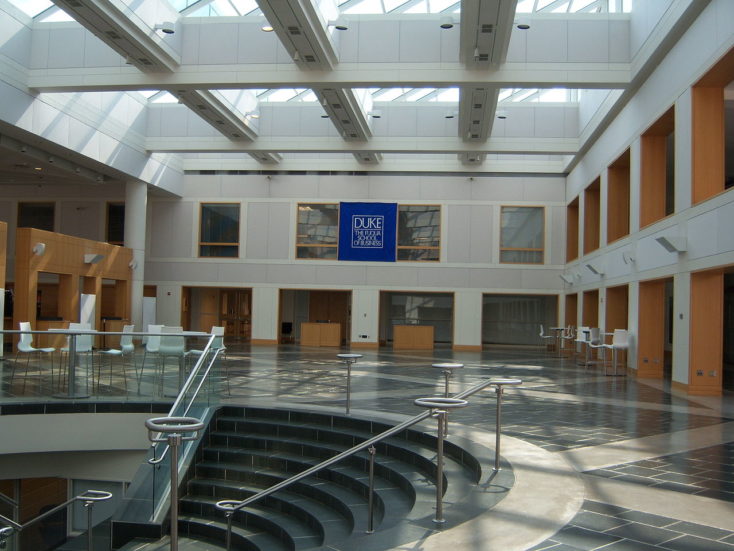
 Fuqua School of Business – Keller Center East – Hall of Flags
 Fuqua School of Business – Keller Center East – Hall of Flags
Frequently Asked Questions About Duke MBA Essays
Does “post-MBA career goals” mean your immediate role, five years out, or longer?
Focus on your immediate post-graduation role first, since that is the most concrete plan and the easiest for the committee to assess. For both your first choice and your alternate, name the function and industry you will target right after Duke. With only 100 words, a brief nod to where that path leads over the next five to ten years can add ambition, but keep the near-term goal front and center. Your longer-range vision has room to breathe in the community essay and the interview.
What should you avoid in the 25 Random Things essay?
The most common misstep is over-packaging the list or filling it only with achievements that already appear elsewhere in your application. Keep the items varied and personal, mix short entries with a few longer ones, and let humor and individuality come through so the committee gets to know you.
How should the Duke essays work together?
Read them as one portrait shot from different angles. The short answer shows focused direction, the 25 Random Things reveals the person behind the resume, and the community essay shows how you will contribute to Team Fuqua. The most common mistake is telling the same story twice, so give each essay material the others do not cover. When the set is done, the committee should come away with a full, consistent sense of who you are and what you will add at Duke.
Can reapplicants reuse recommendations at Duke?
Reapplicants who apply within two years can clone a prior application and reuse last year’s recommendation, with the option to add a new letter if a fresh perspective would help. The reapplicant essay is where you show concrete growth since your last attempt.
Partner with SBC on your MBA Application Journey
Stacy Blackman Consulting offers a range of services to meet your MBA application needs, from our comprehensive All-In Partnership to individualized hourly help with your MBA resume. Contact us today for a free 15-minute advising session to talk strategy with a Principal SBC consultant.
MBA Launchpad
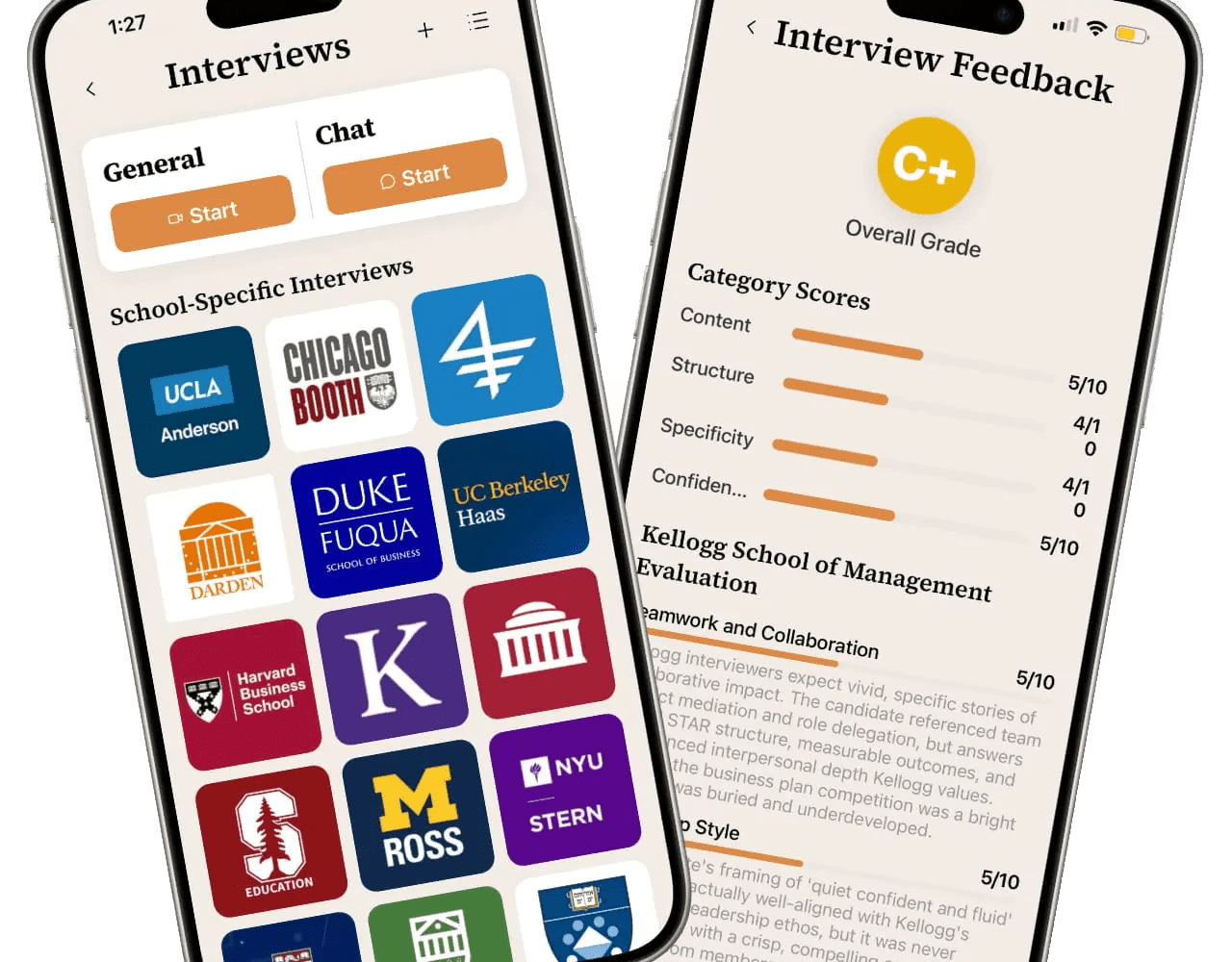
Don’t sleep on our latest product, MBA Launchpad by SBC! It’s an AI-powered admissions assistant built on more than 25 years of real SBC admissions data, with a candidacy assessment, school-list strategy, and essay guidance available 24/7. Download it today on the App Store or on Google Play.
Here’s a snapshot of the caliber of expertise on our SBC team.










Ashley
Ashley is a former MBA Admissions Board Member for Harvard Business School (HBS), where she interviewed and evaluated thousands of business school applicants for over a six year tenure. Ashley holds an MBA from HBS. During her HBS years, Ashley was the Sports Editor for the Harbus and a member of the B-School Blades Ice Hockey Team. After HBS, she worked in Marketing at the Gillette Company on Male and Female shaving ...
×Pauline
A former associate director of admissions at Harvard Business School, Pauline served on the HBS MBA Admissions Board full-time for four years. She evaluated and interviewed HBS applicants, both on-campus and globally. Pauline's career has included sales and marketing management roles with Coca-Cola, Gillette, Procter & Gamble, and IBM. For over 10 years, Pauline has expertly guided MBA applicants, and her clients h ...
×Laura
Laura comes from the MBA Admissions Board at Harvard Business School (HBS) and is an HBS MBA alumnus. In her HBS Admissions role, she evaluated and interviewed hundreds of business school candidates, including internationals, women, military and other applicant pools, for five years. Prior to her time as a student at HBS, Laura began her career in advertising and marketing in Chicago at Leo Burnett where she worked on th ...
×Andrea
Andrea served as the Associate Director of MBA Admissions at Harvard Business School (HBS) for over five years. In this role, she provided strategic direction for student yield-management activities and also served as a full member of the admissions committee. In 2007, Andrea launched the new 2+2 Program at Harvard Business School – a program targeted at college junior applicants to Harvard Business School. Andrea has also served as a Career Coach for Harvard Business School for both cu ...
×Jennifer
Jennifer served as Admissions Officer at the Stanford (GSB) for five years. She holds an MBA from Stanford (GSB) and a B.S. in Chemical Engineering from University of Illinois Urbana-Champaign. Jennifer has over 15 years experience in guiding applicants through the increasingly competitive admissions process into top MBA programs. Having read thousands and thousands of essays and applications while at Stanford (GSB) Admiss ...
×Davina
Davina received her MBA from Stanford's Graduate School of Business (GSB), with a certificate in Public Management, and her BA in Psychology from UC Berkeley. Davina is an experienced strategic planning leader, facilitator, and business case writer who spent more than 15 years building culture, entrepreneurship, and leadership initiatives across Stanford University and the Stanford Graduate School of Business. She designed ...
×Erin
Erin served in key roles in MBA Admissions--as Director at Haas School of Business at UC Berkeley and Assistant Director at Stanford's Graduate School of Business (GSB). Erin served on the admissions committee at each school and has read thousands of applications in her career. At Haas, she served for seven years in roles that encompassed evaluation, outreach, and diversity and inclusion. During her tenure in Admissions at GSB, she was responsible for candidate evaluation, applicant outreach, ...
×Susie
Susie comes from the Admissions Office of the Stanford Graduate School of Business where she reviewed and evaluated hundreds of prospective students’ applications. She holds an MBA from Stanford’s GSB and a BA from Stanford in Economics. Prior to advising MBA applicants, Susie held a variety of roles over a 15-year period in capital markets, finance, and real estate, including as partner in one of the nation’s most innovative finance and real estate investment organizations. In that r ...
×Dione
Dione holds an MBA degree from Stanford Business School (GSB) and a BA degree from Stanford University, where she double majored in Economics and Communication with concentrations in journalism and sociology. Dione has served as an Admissions reader and member of the Minority Admissions Advisory Committee at Stanford. Dione is an accomplished and respected advocate and thought leader on education and diversity. She is ...
×Anthony
Anthony served as the Associate Director of MBA Admissions at the Wharton School at the University of Pennsylvania, where he dedicated over 10 years of expertise. During his time as a Wharton Admissions Officer, he read and reviewed thousands of applications and helped bring in a class of 800+ students a year. Anthony has traveled both domestically and internationally to recruit a ...
×Meghan
Meghan served as the Associate Director of Admissions and Marketing at the Wharton MBA’s Lauder Institute, a joint degree program combining the Wharton MBA with an MA in International Studies. In her role on the Wharton MBA admissions committee, Meghan advised domestic and international applicants; conducted interviews and information sessions domestically and overseas in Asia, Central and South America, and Europe; and evaluated applicants for admission to the program. Meghan also managed ...
×Amy
Amy comes from the Wharton School of the University of Pennsylvania where she was Associate Director. Amy devoted 12 years at the Wharton School, working closely with MBA students and supporting the admissions team. During her tenure at Wharton, Amy served as a trusted adviser to prospective applicants as well as admitted and matriculated students. She conducted admissions chats with applicants early in the admissions ...
×Ally
Ally brings six years of admissions experience to the SBC team, most recently as an Assistant Director of Admission for the full-time MBA program at Columbia Business School (CBS). During her time at Columbia, Ally was responsible for reviewing applications, planning recruitment events, and interviewing candidates for both the full-time MBA program and the Executive MBA program. She traveled both internationally and dome ...
×Emma
Emma comes from the MBA Admissions Office at Columbia Business School (CBS), where she was Associate Director. Emma conducted dozens of interviews each cycle for the MBA and EMBA programs, as well as coordinating the alumni ambassador interview program. She read and evaluated hundreds of applications each cycle, delivered information sessions to audiences across the globe, and advised countless waitlisted applicants. ×
Dana
Dana served as Assistant Director of Admissions at Columbia Business School for the Full-Time MBA program and has over 10 years of experience working in higher education. Known as a scrupulous file reader, Dana reviewed countless applications and assisted in rendering final decisions for the Admissions Committee at CBS. While leading information sessions at Columbia and on the road, Dana met and advised myriad applicants� ...
×Holly
Holly worked as a member of the NYU Stern MBA Admissions team for seven years and holds an MBA from NYU Stern. In her tenure as Director of NYU MBA Admissions, Holly worked closely with admissions teams from Columbia, Michigan Ross, UVA Darden, Cornell Johnson, Berkeley Haas, Yale SOM, and Duke Fuqua on recruiting events domestically and internationally. On the NYU Stern admissions committee, Holly conducted interviews, planned and hosted events, and trained staff on reading and interviewi ...
×Written by SBC Consultant Amy. Reviewed by Stacy Blackman. Learn more about our former admissions officers on the SBC admissions team page.


