HBS Post-Interview Reflection: Your 24-Hour Game Plan
The HBS post-interview reflection is a short written piece that every Harvard Business School interviewee must submit through the online application system within 24 hours of the interview. It gives you the last word in your candidacy and shows the admissions committee how you process the conversation afterward and what you’d add.
Quick Summary
- Write the reflection the way you’d write a thoughtful follow-up note to a colleague after an important meeting. Warm, direct, and more aimed at clear thinking than on polish.
- Anchor it in one or two moments from your conversation that you can take further, so every paragraph could only have been written after your interview.
- Use it to demonstrate the habit HBS prizes in the case method classroom: listening closely, thinking it over afterward, and arriving at a sharper point of view.
What is the HBS post-interview reflection?
HBS interviews last 30 minutes and are conducted by a member of the HBS admissions committee who has already reviewed your application. According to the school’s application process page, the conversation is customized to each candidate and designed to help the committee learn more about you in a conversational setting. Within 24 hours of that interview, every candidate must submit a written reflection through the online application system. HBS shares detailed instructions only with applicants invited to interview, so you won’t see the full prompt until you’re in the pool.
In past cycles, those instructions have provided word guidance of roughly 300 to 450 words and made it clear the reflection isn’t meant to be another formal essay. No other elite MBA program asks for anything quite like it, which is part of why so many interviewees feel unsure how to approach it.
Invited to interview at HBS? SBC offers limited, one-on-one HBS interview prep once invitations go out. Contact us to check availability.
What is HBS looking for in your post-interview reflection?
The committee wants to see how you think once the pressure is off. In a recent YouTube Short, Stacy Blackman calls the reflection “one last chance to add something you didn’t get to say or to clarify something you wish you’d said better.” Anyone who has sat through an HBS case discussion knows the feeling. The argument you should have made usually shows up an hour after class ends.
The admissions committee reads the reflection for evidence of how your mind works after the interview. Stacy has long advised HBS candidates that the school is evaluating how you synthesize and digest the exchange you just had. That directly echoes life in an HBS section, where the most valuable learning often happens after class, as students revisit a discussion and realize what they’d argue differently next time.
“The strongest reflections show that the candidate can learn, be introspective, and process information in a high-stress situation, similar to what the case method challenges them to do every day,” explains SBC consultant and Harvard MBA Margaret. “They come from someone who can find middle ground and keeps growing in everyday settings, not just through formal training.”
SBC consultant Andrea, former Associate Director of MBA Admissions Marketing at HBS, points to intellectual curiosity as the interview’s core: “The single most important element of the interview is demonstrating deep intellectual curiosity with the ability to develop a point of view or perspective.” The reflection is your chance to show that point of view kept developing after you left the room.
It’s also the only writing sample in your file that nobody has polished for weeks. Your essays show what you can do with time and feedback. This shows what you do with a deadline, which is how you’ll write every day as a student.
What should you do right after your HBS interview?
Before you do anything else, capture the conversation on paper or in a notes app while it’s fresh. Write down the questions in the order they came, any subsequent questions your interviewer pressed on, the moments where they leaned in or jotted something down, and the answers you wish you’d framed differently. Add the stories you planned to share but never got to.
Then put it down for a while. Grab a meal or take a walk along the river if you interviewed on campus. Most people find the theme of their reflection gets obvious after an hour or two away, and the moments that felt enormous in the room shrink back down. Once you see the thread, start writing and submit well before the deadline in case the portal misbehaves.
How do you write a strong HBS post-interview reflection?
Open with the conversation itself.
Start inside the interview. A question that caught you off guard, or a point your interviewer pushed back on, makes a natural first line, and it tells the committee right away that this piece couldn’t have been written in advance. Skip the paragraph thanking them for the opportunity. They know you’re grateful.
Choose one or two threads to develop.
You’ll have more to say than room for. Pick the one or two ideas that matter most to the case you’re making for yourself and go deeper on those. Maybe it’s the reasoning behind a decision you only had time to summarize, or a link between something you discussed and an experience your application mentions in passing.
Address a weak answer with confidence.
Maybe you rambled through the question about your biggest setback. Or you blanked on a revenue figure you could normally recite in your sleep, then spent the rest of the interview hearing it in your head. The reflection gives you another pass, as long as you keep the repair short. Interviewers sit through rough patches in 30-minute conversations all the time.
“The biggest mistake I see clients make is trying to use this essay to excuse what they perceived as a mistake,” Margaret says. “It brings more attention to what didn’t go well if that’s the emphasis of the reflection.”
Close by looking ahead.
Wrap up with what the conversation changed or clarified for you. That could be your goals, the way you’d contribute in the classroom, or why HBS in particular makes more sense to you now, as long as it grows out of something you discussed.
What should you leave out of your HBS post-interview reflection?
Don’t summarize the interview. Your interviewer was there, and a question-by-question recap burns your word count while suggesting you couldn’t tell which moments mattered. Don’t include accomplishments that never came up, either. The committee has your application, and a reflection that turns into a sales pitch loses the natural tone HBS asked for.
Pre-written drafts are easy to spot, and Stacy is blunt on this point: definitely don’t “let it read like it was written before the interview even happened.” Candidates who prepare a version in advance and tweak it afterward almost always end up with something that sounds like it came from a stranger to the conversation. Broad praise of HBS has the same problem. If you want to demonstrate enthusiasm, tie it to a particular detail from your conversation.
Frequently Asked Questions About the HBS Post-Interview Reflection
My interview felt rough. Can the reflection rescue it?
You can’t redo the whole half hour, but you can take another run at the one or two answers that bothered you most. Candidates are also notoriously bad at judging their own interviews. That pause you’re still cringing about on the ride home may have come while your interviewer was writing down something you’d just said. Pick the answer that matters most to your story and give the clearer version, then use whatever space is left for the topic you never got to finish.
Will leaving out “why HBS” hurt me?
Your fit has already been weighed through your essays and the interview itself, so the reflection doesn’t need a dedicated “why HBS” paragraph. Bring it in when the conversation gives you a reason. For example, when you discuss goals that sharpened your thinking about the program. Otherwise, leave it out.
Will a less polished reflection count against me?
The committee knows you wrote this in a day and expects something more conversational than your essays. Clean organization and correct spelling still matter because they show care. Past that, spend your time on what you’re saying.
My interviewer never asked about the experience I most wanted to discuss. Should I bring it up in the reflection?
You can, as long as you build a bridge from something you did talk about. Many candidates assume a skipped topic means the committee missed something essential, but the interviewer read your application closely and chose where to spend the 30 minutes. If a story you prepared would have strengthened an answer you gave, connect the two directly, for example by explaining how that experience shaped the leadership approach you described. Introducing it cold, with no link to the conversation, turns the reflection into a second application and undercuts the sense that you were listening.
Prepare for Your HBS Interview With SBC
The strongest reflections come from candidates who walked into the interview knowing their story cold, because that preparation frees them to listen and engage. SBC’s team includes former HBS admissions officers who know how the committee approaches these conversations, and our HBS interview prep pairs you with an expert for mock interviews and a debrief strategy for the 24 hours that follow. For more insight into the HBS interview, listen to B-Schooled episode #194. Ready to prepare with an expert? Contact us today.
MBA Launchpad
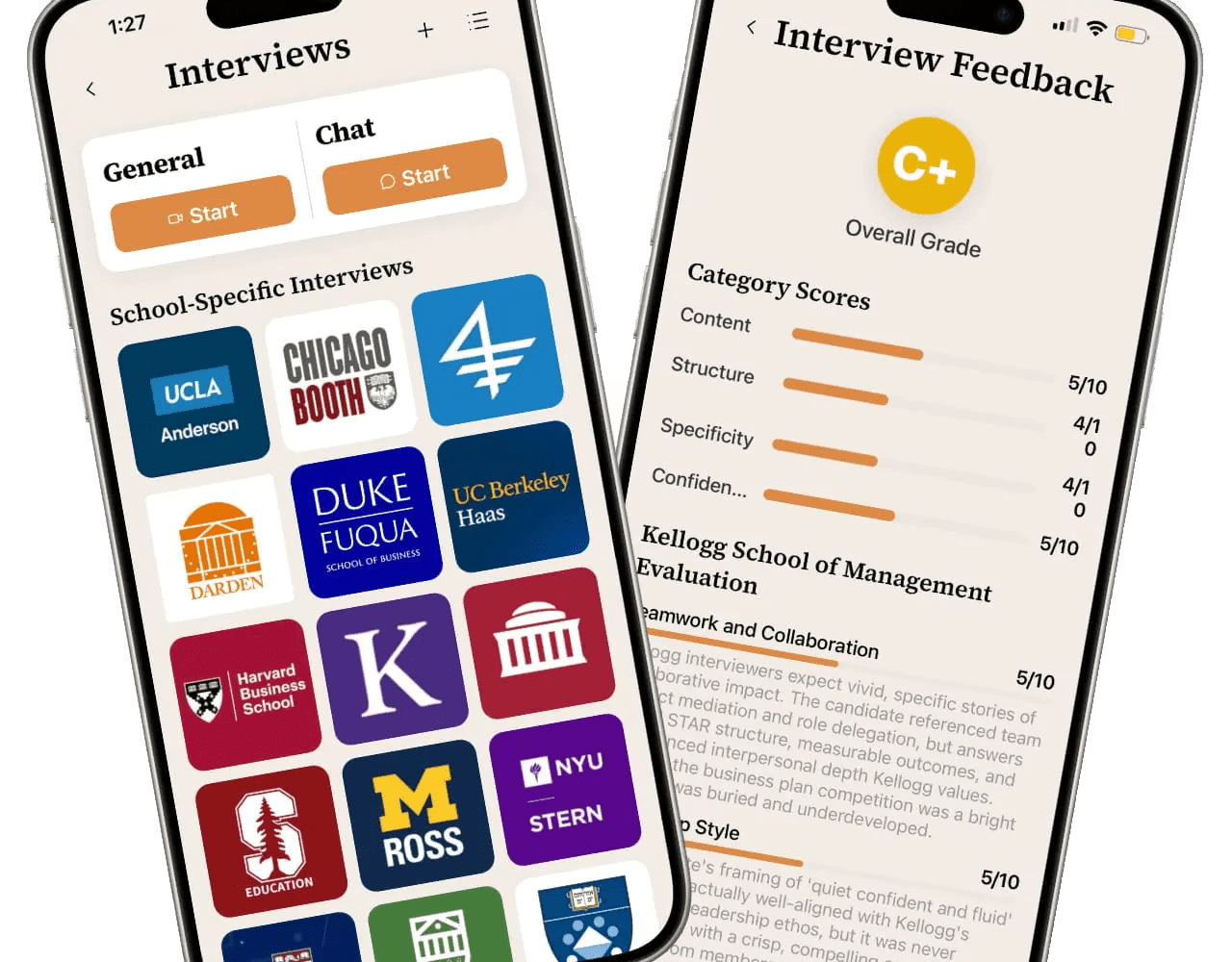
Don’t sleep on our latest product, MBA Launchpad by SBC. Built on more than 25 years of real SBC admissions data, this AI-powered admissions assistant can help you rehearse for interviews at HBS and every other program on your list. Its call feature runs live practice sessions with questions targeted to your school and helps you shape your stories to fit the time you’ll have. Launchpad also offers candidacy assessment, school list strategy, and essay guidance, all available 24/7, and premium features are currently free. Download MBA Launchpad on the App Store or Google Play.
Here’s a snapshot of the caliber of expertise on our SBC team.









Ashley
Ashley is a former MBA Admissions Board Member for Harvard Business School (HBS), where she interviewed and evaluated thousands of business school applicants for over a six year tenure. Ashley holds an MBA from HBS. During her HBS years, Ashley was the Sports Editor for the Harbus and a member of the B-School Blades Ice Hockey Team. After HBS, she worked in Marketing at the Gillette Company on Male and Female shaving ...
×Pauline
A former associate director of admissions at Harvard Business School, Pauline served on the HBS MBA Admissions Board full-time for four years. She evaluated and interviewed HBS applicants, both on-campus and globally. Pauline's career has included sales and marketing management roles with Coca-Cola, Gillette, Procter & Gamble, and IBM. For over 10 years, Pauline has expertly guided MBA applicants, and her clients h ...
×Laura
Laura comes from the MBA Admissions Board at Harvard Business School (HBS) and is an HBS MBA alumnus. In her HBS Admissions role, she evaluated and interviewed hundreds of business school candidates, including internationals, women, military and other applicant pools, for five years. Prior to her time as a student at HBS, Laura began her career in advertising and marketing in Chicago at Leo Burnett where she worked on th ...
×Andrea
Andrea served as the Associate Director of MBA Admissions at Harvard Business School (HBS) for over five years. In this role, she provided strategic direction for student yield-management activities and also served as a full member of the admissions committee. In 2007, Andrea launched the new 2+2 Program at Harvard Business School – a program targeted at college junior applicants to Harvard Business School. Andrea has also served as a Career Coach for Harvard Business School for both cu ...
×Jennifer
Jennifer served as Admissions Officer at the Stanford (GSB) for five years. She holds an MBA from Stanford (GSB) and a B.S. in Chemical Engineering from University of Illinois Urbana-Champaign. Jennifer has over 15 years experience in guiding applicants through the increasingly competitive admissions process into top MBA programs. Having read thousands and thousands of essays and applications while at Stanford (GSB) Admiss ...
×Davina
Davina received her MBA from Stanford's Graduate School of Business (GSB), with a certificate in Public Management, and her BA in Psychology from UC Berkeley. Davina is an experienced strategic planning leader, facilitator, and business case writer who spent more than 15 years building culture, entrepreneurship, and leadership initiatives across Stanford University and the Stanford Graduate School of Business. She designed ...
×Erin
Erin served in key roles in MBA Admissions--as Director at Haas School of Business at UC Berkeley and Assistant Director at Stanford's Graduate School of Business (GSB). Erin served on the admissions committee at each school and has read thousands of applications in her career. At Haas, she served for seven years in roles that encompassed evaluation, outreach, and diversity and inclusion. During her tenure in Admissions at GSB, she was responsible for candidate evaluation, applicant outreach, ...
×Susie
Susie comes from the Admissions Office of the Stanford Graduate School of Business where she reviewed and evaluated hundreds of prospective students’ applications. She holds an MBA from Stanford’s GSB and a BA from Stanford in Economics. Prior to advising MBA applicants, Susie held a variety of roles over a 15-year period in capital markets, finance, and real estate, including as partner in one of the nation’s most innovative finance and real estate investment organizations. In that r ...
×Dione
Dione holds an MBA degree from Stanford Business School (GSB) and a BA degree from Stanford University, where she double majored in Economics and Communication with concentrations in journalism and sociology. Dione has served as an Admissions reader and member of the Minority Admissions Advisory Committee at Stanford. Dione is an accomplished and respected advocate and thought leader on education and diversity. She is ...
×Anthony
Anthony served as the Associate Director of MBA Admissions at the Wharton School at the University of Pennsylvania, where he dedicated over 10 years of expertise. During his time as a Wharton Admissions Officer, he read and reviewed thousands of applications and helped bring in a class of 800+ students a year. Anthony has traveled both domestically and internationally to recruit a ...
×Meghan
Meghan served as the Associate Director of Admissions and Marketing at the Wharton MBA’s Lauder Institute, a joint degree program combining the Wharton MBA with an MA in International Studies. In her role on the Wharton MBA admissions committee, Meghan advised domestic and international applicants; conducted interviews and information sessions domestically and overseas in Asia, Central and South America, and Europe; and evaluated applicants for admission to the program. Meghan also managed ...
×Amy
Amy comes from the Wharton School of the University of Pennsylvania where she was Associate Director. Amy devoted 12 years at the Wharton School, working closely with MBA students and supporting the admissions team. During her tenure at Wharton, Amy served as a trusted adviser to prospective applicants as well as admitted and matriculated students. She conducted admissions chats with applicants early in the admissions ...
×Ally
Ally brings six years of admissions experience to the SBC team, most recently as an Assistant Director of Admission for the full-time MBA program at Columbia Business School (CBS). During her time at Columbia, Ally was responsible for reviewing applications, planning recruitment events, and interviewing candidates for both the full-time MBA program and the Executive MBA program. She traveled both internationally and dome ...
×Emma
Emma comes from the MBA Admissions Office at Columbia Business School (CBS), where she was Associate Director. Emma conducted dozens of interviews each cycle for the MBA and EMBA programs, as well as coordinating the alumni ambassador interview program. She read and evaluated hundreds of applications each cycle, delivered information sessions to audiences across the globe, and advised countless waitlisted applicants. ×
Dana
Dana served as Assistant Director of Admissions at Columbia Business School for the Full-Time MBA program and has over 10 years of experience working in higher education. Known as a scrupulous file reader, Dana reviewed countless applications and assisted in rendering final decisions for the Admissions Committee at CBS. While leading information sessions at Columbia and on the road, Dana met and advised myriad applicants� ...
×Holly
Holly worked as a member of the NYU Stern MBA Admissions team for seven years and holds an MBA from NYU Stern. In her tenure as Director of NYU MBA Admissions, Holly worked closely with admissions teams from Columbia, Michigan Ross, UVA Darden, Cornell Johnson, Berkeley Haas, Yale SOM, and Duke Fuqua on recruiting events domestically and internationally. On the NYU Stern admissions committee, Holly conducted interviews, planned and hosted events, and trained staff on reading and interviewi ...
×Written by Yvonne Milosevic. Reviewed by Stacy Blackman. Learn more about our former admissions officers on the SBC admissions team page.