UCLA MBA Application Essay Advice for the Class of 2029
The UCLA MBA application for 2026-2027 has three short required essays and one optional essay. Together, they cover your post-MBA goals and program fit, the qualities you want to be known for, and a brief first impression of who you are. Because every prompt is deliberately short, success comes down to specificity and a genuine voice.
Quick Summary
- The three essays are one story. Your goals (Essay 1), the values you want to be known for (Essay 2), and your first impression (Essay 3) should each add something new while building toward a single, coherent picture.
- Specificity wins in tight word counts. Name real target companies and real Anderson resources instead of gesturing at “great faculty” or “a strong network.”
- Anderson recruits for its collaborative culture. Show your fit with Share Success, Think Fearlessly, and Drive Change through evidence, not adjectives.
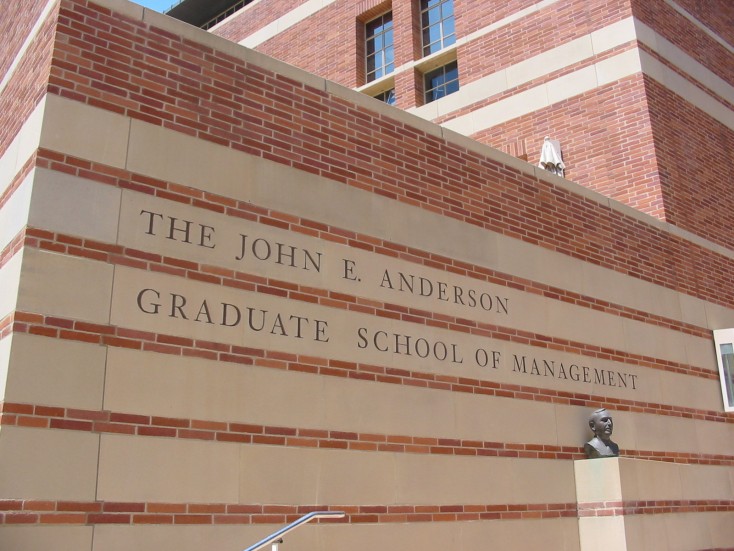
The Anderson School of Management sits in the heart of Los Angeles, with an alumni network that reaches across a regional economy spanning technology, entertainment, healthcare, and real estate. It’s also a small, close-knit program, with a full-time cohort of roughly 300 students, so your personality and fit with the community carry real weight in your application.
UCLA Anderson describes its culture through three pillars: Share Success (inclusive collaboration for meaningful results), Think Fearlessly (innovative solutions to complex business problems), and Drive Change (transformative leaders who catalyze action around a purpose). Keep these in mind before you draft. They run through everything the admissions committee is reading for, especially the second essay.
What essays does the UCLA MBA application require for the 2026-2027 admissions season?
As the program explains, essays are meant to complement the rest of your application and highlight how an MBA fits into your career goals and journey. Anderson asks for essays that are introspective, genuine, and succinct, with a clear vision for your future and the impact you plan to make on the community. There are three required short essays and one optional essay:
- Short Essay 1: Describe your short- and long-term post-MBA goals, including your desired role, industry, and examples of target companies. How will an MBA support your path to achieving your goals, and which UCLA Anderson resources do you expect to rely on most to reach them? (250 words)
- Short Essay 2: How do you hope your UCLA Anderson classmates will describe you by the time you graduate? What qualities and/or values do you want to be known for, and how will you demonstrate them as a student leader and community member? (200 words)
- Short Essay 3: What is the first thing you would tell your classmates about yourself upon arriving at Anderson? (50 words)
- Optional Essay: Are there any extenuating circumstances or additional context you would like to share with the Admissions committee? (250 words maximum)
What’s new this year at UCLA Anderson?
This cycle brings real changes to the UCLA MBA application. The standalone “why an MBA” essay is gone, the goals essay now requires named target companies and specific Anderson resources, and the second and third prompts are new, shifting the focus toward who you are and how you’ll show up on campus. And don’t let the short-answer format fool you. Brief essays are often harder to write than long ones, because you have to know exactly what you want to convey before you spend a single word on it.
SBC’s consultants have graduated from every top MBA program, Anderson included. Reach out for a free 15-minute advising session to talk through your UCLA strategy with a Principal consultant.
UCLA Anderson Essay 1: Your Post-MBA Goals
This is the anchor of your set, and the prompt is more demanding than it looks. The admissions committee reads it for clarity and feasibility, so it needs three things working together: a specific goal, a clear reason the MBA gets you there, and the resources that make Anderson the right place to do it.
Lead with a concrete short-term goal, and follow the prompt literally. It asks for your desired role, industry, and examples of target companies, so name them. “A product management role in consumer tech at a company like Snap, Netflix, or Google” tells the reader far more than “a career in technology.” Then sketch where that path leads over the longer term. Once your goals are on the page, connect the dots: what specific gap does an MBA fill for you, whether that’s a functional skill set, the credibility to pivot, or the network to break into a new industry?
Connect your goals to specific Anderson resources
Finally, and this is the part applicants sometimes shortchange, point to the specific Anderson resources you’ll rely on most. Depending on your direction, that might mean the Parker Career Management Center, the Price Center for Entrepreneurship and Innovation, the Center for Media, Entertainment and Sports, the Easton Technology Management Center, Anderson’s applied management and experiential learning, or the school’s ties to LA’s tech and entertainment ecosystems. At 250 words, spend most of your space on goals, companies, and the two or three resources that genuinely fit.
Research is what separates a strong version of this essay from a generic one. In his B-Schooled conversation, Assistant Dean Alex Lawrence encouraged applicants to point to something specific and unique to Anderson, whether a class, one of the school’s academic centers of excellence, or a particular student experience, rather than praising the program in broad strokes. That homework pays off twice. Lawrence noted that Anderson’s interviewers are trained to ask why the school fits your goals, so the research you do now carries straight into the interview.
UCLA Anderson Essay 2: How Your Classmates Will Describe You
This prompt is new, and it’s a values and character essay in disguise. Anderson wants to know how your classmates will describe you at graduation, which qualities you want to be known for, and how you’ll demonstrate them as both a student leader and a community member. In SBC’s read, the committee is testing self-awareness, authenticity, and fit with Anderson’s collaborative culture.
Alex Lawrence made that priority plain in his B-Schooled interview, describing an admissions committee that looks for genuine community engagement and a giving-back mentality, and for the kind of people it wants in the Anderson family for life. He also noted that recruiters describe Anderson students as smart and competitive, but in a nice way, a useful signal of the collaborative tone to aim for.
Choose distinctive qualities and show them in action
Start by choosing two or three distinctive qualities that are genuinely yours, and skip the generic virtues. “Hardworking team player” describes almost every applicant. Something like “the person who pulls quiet voices into the room” is specific and more memorable. Anderson’s three pillars are a useful lens here, but don’t just recite them. Show which values you actually live and back each with evidence.
The prompt names two roles, so address both. The student-leader side is about initiative, whether that’s a club officer role, launching something new, or leading a team project. The community-member side is about how you show up for peers day to day. The most convincing predictions of how classmates will describe you are rooted in how colleagues already describe you, so ground your future promise in real past behavior. At 200 words, two well-supported qualities beat a long list of adjectives.
UCLA Anderson Essay 3: Your 50-Word Introduction
Fifty words is a personality test, not a resume line. The committee wants the first thing you’d tell your classmates when you arrive, which rewards a genuine, memorable detail over an accomplishment. “I spent two years cooking in a Michelin-starred kitchen before I ever touched a spreadsheet” will spark conversation at orientation. “I worked in consulting” will not.
Pick one vivid idea that sounds like you and invites people in, whether that’s a passion, a quirk, a part of your identity, or an unexpected fact about your path. Resist the urge to cram in achievements. This essay complements the other two: goals in Essay 1, character in Essay 2, and here, the human first impression that makes both feel real.

Should you write the UCLA Anderson optional essay?
The optional essay is truly optional, and Anderson gives no preference to applicants who use it. So, apply your own judgment. Its main purpose is to address a genuine question mark in your profile, such as a gap in your work history, a weak stretch of grades, or the absence of a recommendation from a current manager.
If you do write it, keep the structure clean. State the situation briefly, explain what has changed or what you did about it, and focus on explanation rather than excuse. A challenge you’ve clearly overcome can strengthen your case for admission. This cycle’s prompt also invites “additional context,” which widens the door slightly beyond red flags. Use that room only for context that materially clarifies or strengthens your candidacy, and resist turning it into a fourth essay of bonus achievements.
How should you use AI in your UCLA MBA application?
Anderson’s essays run from 50 to 250 words and turn entirely on your voice, self-awareness, and the specific choices only you can make. That’s precisely what generative AI handles worst, and precisely what the committee is reading for.
UCLA’s graduate admissions guidance permits AI for narrow support, such as checking grammar, refining word choice, or sketching an outline, but it expects the substance and the final writing to be your own. UCLA Anderson does not currently require a formal AI disclosure as part of its essay instructions. Our advice: it’s fine to pressure-test your structure or brainstorm angles, but write the actual sentences yourself, especially in Essays 2 and 3, where authenticity is the entire point. Leaning on AI for the drafting flattens the distinctive voice that makes short essays work.
For a deeper look at the program, don’t miss B-Schooled Podcast #172: Spotlight on UCLA Anderson with Assistant Dean Alex Lawrence. This conversation covers what the admissions committee looks for, how Anderson runs its interviews, and what sets the program apart.
Frequently Asked Questions About the UCLA Anderson MBA Application
What is UCLA Anderson looking for in MBA applicants?
Anderson recruits for its collaborative culture, shaped by the values of Share Success, Think Fearlessly, and Drive Change. It puts real weight on community engagement and leadership. That means the strongest essays will show genuine fit through specific evidence rather than adjectives.
Does UCLA Anderson require a “Why Anderson” essay?
Not as a standalone prompt. The goals essay asks which Anderson resources you expect to rely on most, so your fit with the program still has to come through. Naming specific classes, centers, or student experiences is what makes that case convincingly.
How do you approach the UCLA Anderson 50-word essay?
The 50-word introduction rewards one genuine, memorable detail over an accomplishment. Choose something that sounds like you and would spark a conversation at orientation, and resist the urge to cram in your resume.
How do the three UCLA Anderson essays work together?
Treat them as one narrative with three jobs. Essay 1 handles your goals and program fit, Essay 2 shows the character and values you want to be known for, and Essay 3 gives a brief, human first impression. Because the word counts are tight, each essay should add something new rather than repeat the others or your resume.
Stacy Blackman Consulting offers a range of services to meet your MBA application needs, from our comprehensive All-In Partnership to individualized hourly assistance with reviewing your MBA resume. Contact us today for a free 15-minute advising session to talk strategy with a Principal SBC consultant.
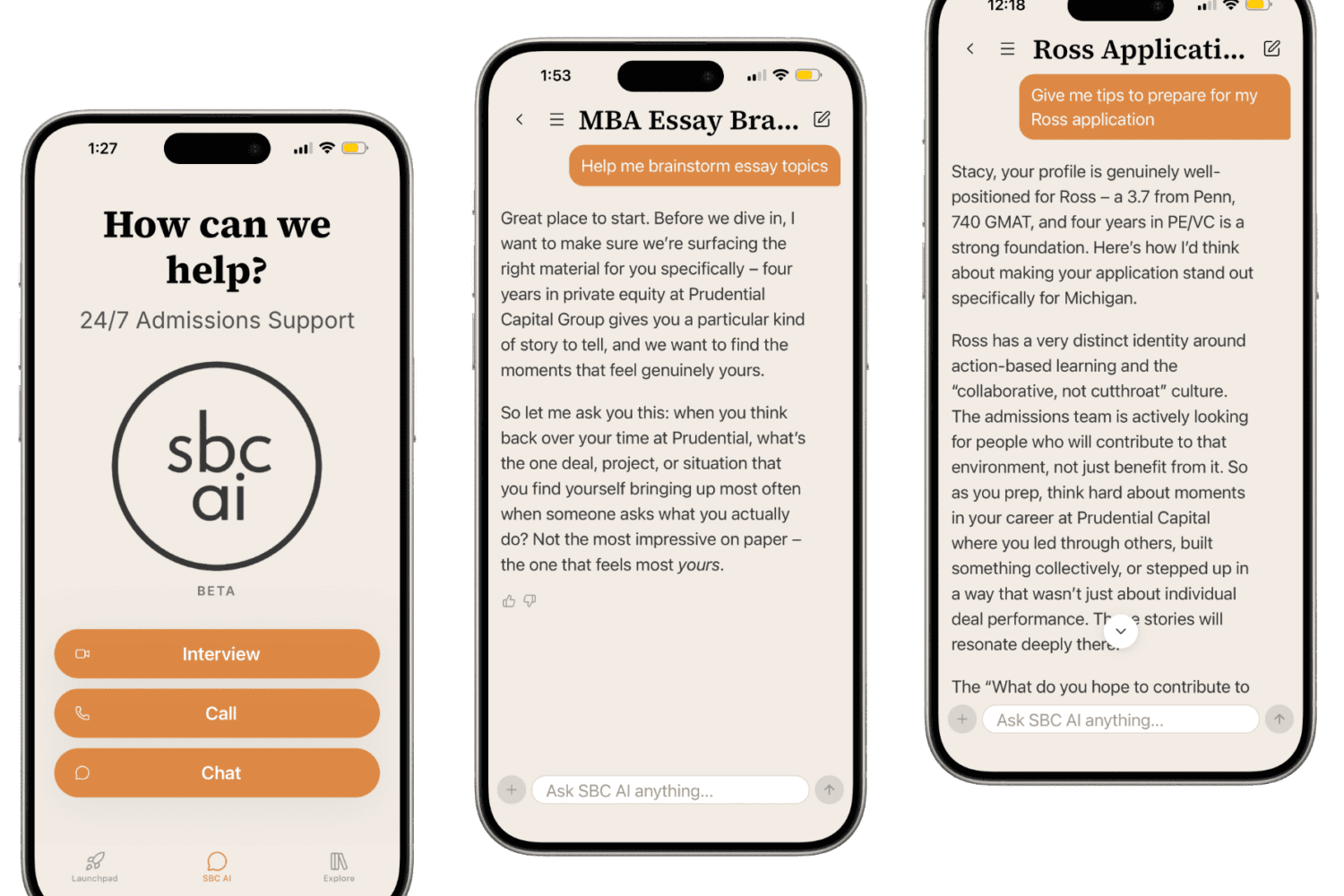
MBA Launchpad
Don’t sleep on our latest product, MBA Launchpad by SBC! It’s an AI-powered admissions assistant built on 25+ years of real SBC admissions data, offering candidacy assessment, school list strategy, and essay guidance available 24/7. Download it now on the App Store or Google Play.
Here’s a snapshot of the caliber of expertise on our SBC team.







Ashley
Ashley is a former MBA Admissions Board Member for Harvard Business School (HBS), where she interviewed and evaluated thousands of business school applicants for over a six year tenure. Ashley holds an MBA from HBS. During her HBS years, Ashley was the Sports Editor for the Harbus and a member of the B-School Blades Ice Hockey Team. After HBS, she worked in Marketing at the Gillette Company on Male and Female shaving ...
×Pauline
A former associate director of admissions at Harvard Business School, Pauline served on the HBS MBA Admissions Board full-time for four years. She evaluated and interviewed HBS applicants, both on-campus and globally. Pauline's career has included sales and marketing management roles with Coca-Cola, Gillette, Procter & Gamble, and IBM. For over 10 years, Pauline has expertly guided MBA applicants, and her clients h ...
×Laura
Laura comes from the MBA Admissions Board at Harvard Business School (HBS) and is an HBS MBA alumnus. In her HBS Admissions role, she evaluated and interviewed hundreds of business school candidates, including internationals, women, military and other applicant pools, for five years. Prior to her time as a student at HBS, Laura began her career in advertising and marketing in Chicago at Leo Burnett where she worked on th ...
×Andrea
Andrea served as the Associate Director of MBA Admissions at Harvard Business School (HBS) for over five years. In this role, she provided strategic direction for student yield-management activities and also served as a full member of the admissions committee. In 2007, Andrea launched the new 2+2 Program at Harvard Business School – a program targeted at college junior applicants to Harvard Business School. Andrea has also served as a Career Coach for Harvard Business School for both cu ...
×Jennifer
Jennifer served as Admissions Officer at the Stanford (GSB) for five years. She holds an MBA from Stanford (GSB) and a B.S. in Chemical Engineering from University of Illinois Urbana-Champaign. Jennifer has over 15 years experience in guiding applicants through the increasingly competitive admissions process into top MBA programs. Having read thousands and thousands of essays and applications while at Stanford (GSB) Admiss ...
×Davina
Davina received her MBA from Stanford's Graduate School of Business (GSB), with a certificate in Public Management, and her BA in Psychology from UC Berkeley. Davina is an experienced strategic planning leader, facilitator, and business case writer who spent more than 15 years building culture, entrepreneurship, and leadership initiatives across Stanford University and the Stanford Graduate School of Business. She designed ...
×Erin K.
Erin served in key roles in MBA Admissions--as Director at Haas School of Business at UC Berkeley and Assistant Director at Stanford's Graduate School of Business (GSB). Erin served on the admissions committee at each school and has read thousands of applications in her career. At Haas, she served for seven years in roles that encompassed evaluation, outreach, and diversity and inclusion. During her tenure in Admissions at GSB, she was responsible for candidate evaluation, applicant outreach, ...
×Susie
Susie comes from the Admissions Office of the Stanford Graduate School of Business where she reviewed and evaluated hundreds of prospective students’ applications. She holds an MBA from Stanford’s GSB and a BA from Stanford in Economics. Prior to advising MBA applicants, Susie held a variety of roles over a 15-year period in capital markets, finance, and real estate, including as partner in one of the nation’s most innovative finance and real estate investment organizations. In that r ...
×Dione
Dione holds an MBA degree from Stanford Business School (GSB) and a BA degree from Stanford University, where she double majored in Economics and Communication with concentrations in journalism and sociology. Dione has served as an Admissions reader and member of the Minority Admissions Advisory Committee at Stanford. Dione is an accomplished and respected advocate and thought leader on education and diversity. She is ...
×Anthony
Anthony served as the Associate Director of MBA Admissions at the Wharton School at the University of Pennsylvania, where he dedicated over 10 years of expertise. During his time as a Wharton Admissions Officer, he read and reviewed thousands of applications and helped bring in a class of 800+ students a year. Anthony has traveled both domestically and internationally to recruit a ...
×Meghan
Meghan served as the Associate Director of Admissions and Marketing at the Wharton MBA’s Lauder Institute, a joint degree program combining the Wharton MBA with an MA in International Studies. In her role on the Wharton MBA admissions committee, Meghan advised domestic and international applicants; conducted interviews and information sessions domestically and overseas in Asia, Central and South America, and Europe; and evaluated applicants for admission to the program. Meghan also managed ...
×Amy
Amy comes from the Wharton School of the University of Pennsylvania where she was Associate Director. Amy devoted 12 years at the Wharton School, working closely with MBA students and supporting the admissions team. During her tenure at Wharton, Amy served as a trusted adviser to prospective applicants as well as admitted and matriculated students. She conducted admissions chats with applicants early in the admissions ...
×Ally
Ally brings six years of admissions experience to the SBC team, most recently as an Assistant Director of Admission for the full-time MBA program at Columbia Business School (CBS). During her time at Columbia, Ally was responsible for reviewing applications, planning recruitment events, and interviewing candidates for both the full-time MBA program and the Executive MBA program. She traveled both internationally and dome ...
×Emma
Emma comes from the MBA Admissions Office at Columbia Business School (CBS), where she was Associate Director. Emma conducted dozens of interviews each cycle for the MBA and EMBA programs, as well as coordinating the alumni ambassador interview program. She read and evaluated hundreds of applications each cycle, delivered information sessions to audiences across the globe, and advised countless waitlisted applicants. ×
Dana
Dana served as Assistant Director of Admissions at Columbia Business School for the Full-Time MBA program and has over 10 years of experience working in higher education. Known as a scrupulous file reader, Dana reviewed countless applications and assisted in rendering final decisions for the Admissions Committee at CBS. While leading information sessions at Columbia and on the road, Dana met and advised myriad applicants� ...
×Holly
Holly worked as a member of the NYU Stern MBA Admissions team for seven years and holds an MBA from NYU Stern. In her tenure as Director of NYU MBA Admissions, Holly worked closely with admissions teams from Columbia, Michigan Ross, UVA Darden, Cornell Johnson, Berkeley Haas, Yale SOM, and Duke Fuqua on recruiting events domestically and internationally. On the NYU Stern admissions committee, Holly conducted interviews, planned and hosted events, and trained staff on reading and interviewi ...
×Written by SBC Consultant Amy. Reviewed by Stacy Blackman. Learn more about our former admissions officers on the SBC admissions team page.


