Cornell MBA Application Advice for the 2026-2027 Admissions Season
The Cornell MBA application components for 2026-2027 are confirmed, and there’s a notable change. Every applicant to Cornell’s SC Johnson College of Business writes a Goals Statement and chooses one of two essays. You can stay with the returning Impact essay or take on a new Table of Contents essay that invites creative, even multimedia, submissions. Here’s how to approach each one.
Quick Summary
- The biggest shift this cycle is the swap of the “Unique Trait” essay for a creative Table of Contents essay. You can submit it in writing, as slides, video, or a portfolio link, so pick the format that shows you off best rather than the flashiest one.
- The Goals Statement asks for both your short- and long-term goals, including the immediate post-MBA period and five to ten years out. The resource short-answer should focus on your immediate transition upon graduating, so tie Johnson’s concrete resources to that first move.
- Lock in your program before you write a word. The Two-Year, One-Year, and Cornell Tech MBAs each imply a different goal and timeline, and that choice shapes every essay you submit.
How should you approach the Cornell MBA application?
Before you draft anything for the Cornell MBA application, set your strategy. The first decision is which program best fits your goals, and Johnson’s own leaders frame it as a question of fit rather than of which program is easier to enter. If you’re already tech-centered and headed back into that field, the one-year Cornell Tech MBA in New York City suits you. If you’re pivoting into or out of tech, the flagship Two-Year MBA in Ithaca fits better, with the option to add a Cornell Tech second year through the dual-campus pathway. Each track shapes the story you’ll tell, so settle that up front.
From there, dig into your research. Explore Johnson’s faculty, coursework, and career outcomes, and pay attention to how the school connects to the wider Cornell community. That cross-campus access is one of Johnson’s real differentiators, and referencing it credibly signals that you’ve done your homework.
Then turn the lens on yourself. Look at your academic record, work history, and activities, and decide which parts of your story need the most emphasis. If you spot a gap, whether it’s a low test score or a thin extracurricular profile, address it head-on before you submit.
Curious about your chances of getting into a top B-school? Contact us to talk strategy with a free 15-minute advising session with an SBC Principal Consultant.

How do you answer the Cornell Johnson Goals Statement?
The Goals Statement combines fill-in-the-blank prompts with a short written answer. You’ll name a target role, company, and industry for two horizons, one immediately after the MBA and one five to ten years out. Then a short-answer question asks you to explain how you’ll use Johnson’s resources, along with the resources you already bring, to land that first post-MBA role.
Note the emphasis this year on your immediate transition. Cornell wants to see a clear, achievable first move, so anchor your written answer there. Name specific levers like courses, the right professional clubs, experiential learning, and the alumni network in your target industry. Then pair those with what you already hold, such as relevant work experience, a strong network, or academic preparation.
Keep your answers specific and consistent with what your recommenders say about you. This statement opens a conversation that continues into your interview, so the logic connecting your past to your stated future needs to hold up under follow-up questions.
How do you choose between the Impact essay and the Table of Contents essay?
This is the one place where Cornell offers an essay choice, so make the call deliberately. Go with the prompt that carries what you most need the committee to see.
Pick the Impact essay if your strongest case is your fit with Johnson and your track record of contributing to communities. It’s the more direct, conventional option, and it rewards specific knowledge of the school.
Choose the Table of Contents essay if your background, personality, or creative range is the thing that sets you apart, and if a more open format would let you show it. This option carries more upside and more risk, so choose it because it serves your story, not because it looks adventurous.
Impact Essay Advice
This prompt asks how you’ll contribute to the Johnson community, and the admissions committee frames it as a way to explore where your engagement meets the school’s culture. In other words, they want evidence, not enthusiasm.
Start with research. Use Cornell’s community search tool to connect with current students, or ask your own network for introductions. As you learn how students actually spend their time, note the clubs, speaker series, and informal traditions that genuinely interest you. Johnson has groups for everything from ice hockey to nearly every professional path, so specificity is easy to come by.
Then prove your potential with your past. If you organized speaker events for a young professionals group or built a mentoring program at work, describe that, and explain how you’d bring the same initiative to a specific Johnson space. The strongest answers name a concrete way you’ll show up and back it with a time you’ve already done something similar.

Table of Contents Essay Advice
This is the cycle’s marquee change, replacing the former “Unique Trait” essay. Cornell asks you to imagine your life as a book and write its table of contents. You can submit it in writing (350 words), as a slide presentation, as a video under 3 minutes, or as links to a personal site or portfolio, with a 5 MB file upload limit.
The open format is a real advantage, as long as you settle the story first. Decide what your chapters need to say before you pick how to present them. A good table of contents has a throughline. Think of it as the connective spine that links your chapters into one coherent arc rather than a chronological list of events. Ask yourself what theme runs through your life, whether that’s reinvention, building things, bridging communities, or whatever is true for you.
Make your chapter titles evocative but legible. A title like “The Year I Coached a Team That Couldn’t Win” invites the reader in, while a cryptic one-word title makes them work too hard. You don’t need a chapter for every year. Choose the handful that reveal how you became who you are, and feel free to include chapters you haven’t lived yet, like your post-MBA plans, to show where the story is heading.
Then choose the format that serves you, not the one that looks boldest. If you write well, a clean written table of contents can outperform a rushed video. If you’re an amateur designer or filmmaker, show that craft. The format is part of the message, so let it reinforce who you are rather than distract from it.
Whatever you build, keep it authentic. Cornell says it values creativity and authenticity, and the second matters more. A sincere, well-structured table of contents beats a gimmick.
What does Cornell Johnson’s AdCom Team look for?
In a chat with SBC consultant Alex on our B-Schooled podcast, Johnson’s dean, Vishal Gaur, and marketing professor Manoj Thomas spelled out what they want to see, and impact led the list. They define it as the mark you’ll leave on the world about ten years out, in any sector, from finance to tech to consulting to nonprofit work. Alongside that, they look for evidence that you’ve excelled and shaped your organization, as well as the energy and drive to lead and contribute. [Hear the full conversation on B-Schooled episode #287]
Community runs just as deep. The school’s representatives point to its high ranking for community and trace that value to Ezra Cornell’s founding mission. They also note that admits often choose Johnson over higher-ranked or better-funded offers because of how genuine the community feels. That’s worth weighing as you decide between the Impact essay and the Table of Contents essay, since the contribution the Impact prompt asks about reflects something the school authentically prizes.
Dean Gaur and Professor Thomas also stress how wide the door is. Recent MBA classes include a former teacher who moved into consulting, a Peace Corps alum who built a supply-chain company, a Coast Guard veteran turned tech product manager, and a professional musician who became an investment researcher. If your background is unconventional, treat it as an asset worth foregrounding rather than a gap to explain away.
Read each prompt closely and map your answer before you write, since Johnson’s questions are distinctive and reward real thought. The review is holistic across academic readiness, professional preparedness, and fit, and the interview is conversational and runs about 30 minutes, so use it to tell your story and clarify anything your written application left open. [Read this admissions director’s Q&A]
Should you submit the optional essay?
Cornell’s optional essay is your space to clarify anything in your application that doesn’t reflect your true potential. It’s genuinely optional for most applicants and required for reapplicants.
Use it if you have a real gap to address, like a low GPA, a below-average test score, a resume gap, or the absence of a recommendation from your current supervisor. State the facts and the contributing circumstances briefly, then stop. Skip the editorializing. An admissions reader wants context, not a plea.
Spend most of your words looking forward. Point to what you’ve done to show you’re ready, like a higher test score, recent quantitative coursework, or expanded responsibility at work.
If you’re reapplying, it should map your progress since your last application. Name what’s changed, whether that’s a promotion, sharper goals, or deeper research into why Johnson fits. Even without one headline update, you can show how your thinking has matured.

What is the Park Leadership Fellows essay?
This essay applies to a narrow group, the domestic Two-Year MBA candidates considered for the Roy H. Park Leadership Fellowship, a full-tuition award for up to 25 incoming students each year. You won’t write it upfront. Cornell invites candidates to attend a virtual Leadership Exploration and Assessment Day after their admissions interview, and the essay accompanies that invitation.
The prompt asks you to describe a past leadership experience, formal or informal, explain how it informs your goals for growing as a leader, and connect those goals to what the fellowship offers. You have 500 words.
Choose an experience that reveals your actual leadership style, not just a title. Informal leadership counts, so a moment when you stepped up without authority can be more telling than a managerial role. Then be honest about your growth edge. Fellowships fund people who know what they’re still working on.
Finally, tie your goals to the fellowship’s structure. Park Fellows take on leadership roles in the school, complete additional development activities, and deliver a public service project before graduating. Show how those specific commitments would move you toward the leader you’re trying to become.
How should you use AI in your MBA application essays?
AI tools can support your writing process, but they can’t replace your voice. Admissions committees read thousands of essays and have grown sharp at spotting generic, machine-smoothed prose. Worse, an essay that sounds like everyone else’s defeats the entire purpose of an application built to reveal you.
Use AI the way you’d use a thoughtful friend. It can help you brainstorm stories, pressure-test your logic, or catch a clunky sentence. It should not generate your essays. The specific details and the honest reflection have to be yours, because those are exactly what the committee is evaluating.
A practical test: if a sentence could appear in any applicant’s essay, cut it. Your strongest material comes from experiences only you have lived, and no model can manufacture that.
Frequently Asked Questions About the Cornell MBA Application
Does a video or multimedia Table of Contents essay improve your chances? Format is neutral on its own. A polished video won’t outscore strong writing, and a rushed one will underperform a clean written version. Pick the medium you can execute well, and that reveals something true about you. If you’re a capable designer or editor, show that craft. Most applicants are better served by a tight written table of contents.
How do you keep the Table of Contents essay from feeling like a gimmick? Anchor it in a genuine throughline and let honest chapter titles carry the weight. Specific, evocative titles drawn from real experiences read as authentic. Clever-for-its-own-sake titles or a flashy format chosen to impress read as a stunt. A good gut check is whether someone who knows you well would recognize you in the chapters.
Do you apply for the Cornell Park Leadership Fellowship? No, there’s no separate application. Cornell identifies candidates during the Two-Year MBA process and, after the admissions interview, invites them to a Leadership Exploration and Assessment Day, at which the Park essay is required. The fellowship is open only to U.S. citizens and permanent residents.
Can you reuse your goals statement from other MBA applications for Cornell? You can start from the same core goals, but don’t paste in a generic version. Cornell’s fill-in-the-blank format and its focus on your immediate post-MBA move call for a tailored answer, and the resource short-answer has to be Johnson-specific to land. Reuse the thinking, rewrite the response.
Ready to crush your Cornell MBA application? Whether you need big-picture strategy or fine-tuned essay support, Stacy Blackman Consulting has you covered. From our All-In Partnership to hourly help with your resume and recs, we’ll meet you where you are. Book your free 15-minute advising session with a Principal SBC consultant and let’s get to work.
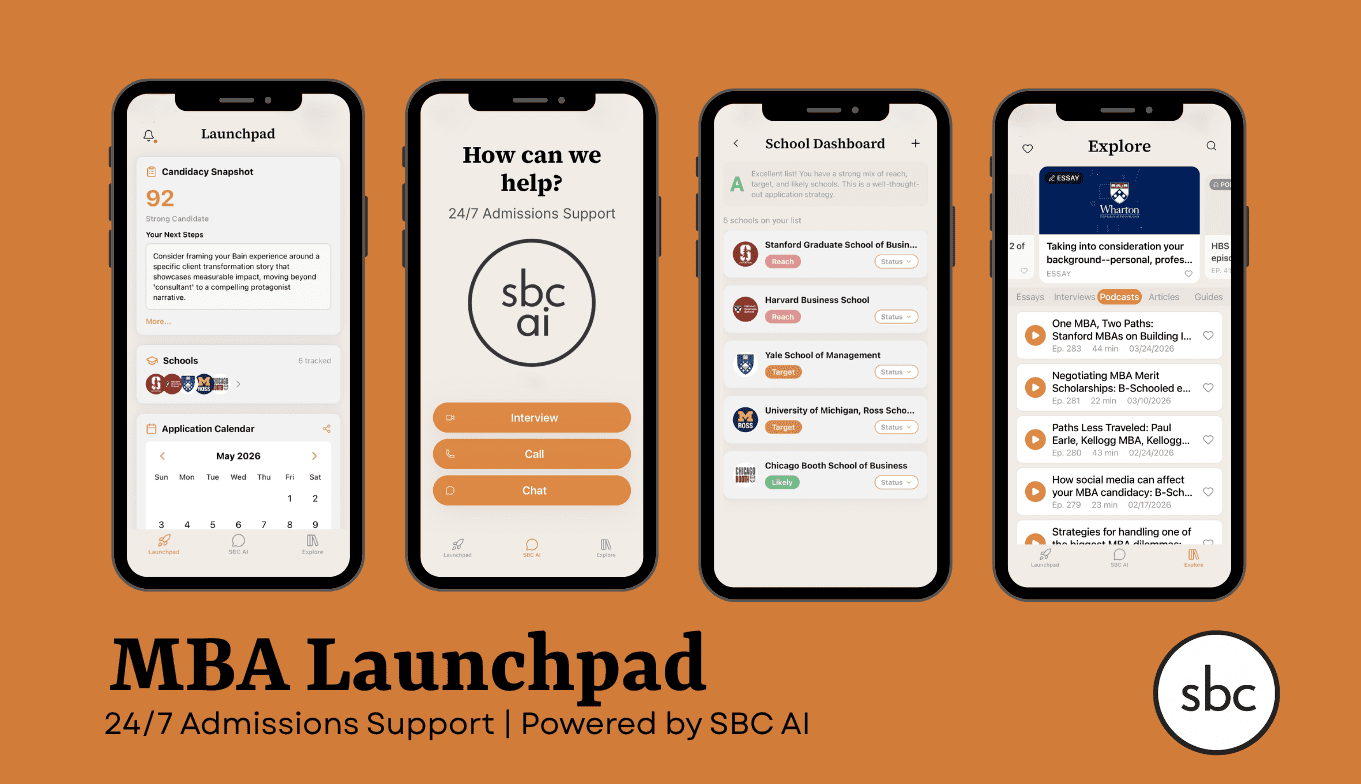
You can also get a head start with MBA Launchpad by SBC. It puts 25+ years of real SBC admissions data in your pocket, and it can assess your profile, build a balanced school list, and pressure-test your essay strategy. It’s free through August 2026. Download it and start with a clear picture of where you stand.
Here’s a snapshot of the caliber of expertise on our SBC team.












Ashley
Ashley is a former MBA Admissions Board Member for Harvard Business School (HBS), where she interviewed and evaluated thousands of business school applicants for over a six year tenure. Ashley holds an MBA from HBS. During her HBS years, Ashley was the Sports Editor for the Harbus and a member of the B-School Blades Ice Hockey Team. After HBS, she worked in Marketing at the Gillette Company on Male and Female shaving ...
×Pauline
A former associate director of admissions at Harvard Business School, Pauline served on the HBS MBA Admissions Board full-time for four years. She evaluated and interviewed HBS applicants, both on-campus and globally. Pauline's career has included sales and marketing management roles with Coca-Cola, Gillette, Procter & Gamble, and IBM. For over 10 years, Pauline has expertly guided MBA applicants, and her clients h ...
×Laura
Laura comes from the MBA Admissions Board at Harvard Business School (HBS) and is an HBS MBA alumnus. In her HBS Admissions role, she evaluated and interviewed hundreds of business school candidates, including internationals, women, military and other applicant pools, for five years. Prior to her time as a student at HBS, Laura began her career in advertising and marketing in Chicago at Leo Burnett where she worked on th ...
×Andrea
Andrea served as the Associate Director of MBA Admissions at Harvard Business School (HBS) for over five years. In this role, she provided strategic direction for student yield-management activities and also served as a full member of the admissions committee. In 2007, Andrea launched the new 2+2 Program at Harvard Business School – a program targeted at college junior applicants to Harvard Business School. Andrea has also served as a Career Coach for Harvard Business School for both cu ...
×Jennifer
Jennifer served as Admissions Officer at the Stanford (GSB) for five years. She holds an MBA from Stanford (GSB) and a B.S. in Chemical Engineering from University of Illinois Urbana-Champaign. Jennifer has over 15 years experience in guiding applicants through the increasingly competitive admissions process into top MBA programs. Having read thousands and thousands of essays and applications while at Stanford (GSB) Admiss ...
×Davina
Davina received her MBA from Stanford's Graduate School of Business (GSB), with a certificate in Public Management, and her BA in Psychology from UC Berkeley. Davina is an experienced strategic planning leader, facilitator, and business case writer who spent more than 15 years building culture, entrepreneurship, and leadership initiatives across Stanford University and the Stanford Graduate School of Business. She designed ...
×Erin K.
Erin served in key roles in MBA Admissions--as Director at Haas School of Business at UC Berkeley and Assistant Director at Stanford's Graduate School of Business (GSB). Erin served on the admissions committee at each school and has read thousands of applications in her career. At Haas, she served for seven years in roles that encompassed evaluation, outreach, and diversity and inclusion. During her tenure in Admissions at GSB, she was responsible for candidate evaluation, applicant outreach, ...
×Susie
Susie comes from the Admissions Office of the Stanford Graduate School of Business where she reviewed and evaluated hundreds of prospective students’ applications. She holds an MBA from Stanford’s GSB and a BA from Stanford in Economics. Prior to advising MBA applicants, Susie held a variety of roles over a 15-year period in capital markets, finance, and real estate, including as partner in one of the nation’s most innovative finance and real estate investment organizations. In that r ...
×Dione
Dione holds an MBA degree from Stanford Business School (GSB) and a BA degree from Stanford University, where she double majored in Economics and Communication with concentrations in journalism and sociology. Dione has served as an Admissions reader and member of the Minority Admissions Advisory Committee at Stanford. Dione is an accomplished and respected advocate and thought leader on education and diversity. She is ...
×Anthony
Anthony served as the Associate Director of MBA Admissions at the Wharton School at the University of Pennsylvania, where he dedicated over 10 years of expertise. During his time as a Wharton Admissions Officer, he read and reviewed thousands of applications and helped bring in a class of 800+ students a year. Anthony has traveled both domestically and internationally to recruit a ...
×Meghan
Meghan served as the Associate Director of Admissions and Marketing at the Wharton MBA’s Lauder Institute, a joint degree program combining the Wharton MBA with an MA in International Studies. In her role on the Wharton MBA admissions committee, Meghan advised domestic and international applicants; conducted interviews and information sessions domestically and overseas in Asia, Central and South America, and Europe; and evaluated applicants for admission to the program. Meghan also managed ...
×Amy
Amy comes from the Wharton School of the University of Pennsylvania where she was Associate Director. Amy devoted 12 years at the Wharton School, working closely with MBA students and supporting the admissions team. During her tenure at Wharton, Amy served as a trusted adviser to prospective applicants as well as admitted and matriculated students. She conducted admissions chats with applicants early in the admissions ...
×Ally
Ally brings six years of admissions experience to the SBC team, most recently as an Assistant Director of Admission for the full-time MBA program at Columbia Business School (CBS). During her time at Columbia, Ally was responsible for reviewing applications, planning recruitment events, and interviewing candidates for both the full-time MBA program and the Executive MBA program. She traveled both internationally and dome ...
×Emma
Emma comes from the MBA Admissions Office at Columbia Business School (CBS), where she was Associate Director. Emma conducted dozens of interviews each cycle for the MBA and EMBA programs, as well as coordinating the alumni ambassador interview program. She read and evaluated hundreds of applications each cycle, delivered information sessions to audiences across the globe, and advised countless waitlisted applicants. ×
Dana
Dana served as Assistant Director of Admissions at Columbia Business School for the Full-Time MBA program and has over 10 years of experience working in higher education. Known as a scrupulous file reader, Dana reviewed countless applications and assisted in rendering final decisions for the Admissions Committee at CBS. While leading information sessions at Columbia and on the road, Dana met and advised myriad applicants� ...
×Holly
Holly worked as a member of the NYU Stern MBA Admissions team for seven years and holds an MBA from NYU Stern. In her tenure as Director of NYU MBA Admissions, Holly worked closely with admissions teams from Columbia, Michigan Ross, UVA Darden, Cornell Johnson, Berkeley Haas, Yale SOM, and Duke Fuqua on recruiting events domestically and internationally. On the NYU Stern admissions committee, Holly conducted interviews, planned and hosted events, and trained staff on reading and interviewi ...
×Written by SBC Consultant Amy. Reviewed by Stacy Blackman. Learn more about our former admissions officers on the SBC admissions team page.


