Oxford MBA Application Essay Tips for 2026-2027
The Oxford MBA application centers on one supporting statement of up to 500 words, plus a separate essay for 1+1 candidates and another for reapplicants, each capped at 250 words. The admissions committee reads every response for communication skills, leadership potential, analytical ability, and fit with the Oxford community. Your job is to reveal what your CV, transcripts, and test scores can’t.
Quick Summary
- Build the supporting statement around one dimension of yourself that the rest of your application can’t show, and use the full 500 words to develop it with a clear arc and concrete detail. Exploring a single thread in depth reveals far more than listing several traits in passing.
- Read every prompt as a chance to demonstrate the four qualities Oxford names outright: communication, leadership, analytical ability, and community fit.
- For the 1+1 and reapplicant essays, specificity wins. Name the faculty, the research, and the concrete progress that prove your case.
Because the Oxford MBA application digs deeper than most, these tips will help you approach each essay with the clarity and purpose Saïd rewards. The program draws people who want to use business to address problems that matter, and it probes your professional scope, your ambitions, and the person behind them. Strong essays go beyond answering the question. They show maturity, self-knowledge, and a clear sense of why Saïd Business School fits your path.
Curious how your profile reads to a school like Oxford? Talk strategy in a free 15-minute session with an SBC Principal Consultant. Contact us to book.
What is the Oxford MBA supporting statement asking for?
This cycle the prompt reads, “Tell us something about you that would be impossible to know from the rest of your application.” Oxford sets no preferred topic or format and asks only that your response add to your application rather than repeat your CV, transcripts, or other materials. Use that word “impossible” as your filter. If an admissions reader could infer a story from the rest of your file, it doesn’t belong here.
You have up to 500 words, which is a lot of room, enough to develop a single dimension of who you are with a clear arc, or to connect two related threads that together reveal something the committee would otherwise miss. A strong version tends to open in a specific moment, trace how it shaped you, and close on what you carry forward into how you lead and work with others. Resist the pull to fill the space with a list. A focused piece that goes deep will stay with a reader far longer than a catalog of accomplishments.
Because Oxford gives you no separate optional essay, this is also the place to address a red flag (low GPA, employment gap) if you have one in a factual sentence or two with no apology, before you return to what you want to showcase.
What should you write about in your supporting statement?
Reach for a moment of self-discovery, such as the multicultural household that shaped how you adapt, the persistence you built through years of competitive sport, or the setback early in your career that taught you something you still carry. Concrete detail is what makes it land.
If you write about the summer you helped a small nonprofit digitize its operations, don’t stop at the word “volunteered.” Show what it felt like to sit beside staff who had never opened a spreadsheet, describe the patience it took to bridge that gap, and reflect on what the experience taught you about humility and leadership.

Whatever you choose, remember what Oxford reads for across all of your written work: communication skills, leadership potential, analytical ability, and fit with the Saïd community. The best supporting statements leave the reader thinking, “Here is someone with depth, someone they’d want in a study group or leading a project at Saïd.”
How should Oxford 1+1 MBA applicants approach the essay?
If you are applying under the Oxford 1+1 MBA scheme, you also need to submit the following essay:
Explain why you see this as particularly beneficial for you and how it fits with your career and personal development aims. (Maximum 250 words)
The 1+1 pairs the MBA with a partnering master’s from another Oxford department. Oxford frames it as combining specialist expertise with the leadership to apply that expertise to complex challenges in business and society. So the essay has to show intentionality. Make clear why both degrees are essential to where you’re going.
A generic dual-degree pitch, the kind that says little more than that an extra year would be valuable, won’t clear Oxford’s bar. Show that your ambitions require both a foundation in business and deeper command of a specific discipline, whether that’s public policy through the Master of Public Policy, environmental change through an MSc at the School of Geography and the Environment, or regional expertise through one of the area studies degrees.
A candidate aiming to lead impact-investment funds in developing economies might pair the MBA’s financial and managerial toolkit with the MSc in African Studies, using its regional and policy grounding to sharpen every investment decision.
What should the 1+1 essay cover?
The prompt names two aims, your career and your personal development, and most applicants answer only the first. Give the second equal attention. Spell out what the paired discipline will change in how you think, the perspective or capacity you want to build in yourself, and who the combination will help you become as a leader. Oxford is admitting a person, so show how both degrees will shape the one you’re becoming.
Prove you’ve done the research. Naming the department, faculty, or courses that drew you to the master’s signals serious engagement. Then show how each degree sharpens the other, the interdisciplinary thinking Oxford built the 1+1 around, and tie that to a long-term goal you couldn’t reach with either alone. You have only 250 words for all of this, so stay economical. Pick the one reason the pairing matters most and make it concrete. When the synergy is clear, the case for the 1+1 makes itself.
What should reapplicants write in the Oxford reapplicant essay?
Reapplicants often dread this prompt, but it’s one of the most constructive openings in the whole process. Oxford wants this essay to show resilience and growth. The strongest responses tell a clear story of how you used the intervening time to strengthen your candidacy and sharpen your goals, without dwelling on why the last application fell short.
Include quantifiable progress here, whether that’s a higher test score, a promotion, or expanded leadership responsibility. The less visible kind counts too. Maybe you took on a mentoring role, deepened your community involvement, or came to understand exactly how Oxford aligns with your long-term plans. Even growth in self-awareness or communication can strengthen the application when you frame it honestly and tie it back to what Oxford values.
Tone carries a lot of weight. A reapplicant essay works when it conveys momentum, and listing updates without a through-line falls flat. Show that you listened, reflected, and acted. You might explain that a year ago your goals were still vague, and that new work experience and conversations with Oxford alumni have since brought a sharper, more achievable vision into focus. That kind of evolution is exactly the maturity the committee hopes to see.
Across all three essays, the throughline is the same. Oxford wants clarity, authenticity, and specificity, and it wants proof that you’ll enrich the class and carry Saïd’s values into whatever you lead next.
How should you use AI in your Oxford MBA Application?
Oxford spells out an expectation in its written-work instructions. Your essays must be your own work, and they may be checked with plagiarism-detection software during the admissions process. If you quote or refer to someone else’s work, you’re asked to cite it with appropriate footnotes, which don’t count toward your word limit.
Within those bounds, AI can play a supporting role. Use it to brainstorm angles, pressure-test an outline, or tighten a long draft. What it can’t do is supply the substance. The supporting statement tests self-knowledge, and smoothed-over, AI-generated phrasing is the fastest way to sound like everyone else. The committee is reading for your voice and your judgment, so keep both firmly in your hands.
Frequently Asked Questions About Oxford MBA Essays
Can my supporting statement be about a professional accomplishment?
It can, but only if that accomplishment reveals something the rest of your application doesn’t already show. The trap is using these 500 words to restate a promotion or a project the committee can already see on your CV. A work story earns its place only when it exposes a value, a way of thinking, or a side of you that lives nowhere else in your file. If it just repeats what’s already there, choose something else.
Do I need a dramatic story to stand out at Oxford?
Depth matters more than drama here. Admissions readers remember reflection and precise, concrete observation. A small moment that shows how you think or what you value will land with a reader, so choose the story you can render in vivid detail.
Isn’t the 1+1 essay just a pitch for wanting two degrees?
Treating it that way is the most common way to underwhelm the committee. Oxford already knows the dual degree is attractive. It wants the logic that makes both degrees necessary to your goals, backed by concrete references to the master’s faculty, research, or curriculum you’re targeting. Make that case with precision, and the essay does its job.
As a reapplicant, can I reuse most of my previous application?
Leaning on last year’s materials is exactly what sinks reapplicants. The committee wants to see movement since your last attempt, so lead with what’s changed. Point to new responsibilities, stronger metrics, or a clearer vision. Frame the essay as a story of momentum, with your previous application as the baseline you’ve clearly grown past.
Oxford Saïd rewards applicants who pair intellectual rigor with a drive to make a difference. If your essays convey both the depth of your character and the clarity of your goals, you’ll stand out as someone who will enrich the class and lead well beyond it. Stacy Blackman Consulting offers everything from our comprehensive All-In Partnership to test prep and targeted task help. Contact us today for a free 15-minute advising session with a Principal SBC consultant.
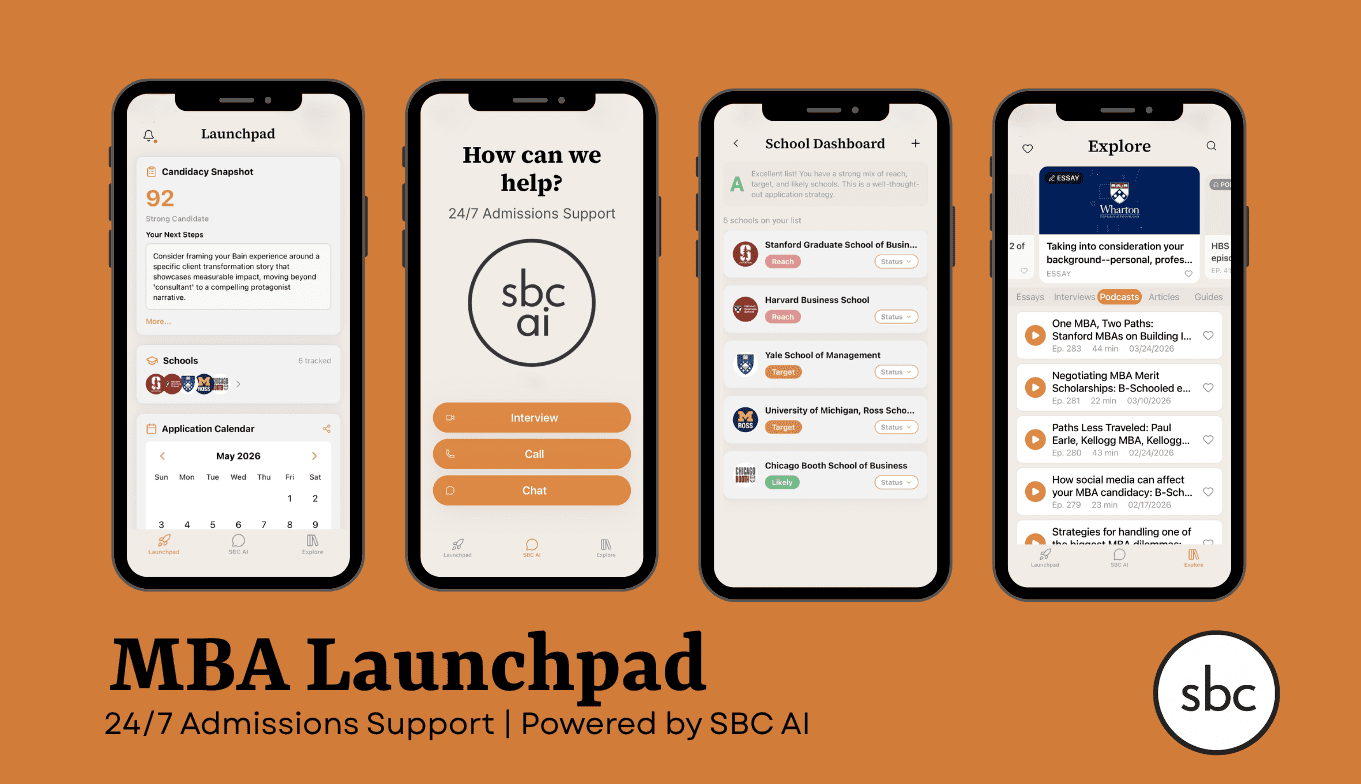
MBA Launchpad
Don’t sleep on our latest product, MBA Launchpad by SBC! It’s an AI-powered admissions assistant built on 25+ years of real SBC data, offering a data-backed read on your candidacy, school-list strategy, and essay guidance available 24/7. Premium features are currently free. Download it on the App Store or Google Play.
Here’s a snapshot of the caliber of expertise on our SBC team.



Ashley
Ashley is a former MBA Admissions Board Member for Harvard Business School (HBS), where she interviewed and evaluated thousands of business school applicants for over a six year tenure. Ashley holds an MBA from HBS. During her HBS years, Ashley was the Sports Editor for the Harbus and a member of the B-School Blades Ice Hockey Team. After HBS, she worked in Marketing at the Gillette Company on Male and Female shaving ...
×Pauline
A former associate director of admissions at Harvard Business School, Pauline served on the HBS MBA Admissions Board full-time for four years. She evaluated and interviewed HBS applicants, both on-campus and globally. Pauline's career has included sales and marketing management roles with Coca-Cola, Gillette, Procter & Gamble, and IBM. For over 10 years, Pauline has expertly guided MBA applicants, and her clients h ...
×Laura
Laura comes from the MBA Admissions Board at Harvard Business School (HBS) and is an HBS MBA alumnus. In her HBS Admissions role, she evaluated and interviewed hundreds of business school candidates, including internationals, women, military and other applicant pools, for five years. Prior to her time as a student at HBS, Laura began her career in advertising and marketing in Chicago at Leo Burnett where she worked on th ...
×Andrea
Andrea served as the Associate Director of MBA Admissions at Harvard Business School (HBS) for over five years. In this role, she provided strategic direction for student yield-management activities and also served as a full member of the admissions committee. In 2007, Andrea launched the new 2+2 Program at Harvard Business School – a program targeted at college junior applicants to Harvard Business School. Andrea has also served as a Career Coach for Harvard Business School for both cu ...
×Jennifer
Jennifer served as Admissions Officer at the Stanford (GSB) for five years. She holds an MBA from Stanford (GSB) and a B.S. in Chemical Engineering from University of Illinois Urbana-Champaign. Jennifer has over 15 years experience in guiding applicants through the increasingly competitive admissions process into top MBA programs. Having read thousands and thousands of essays and applications while at Stanford (GSB) Admiss ...
×Davina
Davina received her MBA from Stanford's Graduate School of Business (GSB), with a certificate in Public Management, and her BA in Psychology from UC Berkeley. Davina is an experienced strategic planning leader, facilitator, and business case writer who spent more than 15 years building culture, entrepreneurship, and leadership initiatives across Stanford University and the Stanford Graduate School of Business. She designed ...
×Erin K.
Erin served in key roles in MBA Admissions--as Director at Haas School of Business at UC Berkeley and Assistant Director at Stanford's Graduate School of Business (GSB). Erin served on the admissions committee at each school and has read thousands of applications in her career. At Haas, she served for seven years in roles that encompassed evaluation, outreach, and diversity and inclusion. During her tenure in Admissions at GSB, she was responsible for candidate evaluation, applicant outreach, ...
×Susie
Susie comes from the Admissions Office of the Stanford Graduate School of Business where she reviewed and evaluated hundreds of prospective students’ applications. She holds an MBA from Stanford’s GSB and a BA from Stanford in Economics. Prior to advising MBA applicants, Susie held a variety of roles over a 15-year period in capital markets, finance, and real estate, including as partner in one of the nation’s most innovative finance and real estate investment organizations. In that r ...
×Dione
Dione holds an MBA degree from Stanford Business School (GSB) and a BA degree from Stanford University, where she double majored in Economics and Communication with concentrations in journalism and sociology. Dione has served as an Admissions reader and member of the Minority Admissions Advisory Committee at Stanford. Dione is an accomplished and respected advocate and thought leader on education and diversity. She is ...
×Anthony
Anthony served as the Associate Director of MBA Admissions at the Wharton School at the University of Pennsylvania, where he dedicated over 10 years of expertise. During his time as a Wharton Admissions Officer, he read and reviewed thousands of applications and helped bring in a class of 800+ students a year. Anthony has traveled both domestically and internationally to recruit a ...
×Meghan
Meghan served as the Associate Director of Admissions and Marketing at the Wharton MBA’s Lauder Institute, a joint degree program combining the Wharton MBA with an MA in International Studies. In her role on the Wharton MBA admissions committee, Meghan advised domestic and international applicants; conducted interviews and information sessions domestically and overseas in Asia, Central and South America, and Europe; and evaluated applicants for admission to the program. Meghan also managed ...
×Amy
Amy comes from the Wharton School of the University of Pennsylvania where she was Associate Director. Amy devoted 12 years at the Wharton School, working closely with MBA students and supporting the admissions team. During her tenure at Wharton, Amy served as a trusted adviser to prospective applicants as well as admitted and matriculated students. She conducted admissions chats with applicants early in the admissions ...
×Ally
Ally brings six years of admissions experience to the SBC team, most recently as an Assistant Director of Admission for the full-time MBA program at Columbia Business School (CBS). During her time at Columbia, Ally was responsible for reviewing applications, planning recruitment events, and interviewing candidates for both the full-time MBA program and the Executive MBA program. She traveled both internationally and dome ...
×Emma
Emma comes from the MBA Admissions Office at Columbia Business School (CBS), where she was Associate Director. Emma conducted dozens of interviews each cycle for the MBA and EMBA programs, as well as coordinating the alumni ambassador interview program. She read and evaluated hundreds of applications each cycle, delivered information sessions to audiences across the globe, and advised countless waitlisted applicants. ×
Dana
Dana served as Assistant Director of Admissions at Columbia Business School for the Full-Time MBA program and has over 10 years of experience working in higher education. Known as a scrupulous file reader, Dana reviewed countless applications and assisted in rendering final decisions for the Admissions Committee at CBS. While leading information sessions at Columbia and on the road, Dana met and advised myriad applicants� ...
×Holly
Holly worked as a member of the NYU Stern MBA Admissions team for seven years and holds an MBA from NYU Stern. In her tenure as Director of NYU MBA Admissions, Holly worked closely with admissions teams from Columbia, Michigan Ross, UVA Darden, Cornell Johnson, Berkeley Haas, Yale SOM, and Duke Fuqua on recruiting events domestically and internationally. On the NYU Stern admissions committee, Holly conducted interviews, planned and hosted events, and trained staff on reading and interviewi ...
×Written by SBC Consultant Amy. Reviewed by Stacy Blackman. Learn more about our former admissions officers on the SBC admissions team page.


