Yale MBA Essay Tips and Advice for 2026-2027
The Yale School of Management keeps things refreshingly simple for the 2026-2027 admissions season: one required essay under 500 words, with three prompts to choose from. Our Yale MBA essay tips walk you through each option, the behavioral storytelling Yale rewards, and how to tie your response to the school’s mission of educating leaders for business and society.
Quick Summary
- Pick the prompt that lets you write with the most conviction. Yale has said there’s no wrong choice among the three, so let your strongest material make the decision for you.
- Yale reads for behavior. Ground the essay in what you did, decided, and changed, using concrete specifics that let the reader watch you act.
- Connect your story to impact beyond yourself. Yale’s mission centers on leaders for business and society. The strongest essays show values in action that have touched a team, an organization, or a community.
Before you draft, read the selection closely and study what Yale SOM values in a candidate. The admissions blog is a strong place to start. Yale’s admissions leaders have long cautioned against reverse-engineering the process. In a Yale SOM panel for applicants, Assistant Dean for Admissions Bruce DelMonico advised against trying to predict what the committee wants or presenting a manufactured profile, since Yale looks for many different qualities rather than a single ideal type. His bottom line for applicants was simple. “Stick to who you are.”
So, let your essay bring your personal and leadership qualities into focus, and your resume and recommendations carry the weight of your career record. The optional section is there only if some part of your application needs context.
What is the Yale SOM MBA essay question for 2026-2027?
The Yale SOM application has one required essay of no more than 500 words and three prompts to choose from. In the school’s framing, the question is designed to reveal what matters to you, whether that emerges from your background, motivations, responsibilities, ideals, challenges, or aspirations. The three-option format exists so every applicant can find an honest entry point.
All three prompts are behavioral questions, signaled by the tip-off word “describe.” Behavioral questions ask you to show how you act in real situations so the reader can anticipate how you’ll act in the future. A reliable way to structure this kind of response is the STAR framework: lay out the Situation, define the Task you needed to accomplish, walk through the Action you took, and land on the Result. Used well, STAR keeps you anchored in what you did rather than what you believe.
Curious how your profile stacks up at Yale SOM? Book a free 15-minute strategy session with an SBC Principal Consultant.
How do you choose the right Yale SOM essay prompt?
Start from substance, not strategy. Yale’s own guidance is that the most compelling essays are those that are truly important to the writer. So, let that be your filter rather than any guess about what the committee wants to hear. There is no wrong choice, only the choice that lets you show the most of yourself.
If the thing that matters most to you doesn’t surface right away, ask the people who know you well. Keep a notebook handy and jot down moments as they come to you during the day. Often, the strongest material arrives when you aren’t forcing it. When you know your subject, the prompt that fits it usually becomes obvious.

Once you’ve chosen, remember that Yale cares more about how you engage your subject than about which subject you picked. In the essay walkthrough that accompanies Yale’s application guide, Assistant Dean Laurel Grodman roots the essay in the straightforward belief that past behavior is the best available predictor of future behavior. Whichever prompt you choose, spend the bulk of your essay on your approach, your actions, and the specific behaviors you showed, not on the abstract importance of the thing itself.
Prompt 1: Describe the biggest commitment you have ever made
Yale asks why this commitment is meaningful to you and what actions you’ve taken to support it. Choose this prompt when what matters most to you is a sustained commitment to a cause, an organization, or a person.
Reflect on what commitment has meant in your life. Was it a role, a team, a value you’ve defended, or a relationship you’ve shown up for over time? Grodman notes that the commitment can run in almost any direction, personal or professional, a single specific cause or a broader ideal, and it doesn’t have to be finished. What she wants to see are the concrete steps you’ve taken in pursuit of it, even when the work is ongoing. Using STAR, name the situation and what you needed to accomplish, then get specific about what you did, what you said, and how you felt about the outcome. The commitment should be substantial enough to reveal who you are and what drives you.
Solo commitments can work here, since many applicants are individual contributors. Even so, showing how you operate alongside other people, as a leader and as a teammate, usually reads stronger than a story you carried entirely on your own. Leadership and commitment tend to travel together, and the strongest commitment essays show you holding the line in a way that lifted an organization, a team, or the people around you.
Keep Yale’s mission in view as you write, but resist quoting it back to the committee. Naming “leaders for business and society” in your essay proves nothing on its own. Whether your commitment is individual or shared, show that it made a positive difference to a community broader than yourself. Then, let your fit with the mission come through in what you did rather than what you declared.

Prompt 2: Describe the community that has been most meaningful to you.
This prompt asks two things at once: the most valuable thing you’ve gained from a community, and the most important thing you’ve contributed to it. Choose it when a group or community, rather than a single commitment or crisis, has shaped you most.
Begin by defining the community and how you came to belong to it. It might be where you grew up, a group formed around a shared identity or interest, or a professional or volunteer organization. A clear picture of the community and your role in it gives the reader the context to understand everything that follows.
A workable structure is to spend the first third of the essay establishing the community and your involvement, the middle third on what you gained (reaching past surface benefits like networking toward something that changed how you think or lead), and the final third on what you gave back. If your most meaningful community is one you left years ago, connect it to the present by showing how it continues to shape you.
The strongest versions of this essay capture a moment of real growth or a turning point in your character, and they make the exchange between you and the community feel mutual.
Grodman’s one caution on this prompt is to keep yourself in the story. It’s easy to describe a community in the abstract and quietly disappear from your own essay. Be sure to anchor every section in your specific role, what you drew from the community, and what you contributed to it.
Prompt 3: Describe the most significant challenge you have faced.
Yale asks how you confronted the challenge and how it shaped you. The two words carrying the most weight are “most significant.” This isn’t the place for any old hurdle you’ve cleared. It should be one that genuinely changed you.
Think about a time you rose to something hard and stepped into a leadership role, even an informal one. Real challenges come with uncertainty, and you were probably confused, discouraged, or frustrated along the way. That’s normal and worth showing. The common misstep is spending most of the essay establishing how difficult the situation was.
Yale asks how you confronted the challenge, so keep the setup brief and give the bulk of your words to what you did in response and how it changed you. STAR keeps this concrete by moving from the situation to the task you faced, the specific action you took, and the result, with enough texture so the reader sees what you thought, felt, and did.
Growth is the point, and the outcome doesn’t have to be a clean victory. Grodman says that Yale worded this prompt deliberately so it “wasn’t necessarily some victory story.” The challenge can be one you’re still working through, or even one that will persist, as long as you show what you did in response and how it shaped you. If things didn’t land the way you hoped, that’s fine, especially when you can show what you learned and applied later. Sincerity beats polish here.
Yale’s institutional voice reinforces why this framing works. Former dean Edward A. Snyder once described the school as persistent and disciplined in connecting to big issues, integrating with Yale, and working across sectors, with success depending on alignment and superior teamwork. An essay that shows you meeting a challenge through exactly those instincts speaks Yale’s language.
How should you approach the Yale SOM optional essay?
The optional information section is exactly that, optional, and Yale caps it at 200 words. It isn’t a second required essay, and if nothing in your application needs explaining, leave it blank. In most cases, the rest of your materials tell Yale what it needs to know.
Use it only when the committee would genuinely benefit from a brief explanation of something material to your candidacy that has no other home in the application. That might be context on your academic record, a promotion or recognition that doesn’t appear elsewhere, or a concrete step you’ve taken to strengthen a weaker part of your profile. Note that gaps in work experience and your choice of recommender belong in the dedicated prompts within the Work Experience section, not here, and additional context on your Background Information belongs in that section’s Supplemental Detail area.
If you do write it, keep it factual and focused. Don’t make excuses for perceived weaknesses. Address them head-on with concrete evidence of what you’ve done about them.
How should you use AI in your Yale SOM MBA essays?
Yale SOM addresses AI directly through a Statement on AI in its application, and the school’s position maps cleanly onto how you should approach this essay. Yale asks that any AI use support rather than compromise the authenticity and originality of your submission. The comparison the admissions office draws is useful. Treat AI the way you’d treat a friend or colleague you ask to brainstorm topics, organize your thinking, react to a draft, or tidy up grammar and clarity. What you can’t do is hand off the writing itself.
That distinction matters most for these particular prompts. Just as you couldn’t ask another person to write your essay, AI shouldn’t generate the substance of your response or stand in for the judgment and self-reflection Yale is asking you to demonstrate. Your own voice and ideas belong at the forefront. A behavioral essay lives or dies on specific, personal detail, the one decision or conversation only you could recount. An essay with no fingerprints on it works against you with a committee reading for a real person.
Yale extends the same thinking to the spoken parts of the application, and there it draws a harder line. Don’t use AI to script your video questions or interview. Those moments are built to be spontaneous, and reading from a script keeps the committee from seeing how you actually communicate. As Yale puts it, a genuinely delivered answer, even an imperfectly worded one, tells the AdCom more than a rehearsed one, and it won’t harm your candidacy.
Fittingly, Yale notes that its own AI statement was drafted with AI and then heavily reworked by its admissions team. That’s a fair model for how the tool should factor into your essay. Useful for structure and a second opinion, finished in your own hand.
Frequently Asked Questions About Yale MBA Essays
Should you write about something personal or keep it professional?
Lean toward the personal, or at least give it serious thought before defaulting to work. Grodman’s advice is to explore a non-professional topic, since your resume, recommendations, and short-answer responses already showcase your professional side to the committee. A personal subject often surfaces something nothing else in the file can. Work stories aren’t off the table, especially when they reveal something that doesn’t come through elsewhere, but as DelMonico notes, it’s still a business school application; use judgment about how far into the personal you go.
How do you choose among the three prompts?
Start from your life’s material, not the menu. Pin down the single most meaningful thing you want the committee to understand about you, then pick the prompt—commitment, community, or challenge—that lets you tell that story most fully. Yale doesn’t favor any option, and there’s no wrong choice, so the only real deciding factor is fit.
What if you don’t have one dramatic commitment or challenge to write about?
You don’t need a dramatic one. Yale reads these essays for how you think and act, not for the scale of the story. Therefore, a quietly sustained commitment or an ordinary challenge handled with honest self-awareness lands better than a headline event told at a distance. Choose the subject you can write about with the most specificity.
Stacy Blackman Consulting’s team includes consultants from every top program, including Yale SOM. We offer a full range of services to meet your MBA application needs, from our comprehensive All-In Partnership to test preparation and targeted task help. Contact us today for a free 15-minute advising session to talk strategy with a Principal SBC consultant.
MBA Launchpad
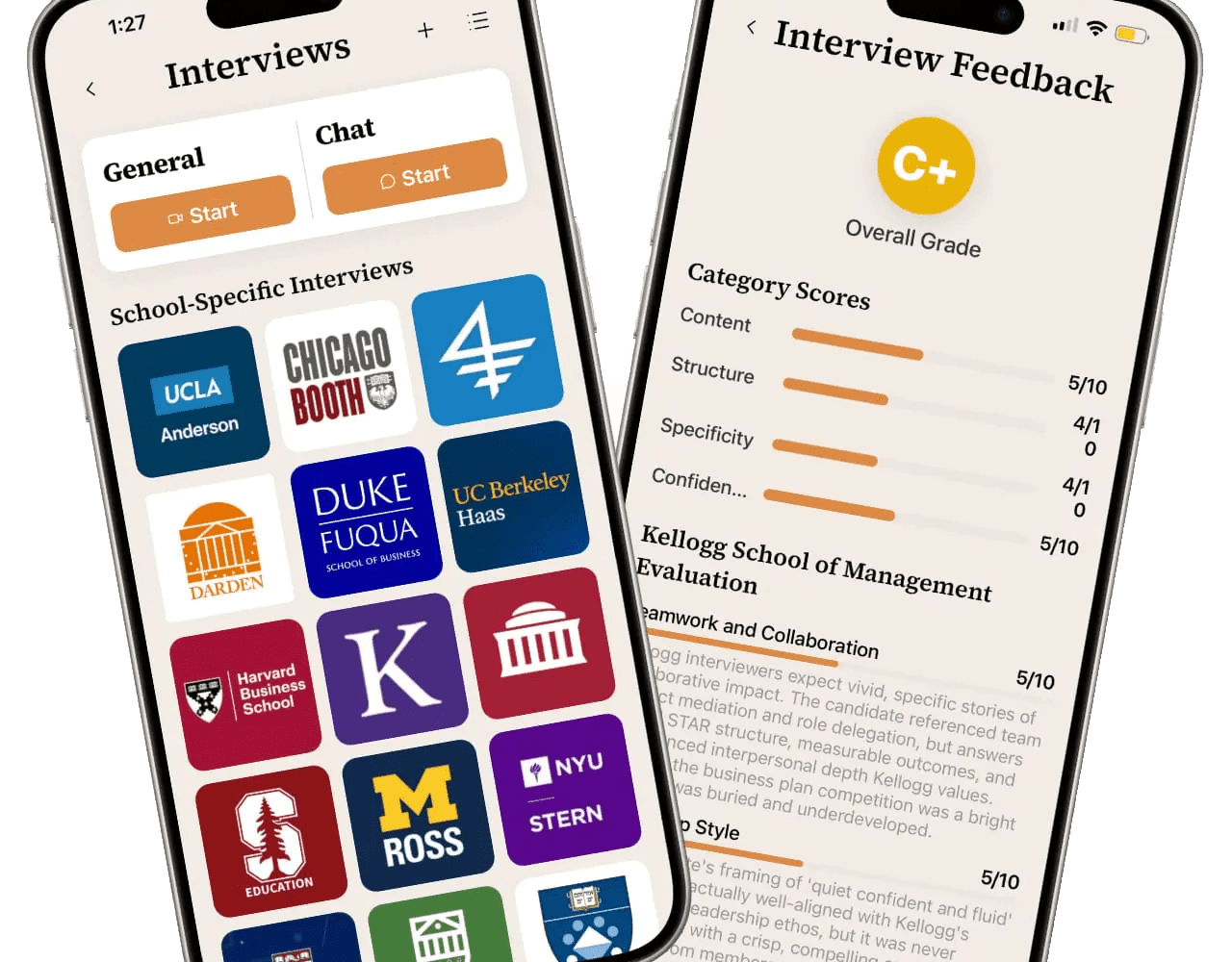
Don’t sleep on our latest product, MBA Launchpad by SBC! It’s an AI-powered admissions assistant built on more than 25 years of real SBC admissions data, offering a candidacy assessment, school list strategy, and essay guidance available 24/7. Download it on the App Store or Google Play.
Here’s a snapshot of the caliber of expertise on our SBC team.






Ashley
Ashley is a former MBA Admissions Board Member for Harvard Business School (HBS), where she interviewed and evaluated thousands of business school applicants for over a six year tenure. Ashley holds an MBA from HBS. During her HBS years, Ashley was the Sports Editor for the Harbus and a member of the B-School Blades Ice Hockey Team. After HBS, she worked in Marketing at the Gillette Company on Male and Female shaving ...
×Pauline
A former associate director of admissions at Harvard Business School, Pauline served on the HBS MBA Admissions Board full-time for four years. She evaluated and interviewed HBS applicants, both on-campus and globally. Pauline's career has included sales and marketing management roles with Coca-Cola, Gillette, Procter & Gamble, and IBM. For over 10 years, Pauline has expertly guided MBA applicants, and her clients h ...
×Laura
Laura comes from the MBA Admissions Board at Harvard Business School (HBS) and is an HBS MBA alumnus. In her HBS Admissions role, she evaluated and interviewed hundreds of business school candidates, including internationals, women, military and other applicant pools, for five years. Prior to her time as a student at HBS, Laura began her career in advertising and marketing in Chicago at Leo Burnett where she worked on th ...
×Andrea
Andrea served as the Associate Director of MBA Admissions at Harvard Business School (HBS) for over five years. In this role, she provided strategic direction for student yield-management activities and also served as a full member of the admissions committee. In 2007, Andrea launched the new 2+2 Program at Harvard Business School – a program targeted at college junior applicants to Harvard Business School. Andrea has also served as a Career Coach for Harvard Business School for both cu ...
×Jennifer
Jennifer served as Admissions Officer at the Stanford (GSB) for five years. She holds an MBA from Stanford (GSB) and a B.S. in Chemical Engineering from University of Illinois Urbana-Champaign. Jennifer has over 15 years experience in guiding applicants through the increasingly competitive admissions process into top MBA programs. Having read thousands and thousands of essays and applications while at Stanford (GSB) Admiss ...
×Davina
Davina received her MBA from Stanford's Graduate School of Business (GSB), with a certificate in Public Management, and her BA in Psychology from UC Berkeley. Davina is an experienced strategic planning leader, facilitator, and business case writer who spent more than 15 years building culture, entrepreneurship, and leadership initiatives across Stanford University and the Stanford Graduate School of Business. She designed ...
×Erin K.
Erin served in key roles in MBA Admissions--as Director at Haas School of Business at UC Berkeley and Assistant Director at Stanford's Graduate School of Business (GSB). Erin served on the admissions committee at each school and has read thousands of applications in her career. At Haas, she served for seven years in roles that encompassed evaluation, outreach, and diversity and inclusion. During her tenure in Admissions at GSB, she was responsible for candidate evaluation, applicant outreach, ...
×Susie
Susie comes from the Admissions Office of the Stanford Graduate School of Business where she reviewed and evaluated hundreds of prospective students’ applications. She holds an MBA from Stanford’s GSB and a BA from Stanford in Economics. Prior to advising MBA applicants, Susie held a variety of roles over a 15-year period in capital markets, finance, and real estate, including as partner in one of the nation’s most innovative finance and real estate investment organizations. In that r ...
×Dione
Dione holds an MBA degree from Stanford Business School (GSB) and a BA degree from Stanford University, where she double majored in Economics and Communication with concentrations in journalism and sociology. Dione has served as an Admissions reader and member of the Minority Admissions Advisory Committee at Stanford. Dione is an accomplished and respected advocate and thought leader on education and diversity. She is ...
×Anthony
Anthony served as the Associate Director of MBA Admissions at the Wharton School at the University of Pennsylvania, where he dedicated over 10 years of expertise. During his time as a Wharton Admissions Officer, he read and reviewed thousands of applications and helped bring in a class of 800+ students a year. Anthony has traveled both domestically and internationally to recruit a ...
×Meghan
Meghan served as the Associate Director of Admissions and Marketing at the Wharton MBA’s Lauder Institute, a joint degree program combining the Wharton MBA with an MA in International Studies. In her role on the Wharton MBA admissions committee, Meghan advised domestic and international applicants; conducted interviews and information sessions domestically and overseas in Asia, Central and South America, and Europe; and evaluated applicants for admission to the program. Meghan also managed ...
×Amy
Amy comes from the Wharton School of the University of Pennsylvania where she was Associate Director. Amy devoted 12 years at the Wharton School, working closely with MBA students and supporting the admissions team. During her tenure at Wharton, Amy served as a trusted adviser to prospective applicants as well as admitted and matriculated students. She conducted admissions chats with applicants early in the admissions ...
×Ally
Ally brings six years of admissions experience to the SBC team, most recently as an Assistant Director of Admission for the full-time MBA program at Columbia Business School (CBS). During her time at Columbia, Ally was responsible for reviewing applications, planning recruitment events, and interviewing candidates for both the full-time MBA program and the Executive MBA program. She traveled both internationally and dome ...
×Emma
Emma comes from the MBA Admissions Office at Columbia Business School (CBS), where she was Associate Director. Emma conducted dozens of interviews each cycle for the MBA and EMBA programs, as well as coordinating the alumni ambassador interview program. She read and evaluated hundreds of applications each cycle, delivered information sessions to audiences across the globe, and advised countless waitlisted applicants. ×
Dana
Dana served as Assistant Director of Admissions at Columbia Business School for the Full-Time MBA program and has over 10 years of experience working in higher education. Known as a scrupulous file reader, Dana reviewed countless applications and assisted in rendering final decisions for the Admissions Committee at CBS. While leading information sessions at Columbia and on the road, Dana met and advised myriad applicants� ...
×Holly
Holly worked as a member of the NYU Stern MBA Admissions team for seven years and holds an MBA from NYU Stern. In her tenure as Director of NYU MBA Admissions, Holly worked closely with admissions teams from Columbia, Michigan Ross, UVA Darden, Cornell Johnson, Berkeley Haas, Yale SOM, and Duke Fuqua on recruiting events domestically and internationally. On the NYU Stern admissions committee, Holly conducted interviews, planned and hosted events, and trained staff on reading and interviewi ...
×Written by SBC Consultant Amy. Reviewed by Stacy Blackman. Learn more about our former admissions officers on the SBC admissions team page.