NYU Stern Essays and Tips for 2026-2027
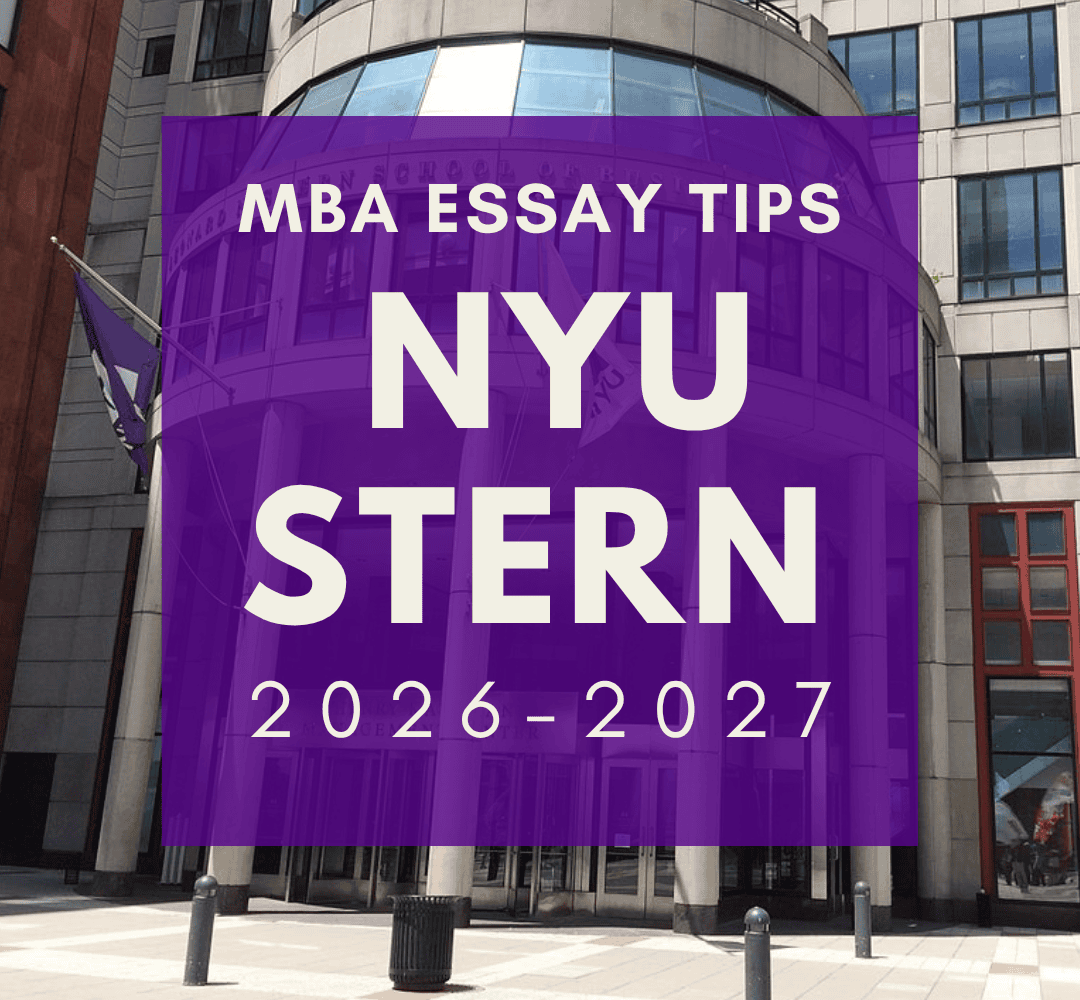
The NYU Stern School of Business has two required essays and one optional essay for the 2026-2027 admissions season. A 500-word career goals essay now asks why Stern specifically; the Pick Six remains a six-image visual introduction; and an optional 500-word essay handles context. Together, the NYU Stern essays test the school’s IQ+EQ standard from two different directions.
Quick Summary
- Stern evaluates IQ+EQ across the whole application, so spread the evidence rather than loading it into one place. Let the goals essay carry your rigor and let the Pick Six carry the person behind it.
- The longer Essay 1 isn’t an invitation to say more about your goals. Rather, it’s an opportunity to prove you’ve researched Stern with a level of specificity that a generic “why MBA” answer can’t fake.
- The Pick Six now asks explicitly for what sits beyond your resume. Six polished professional images miss the assignment.
What are the NYU Stern essays for 2026-2027?
Stern’s essay requirements for the Class of 2029 include one required written essay, one required visual essay, and one optional essay:
- Essay 1: Professional Aspirations (500-word maximum, double-spaced, 12-point font). What are your short-term career goals? Why is the Stern MBA the necessary next chapter in your professional story? Please be specific.
- Essay 2: Personal Expression, also known as the “Pick Six.” Introduce yourself to the Admissions Committee and to your future classmates using six images and corresponding captions, uploaded as a single PDF.
- Essay 3: Additional Information (optional, 500-word maximum).
Stern’s admissions site says the committee looks for “students who best exemplify Stern’s core value: IQ+EQ” and evaluates candidates across three dimensions: academic profile, professional achievements and aspirations, and alignment with Stern’s core values. The essays are where the second and third dimensions live.
Not sure how your profile stacks up at Stern? Book a free 15-minute chat with an SBC Principal Consultant.
What changed in the NYU Stern essays this year?
Three things, and the first two matter a great deal for how you plan your writing time.
The “Change: ___ it” essay is gone. Stern has retired the fill-in-the-blank branding prompt that ran in the last few cycles. If you started drafting from last year’s questions, that work doesn’t carry over.
The career goals essay tripled in length and changed its question. Last year Stern asked only what your short-term goals were, in 150 words, and pointedly skipped the “why an MBA” question. This year you get 500 words and an explicit demand to explain why Stern is the necessary next chapter. That’s a different essay, not a longer version of the old one.
The Pick Six instructions were rewritten. The mechanics are the same, but the framing tightened. Stern now says the exercise is about the qualities you’ll bring to the community beyond your professional and academic achievements, and it names what the images should illustrate: interests, values, motivations, perspective, and personality. Collages are now an acceptable format.
Our read at SBC is that the net effect concentrates your professional case in one place and clears the rest of the application for everything else. That’s a cleaner design, and it’s less forgiving of applicants who try to run the same material through both essays.
How should you answer Stern’s professional aspirations essay?
Treat “necessary” as the operative word. Stern isn’t asking whether an MBA would be nice to have. It’s asking you to show a gap between where your career can go on its current trajectory and where you want it to go, then to demonstrate that Stern closes it.
How should you structure 500 words?
A workable split gives roughly a third to your trajectory, a third to the goal itself, and a third to Stern. Resist the urge to spend 250 words on backstory. Your resume already covers what you’ve done, so the essay only needs enough of your history to make the next step legible.
The phrase “professional story” invites an arc. Something built a set of skills, something revealed a gap or an ambition, and the MBA is the bridge. That structure carries a reader efficiently, which matters when you’re working against a word cap.
How specific do your goals need to be?
Stern ends the prompt with two words of instruction: please be specific. Take them literally. Name the function, the industry, and where you can, two or three target employers. “Product management at a consumer fintech, with Ramp and Chime as targets” tells an admissions reader far more than “a leadership role in technology.”
Specificity isn’t a commitment device. Nobody will hold you to the companies you list. However, it is evidence that you’ve done the work of understanding the path, which is exactly what the committee is measuring.
How do you make the Stern portion specific?
This is where most drafts thin out. Naming New York City isn’t a differentiator, so go a layer deeper and connect specific offerings to the gap you’ve defined. Stern’s specializations run past two dozen, including a new AI specialization announced in early 2026, and the experiential learning and global programs each open different doors. Pick the two or three that map to your goal and say what you’d do with them.
One efficient test before you submit: if you swapped “Stern” for another school’s name and the paragraph still worked, it isn’t specific enough yet.

How do you approach the NYU Stern Pick Six essay?
The Pick Six is the most recognizable element of the Stern application, and the one applicants most often overthink. Six images, six one-sentence captions, and a brief introduction of no more than three sentences, all delivered as a single PDF.
What is Stern actually asking for?
Read the revised instructions closely. Stern wants the qualities you’ll bring to the community beyond your professional and academic achievements, and it lists five things the images should illustrate: interests, values, motivations, perspective, and personality.
That “beyond” clause changes the calculation from last cycle. You don’t need to prove your professional readiness here, because Essay 1 and your resume already do that. A professional image can still earn a slot, but only if it reveals something about how you think or what you care about rather than what you accomplished.
How do you choose the six images?
Start with the qualities, not the photos. List the six things you’d want a classmate to know about you after a long dinner, then go looking for images that carry them. Working in that order prevents the common failure mode: picking six pictures you happen to like and reverse-engineering meaning onto them.
Use Stern’s five-word list as a coverage check when you’re done. You don’t need one image per category, but if all six land on “interests” and none touch values or perspective, you’ve built a hobby slideshow.
A few things to avoid:
- Landmark photos that could belong to any tourist
- Awards, diplomas, and logos, unless the image shows something about your motivation rather than your credential
- Group shots where a reader can’t tell which person is you
- Any image that needs a paragraph of explanation to land, since you only get one sentence
How should you write the captions?
Each caption gets one sentence, so spend it on why the image matters rather than on what it depicts. A reader can see that you’re standing in a kitchen. What they can’t see is that you cook your grandmother’s recipes every Sunday because it’s the only way you know to keep a language you never learned.
Captions are also the one place in the Stern application where a light touch of humor works, provided it sounds like you.
Does the design quality matter?
Less than applicants fear. Stern accepts photos, infographics, drawings, and collages, which signals that curation matters more than production values. A thoughtfully chosen set of ordinary photos beats a beautifully designed deck of generic ones every time.
Before you finalize, hand the PDF to someone who knows you well and ask what six words they’d take away. If their list doesn’t resemble the one you started with, revise until it does.
Should you write the NYU Stern optional essay?
Stern widened this prompt for 2026-2027. It now invites you to give context to your application and to surface important aspects of yourself not otherwise apparent, including hardships you’ve encountered, alongside the familiar list of employment gaps, academic questions, and test plans.
The wider aperture doesn’t make the essay mandatory. If your application is coherent and nothing in it would prompt a question, skip it. Admissions readers are working through thousands of files, and a 500-word essay that clarifies nothing costs you goodwill.
Two situations warrant using it. The first is the classic one, where something in your record needs context: a weak semester, a gap between roles, a score you plan to retake. Explain the circumstance briefly, then spend most of your words on evidence that the concern no longer applies. Self-awareness plus a plan reads as maturity. Excuses don’t.
The second is newer. If a hardship or a circumstance genuinely shaped your path and has nowhere else to live in the application, Stern has now told you it belongs here. Name the situation plainly, keep the emphasis on what you did in response, and resist any impulse to perform difficulty.
What still doesn’t belong is a bonus leadership story. If the material would fit comfortably in Essay 1 or the Pick Six, put it there instead.

What should reapplicants write?
Stern now addresses reapplicants directly in the prompt, asking you to use the optional essay to highlight what has changed since your last application. Lead with the concrete deltas: a promotion, a higher test score, a completed quant class, a sharpened and better-researched goal. Then show, briefly, that you understand why the earlier application fell short. Stern’s re-applicants page covers the process details, including the waived application fee.
What is the EQ Endorsement, and who should write it?
Stern calls its recommendations EQ Endorsements, which tells you what they’re weighted toward. One is required and a second is optional.
Note the requirement carefully, because it’s stricter than a standard recommendation ask. The required endorsement must come from your current supervisor. If that isn’t possible, you’ll need to explain why in the application itself, so plan for that conversation early rather than treating it as a footnote.
Whoever writes it, brief them well. Stern’s questions probe self-awareness, empathy, communication, and self-management, and those qualities are hard to evidence in the abstract. Give your endorser two or three specific moments they witnessed: the time you took hard feedback and changed course, the time you defused a conflict on the team, the time you told a client something they didn’t want to hear. Stories beat adjectives.
How should you use AI in your NYU Stern MBA essays?
Stern doesn’t publish a separate generative AI clause in its essay instructions, which sets it apart from schools that require a disclosure statement or a citation format. What it does have is the attestation you sign when you submit. Stern’s admissions policies require you to certify that everything you’ve submitted is the product of your own work, honestly represented, and the school reserves the right to revoke admission if that certification proves false.
SBC’s read is that the absence of a disclosure box makes the line stricter rather than looser. There’s no mechanism here for declaring partial AI authorship, so the safe interpretation is that the writing needs to be yours.
That leaves plenty of legitimate uses. AI is a reasonable thinking partner for mapping your career arc, stress-testing whether your goals hold together, or asking what a skeptical reader would push back on. It’s also useful for the unglamorous work of getting a 700-word draft down to 500.
Two cautions specific to this application. First, the “why Stern” material is exactly the kind of content AI hallucinates, inventing course names and program details that don’t exist. Verify anything you name against Stern’s own site. Second, the Pick Six resists automation by design. Generated images would defeat the entire purpose of an exercise built to show the committee who you actually are.
Frequently Asked Questions About NYU Stern MBA Essays
Stern dropped the “Change: ___ it” essay. Where do those qualities belong now?
Mostly in the Pick Six, with the EQ Endorsement as a second channel. The prompt is gone, but the trait it measured isn’t. Adaptability and self-management sit at the center of Stern’s IQ+EQ standard, and they’re written directly into the endorsement questions. Stern still wants to know how you handle change.
The Pick Six is the natural home. Its revised instructions ask for values, motivations, and perspective, all of which a change story delivers. One image can carry a pivot: the city you moved to alone, the thing you rebuilt after it broke, the work you took up when the old path closed. That’s the same material the retired prompt was fishing for, delivered in a form that doesn’t announce itself.
Your EQ Endorsement is the second channel, and applicants underuse it. Brief your endorser on a specific moment when you took hard feedback and changed course, or when you steadied a team through a shift nobody planned for. The optional essay can work too, though only if the change is a genuine anomaly that needs explaining. What doesn’t work is forcing this into Essay 1, which has 500 words and a different job to do.
Can you reuse your Pick Six from a previous application?
You can, but reapplicants generally shouldn’t submit it unchanged. The point of a reapplication is to show growth, and a refreshed Pick Six that reflects the past year is an easy way to demonstrate it.
Should you submit a second EQ Endorsement even though only one is required?
Only when the second endorser can show the committee something the first can’t. A second voice from the same office, describing the same projects in the same register, adds length without adding information.
The endorsements that earn their place come from a different context entirely: a former manager at another company, a nonprofit board chair, a client who worked with you across the table rather than beside you. Those readers have seen your emotional intelligence under conditions your current supervisor never observed, which is the whole point of the exercise.
Seniority and name recognition don’t substitute for proximity. An endorsement from someone impressive who barely knows you reads as a networking exercise, and admissions committees have seen enough of them to spot it immediately.
For Essay 1, should you also write about your long-term career vision?
Stern asks for short-term goals and nothing else, so the immediate role is the assignment. Answer it directly and in detail. The long term belongs in this essay only where it explains the short term, and a sentence or two of direction is usually enough to do that work.
What that sentence buys you is context. It turns a first job into a deliberate step rather than a landing spot. A full paragraph of fifteen-year vision buys you nothing, and if you’ve drafted applications for schools that ask about long-term goals, resist the urge to paste that material in here. Those essays exist because those schools asked, and Stern didn’t.
There’s a practical reason the prompt is built this way. An admissions reader can assess whether you’ll plausibly land the role you named next year, given your background and Stern’s recruiting pipelines. Nobody can assess where you’ll be in 2045. Near-term specificity is testable, which is exactly why Stern ends the prompt by asking for it.
Getting your NYU Stern application right
Stern’s essays reward applicants who treat the two required pieces as complementary rather than redundant. The goals essay proves you’ve thought rigorously about your future. The Pick Six proves there’s a person worth having in the room while you build it. Applicants who nail one and coast on the other tend to land in the middle of the pile.
Ready to build a Stern application that works on both fronts? Contact us for a free 15-minute advising session with an SBC Principal Consultant, and learn how our team of former admissions officers can help you tell your story.
MBA Launchpad
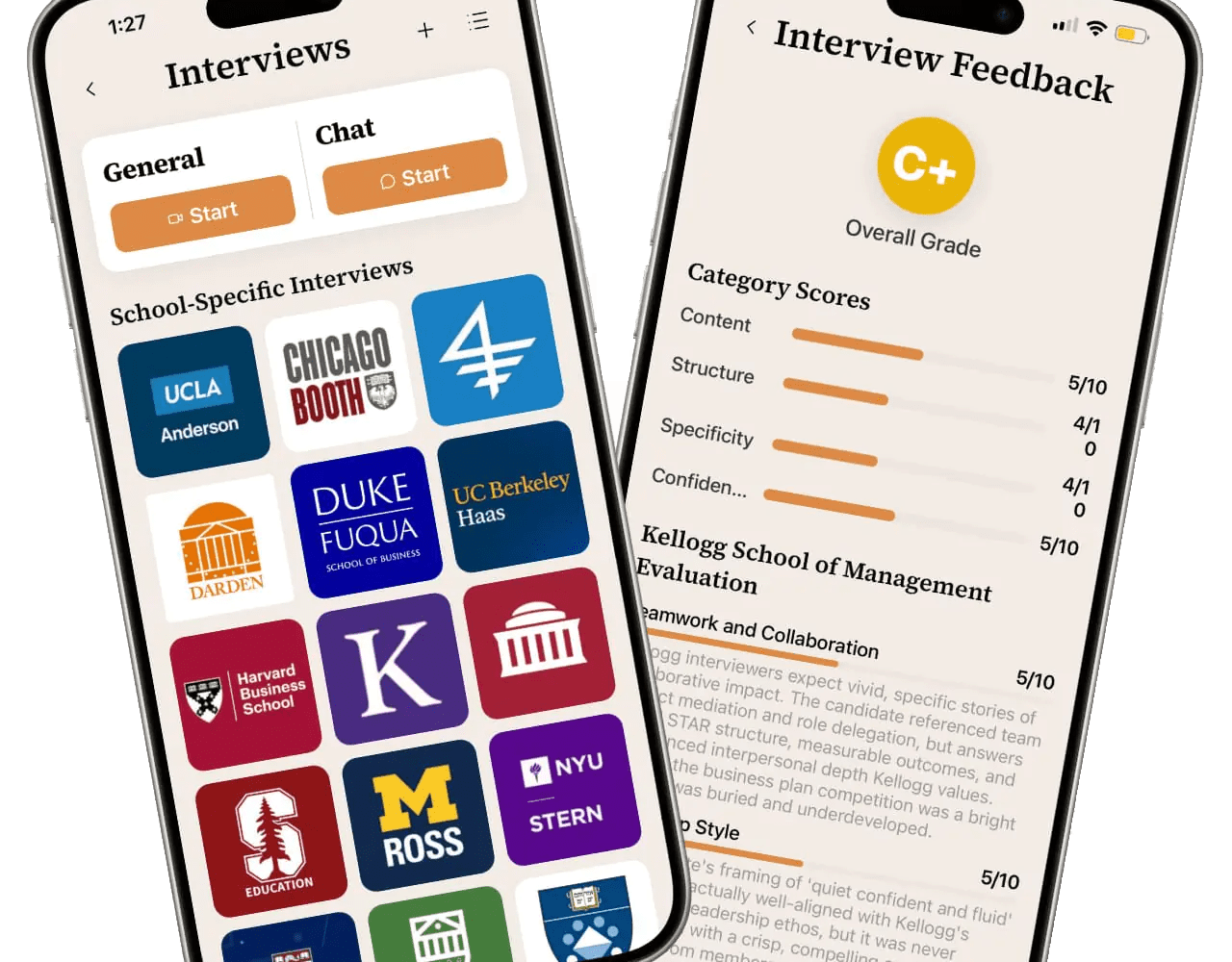
Don’t sleep on our latest product, MBA Launchpad by SBC. It’s your AI-powered admissions assistant, built on 25+ years of real SBC data. Candidacy assessment, school list strategy, essay guidance, and more are available 24/7 in your pocket. Download now on the App Store and Google Play.
Here’s a snapshot of the caliber of expertise on our SBC team.














Ashley
Ashley is a former MBA Admissions Board Member for Harvard Business School (HBS), where she interviewed and evaluated thousands of business school applicants for over a six year tenure. Ashley holds an MBA from HBS. During her HBS years, Ashley was the Sports Editor for the Harbus and a member of the B-School Blades Ice Hockey Team. After HBS, she worked in Marketing at the Gillette Company on Male and Female shaving ...
×Pauline
A former associate director of admissions at Harvard Business School, Pauline served on the HBS MBA Admissions Board full-time for four years. She evaluated and interviewed HBS applicants, both on-campus and globally. Pauline's career has included sales and marketing management roles with Coca-Cola, Gillette, Procter & Gamble, and IBM. For over 10 years, Pauline has expertly guided MBA applicants, and her clients h ...
×Laura
Laura comes from the MBA Admissions Board at Harvard Business School (HBS) and is an HBS MBA alumnus. In her HBS Admissions role, she evaluated and interviewed hundreds of business school candidates, including internationals, women, military and other applicant pools, for five years. Prior to her time as a student at HBS, Laura began her career in advertising and marketing in Chicago at Leo Burnett where she worked on th ...
×Andrea
Andrea served as the Associate Director of MBA Admissions at Harvard Business School (HBS) for over five years. In this role, she provided strategic direction for student yield-management activities and also served as a full member of the admissions committee. In 2007, Andrea launched the new 2+2 Program at Harvard Business School – a program targeted at college junior applicants to Harvard Business School. Andrea has also served as a Career Coach for Harvard Business School for both cu ...
×Jennifer
Jennifer served as Admissions Officer at the Stanford (GSB) for five years. She holds an MBA from Stanford (GSB) and a B.S. in Chemical Engineering from University of Illinois Urbana-Champaign. Jennifer has over 15 years experience in guiding applicants through the increasingly competitive admissions process into top MBA programs. Having read thousands and thousands of essays and applications while at Stanford (GSB) Admiss ...
×Davina
Davina received her MBA from Stanford's Graduate School of Business (GSB), with a certificate in Public Management, and her BA in Psychology from UC Berkeley. Davina is an experienced strategic planning leader, facilitator, and business case writer who spent more than 15 years building culture, entrepreneurship, and leadership initiatives across Stanford University and the Stanford Graduate School of Business. She designed ...
×Erin K.
Erin served in key roles in MBA Admissions--as Director at Haas School of Business at UC Berkeley and Assistant Director at Stanford's Graduate School of Business (GSB). Erin served on the admissions committee at each school and has read thousands of applications in her career. At Haas, she served for seven years in roles that encompassed evaluation, outreach, and diversity and inclusion. During her tenure in Admissions at GSB, she was responsible for candidate evaluation, applicant outreach, ...
×Susie
Susie comes from the Admissions Office of the Stanford Graduate School of Business where she reviewed and evaluated hundreds of prospective students’ applications. She holds an MBA from Stanford’s GSB and a BA from Stanford in Economics. Prior to advising MBA applicants, Susie held a variety of roles over a 15-year period in capital markets, finance, and real estate, including as partner in one of the nation’s most innovative finance and real estate investment organizations. In that r ...
×Dione
Dione holds an MBA degree from Stanford Business School (GSB) and a BA degree from Stanford University, where she double majored in Economics and Communication with concentrations in journalism and sociology. Dione has served as an Admissions reader and member of the Minority Admissions Advisory Committee at Stanford. Dione is an accomplished and respected advocate and thought leader on education and diversity. She is ...
×Anthony
Anthony served as the Associate Director of MBA Admissions at the Wharton School at the University of Pennsylvania, where he dedicated over 10 years of expertise. During his time as a Wharton Admissions Officer, he read and reviewed thousands of applications and helped bring in a class of 800+ students a year. Anthony has traveled both domestically and internationally to recruit a ...
×Meghan
Meghan served as the Associate Director of Admissions and Marketing at the Wharton MBA’s Lauder Institute, a joint degree program combining the Wharton MBA with an MA in International Studies. In her role on the Wharton MBA admissions committee, Meghan advised domestic and international applicants; conducted interviews and information sessions domestically and overseas in Asia, Central and South America, and Europe; and evaluated applicants for admission to the program. Meghan also managed ...
×Amy
Amy comes from the Wharton School of the University of Pennsylvania where she was Associate Director. Amy devoted 12 years at the Wharton School, working closely with MBA students and supporting the admissions team. During her tenure at Wharton, Amy served as a trusted adviser to prospective applicants as well as admitted and matriculated students. She conducted admissions chats with applicants early in the admissions ...
×Ally
Ally brings six years of admissions experience to the SBC team, most recently as an Assistant Director of Admission for the full-time MBA program at Columbia Business School (CBS). During her time at Columbia, Ally was responsible for reviewing applications, planning recruitment events, and interviewing candidates for both the full-time MBA program and the Executive MBA program. She traveled both internationally and dome ...
×Emma
Emma comes from the MBA Admissions Office at Columbia Business School (CBS), where she was Associate Director. Emma conducted dozens of interviews each cycle for the MBA and EMBA programs, as well as coordinating the alumni ambassador interview program. She read and evaluated hundreds of applications each cycle, delivered information sessions to audiences across the globe, and advised countless waitlisted applicants. ×
Dana
Dana served as Assistant Director of Admissions at Columbia Business School for the Full-Time MBA program and has over 10 years of experience working in higher education. Known as a scrupulous file reader, Dana reviewed countless applications and assisted in rendering final decisions for the Admissions Committee at CBS. While leading information sessions at Columbia and on the road, Dana met and advised myriad applicants� ...
×Holly
Holly worked as a member of the NYU Stern MBA Admissions team for seven years and holds an MBA from NYU Stern. In her tenure as Director of NYU MBA Admissions, Holly worked closely with admissions teams from Columbia, Michigan Ross, UVA Darden, Cornell Johnson, Berkeley Haas, Yale SOM, and Duke Fuqua on recruiting events domestically and internationally. On the NYU Stern admissions committee, Holly conducted interviews, planned and hosted events, and trained staff on reading and interviewi ...
×Written by SBC Consultant Amy. Reviewed by Stacy Blackman. Learn more about our former admissions officers on the SBC admissions team page.
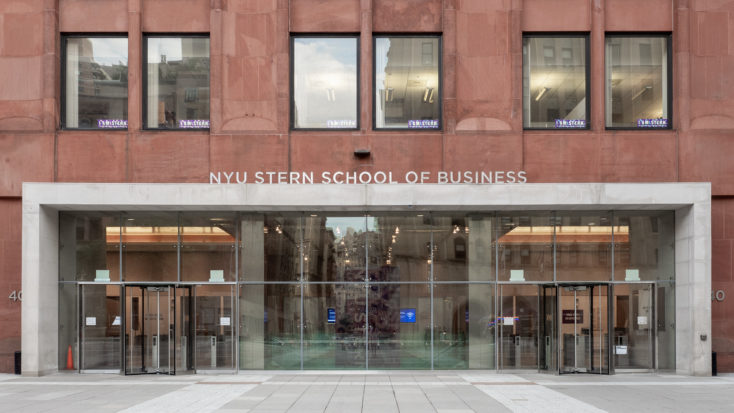
(Image of NYU Stern Paulson Auditorium by Ajay Suresh CC BY 2.0)