Optional MBA Essay Advice: 4 Scenarios Where It’s a Must
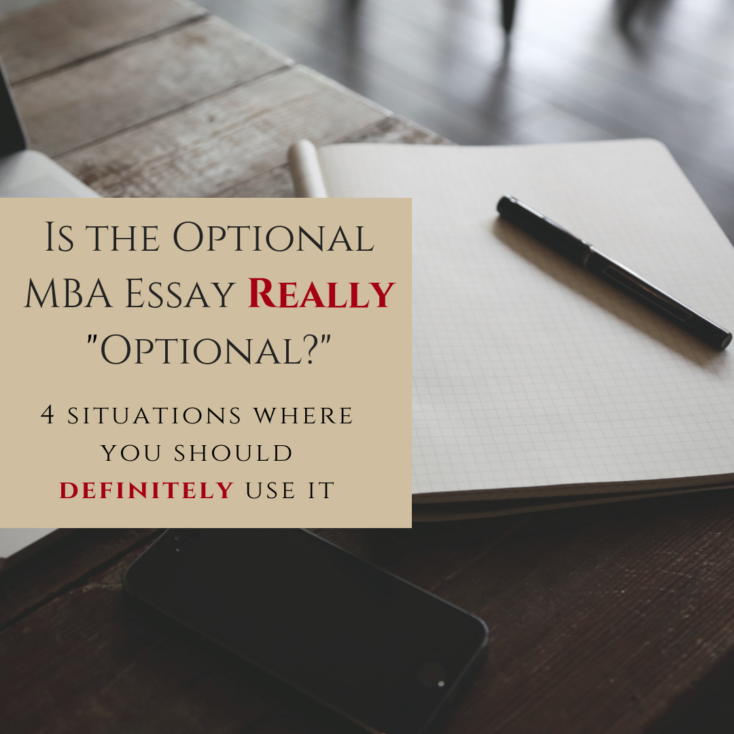
Every year, MBA applicants grapple with the same question: Should I write the optional MBA essay or leave it blank? On the surface, the idea of something being “optional” sounds appealing. But for many, it becomes a source of stress. If you don’t write one, will the AdCom think you missed an opportunity? If you do, will you risk weakening an otherwise strong application?
Here’s the truth: the optional MBA essay exists to help you, not to trick you. You won’t be penalized if you leave it blank, and you shouldn’t build your application around it.
The smart move is to complete the rest of your materials first—your resume, recommendations, and required essays—and then step back to see if there’s anything important that’s missing or could be misunderstood. If the answer is yes, the optional essay is the right place to provide context.
With that in mind, here are four clear reasons when it makes sense to write the optional MBA essay.
Need help deciding if your situation calls for the optional essay? Contact Stacy Blackman Consulting today to schedule a free 15-minute advising session with one of our Principal Consultants.
When to Use the Optional MBA Essay in Your MBA Application
Reason 1: Explaining Academic Weaknesses
If your transcript includes a grade that doesn’t reflect your ability—especially in a quantitative subject—address it briefly here. Explain the circumstance without excuses, then pivot quickly to evidence of improvement: higher grades later on, supplemental coursework, or an improved test score. The goal is reassurance, not an extended defense.
Reason 2: Clarifying Employment Gaps or Career Shifts
This is one of the most effective uses of the optional MBA essay. For instance, one recent SBC client experienced an eight-month gap following a layoff. With no further details, that could have raised concerns.

In the optional essay, he explained that he had spent that time completing data analytics coursework, volunteering with a nonprofit, and prepping for the GMAT. What might have looked like downtime instead showed resilience and initiative.
Applicants making a significant career change can also benefit from using the optional essay. Without context, a pivot may seem impulsive. With a concise explanation—why you’re shifting, what sparked the interest, and how the MBA fits—you can show the AdCom that the move is intentional and well-thought-out.
Reason 3: Explaining Your Choice of Recommender
Many applicants hesitate to ask their current supervisor for a recommendation, either because they don’t want to reveal MBA plans at work or because they haven’t worked with that manager long enough. If you’ve chosen an alternate recommender, note it here. A short explanation—literally two sentences—is enough to prevent the AdCom from making assumptions about your professional relationships.
Reason 4: Adding Useful Context
The optional essay can also highlight something meaningful that doesn’t fit anywhere else. This could be a unique personal background, an extracurricular passion, or, for those applying without test scores, a demonstration of academic readiness through other means. The key is to keep it purposeful. Don’t use this as a backdoor to repeat why you love the school or to rehash achievements already on your resume.

When to Leave It Blank
The optional MBA essay is not an “extra credit” assignment. If you don’t have a weakness to explain or new context to add, there’s no need to force it. Admissions officers have limited time to read each file, and they will not appreciate unnecessary repetition. A weak or irrelevant optional essay can hurt more than it helps.
How to Handle It If You Do Write One
If you decide the optional essay is necessary, keep it professional and concise. Stick to the facts, avoid oversharing, and always close on a forward-looking note. For most situations, a few succinct paragraphs are plenty. You’re not trying to win the AdCom over with flair—you’re removing doubt so they can focus on the stronger parts of your application.
The Bottom Line
The optional MBA essay is precisely what it says: optional. It can clarify an academic blip, explain a resume gap, justify a recommender choice, or provide important context that doesn’t fit elsewhere.
But if none of that applies to you, resist the urge to write one just for the sake of it. At the end of the day, the optional essay should serve your strategy, not distract from it.
***
Do your circumstances warrant writing the optional MBA essay? Stacy Blackman Consulting’s experts can give you a clear read—and help you craft a concise, effective essay that supports your candidacy without overshadowing it. Contact us today for a free 15-minute advising session with a Principal SBC consultant.
Here’s a snapshot of the caliber of expertise on our SBC team.









Ashley
Ashley is a former MBA Admissions Board Member for Harvard Business School (HBS), where she interviewed and evaluated thousands of business school applicants for over a six year tenure. Ashley holds an MBA from HBS. During her HBS years, Ashley was the Sports Editor for the Harbus and a member of the B-School Blades Ice Hockey Team. After HBS, she worked in Marketing at the Gillette Company on Male and Female shaving ...
×Pauline
A former associate director of admissions at Harvard Business School, Pauline served on the HBS MBA Admissions Board full-time for four years. She evaluated and interviewed HBS applicants, both on-campus and globally. Pauline's career has included sales and marketing management roles with Coca-Cola, Gillette, Procter & Gamble, and IBM. For over 10 years, Pauline has expertly guided MBA applicants, and her clients h ...
×Laura
Laura comes from the MBA Admissions Board at Harvard Business School (HBS) and is an HBS MBA alumnus. In her HBS Admissions role, she evaluated and interviewed hundreds of business school candidates, including internationals, women, military and other applicant pools, for five years. Prior to her time as a student at HBS, Laura began her career in advertising and marketing in Chicago at Leo Burnett where she worked on th ...
×Andrea
Andrea served as the Associate Director of MBA Admissions at Harvard Business School (HBS) for over five years. In this role, she provided strategic direction for student yield-management activities and also served as a full member of the admissions committee. In 2007, Andrea launched the new 2+2 Program at Harvard Business School – a program targeted at college junior applicants to Harvard Business School. Andrea has also served as a Career Coach for Harvard Business School for both cu ...
×Jennifer
Jennifer served as Admissions Officer at the Stanford (GSB) for five years. She holds an MBA from Stanford (GSB) and a B.S. in Chemical Engineering from University of Illinois Urbana-Champaign. Jennifer has over 15 years experience in guiding applicants through the increasingly competitive admissions process into top MBA programs. Having read thousands and thousands of essays and applications while at Stanford (GSB) Admiss ...
×Davina
Davina received her MBA from Stanford's Graduate School of Business (GSB), with a certificate in Public Management, and her BA in Psychology from UC Berkeley. Davina is an experienced strategic planning leader, facilitator, and business case writer who spent more than 15 years building culture, entrepreneurship, and leadership initiatives across Stanford University and the Stanford Graduate School of Business. She designed ...
×Erin K.
Erin served in key roles in MBA Admissions--as Director at Haas School of Business at UC Berkeley and Assistant Director at Stanford's Graduate School of Business (GSB). Erin served on the admissions committee at each school and has read thousands of applications in her career. At Haas, she served for seven years in roles that encompassed evaluation, outreach, and diversity and inclusion. During her tenure in Admissions at GSB, she was responsible for candidate evaluation, applicant outreach, ...
×Susie
Susie comes from the Admissions Office of the Stanford Graduate School of Business where she reviewed and evaluated hundreds of prospective students’ applications. She holds an MBA from Stanford’s GSB and a BA from Stanford in Economics. Prior to advising MBA applicants, Susie held a variety of roles over a 15-year period in capital markets, finance, and real estate, including as partner in one of the nation’s most innovative finance and real estate investment organizations. In that r ...
×Dione
Dione holds an MBA degree from Stanford Business School (GSB) and a BA degree from Stanford University, where she double majored in Economics and Communication with concentrations in journalism and sociology. Dione has served as an Admissions reader and member of the Minority Admissions Advisory Committee at Stanford. Dione is an accomplished and respected advocate and thought leader on education and diversity. She is ...
×Anthony
Anthony served as the Associate Director of MBA Admissions at the Wharton School at the University of Pennsylvania, where he dedicated over 10 years of expertise. During his time as a Wharton Admissions Officer, he read and reviewed thousands of applications and helped bring in a class of 800+ students a year. Anthony has traveled both domestically and internationally to recruit a ...
×Meghan
Meghan served as the Associate Director of Admissions and Marketing at the Wharton MBA’s Lauder Institute, a joint degree program combining the Wharton MBA with an MA in International Studies. In her role on the Wharton MBA admissions committee, Meghan advised domestic and international applicants; conducted interviews and information sessions domestically and overseas in Asia, Central and South America, and Europe; and evaluated applicants for admission to the program. Meghan also managed ...
×Amy
Amy comes from the Wharton School of the University of Pennsylvania where she was Associate Director. Amy devoted 12 years at the Wharton School, working closely with MBA students and supporting the admissions team. During her tenure at Wharton, Amy served as a trusted adviser to prospective applicants as well as admitted and matriculated students. She conducted admissions chats with applicants early in the admissions ...
×Ally
Ally brings six years of admissions experience to the SBC team, most recently as an Assistant Director of Admission for the full-time MBA program at Columbia Business School (CBS). During her time at Columbia, Ally was responsible for reviewing applications, planning recruitment events, and interviewing candidates for both the full-time MBA program and the Executive MBA program. She traveled both internationally and dome ...
×Emma
Emma comes from the MBA Admissions Office at Columbia Business School (CBS), where she was Associate Director. Emma conducted dozens of interviews each cycle for the MBA and EMBA programs, as well as coordinating the alumni ambassador interview program. She read and evaluated hundreds of applications each cycle, delivered information sessions to audiences across the globe, and advised countless waitlisted applicants. ×
Dana
Dana served as Assistant Director of Admissions at Columbia Business School for the Full-Time MBA program and has over 10 years of experience working in higher education. Known as a scrupulous file reader, Dana reviewed countless applications and assisted in rendering final decisions for the Admissions Committee at CBS. While leading information sessions at Columbia and on the road, Dana met and advised myriad applicants� ...
×Holly
Holly worked as a member of the NYU Stern MBA Admissions team for seven years and holds an MBA from NYU Stern. In her tenure as Director of NYU MBA Admissions, Holly worked closely with admissions teams from Columbia, Michigan Ross, UVA Darden, Cornell Johnson, Berkeley Haas, Yale SOM, and Duke Fuqua on recruiting events domestically and internationally. On the NYU Stern admissions committee, Holly conducted interviews, planned and hosted events, and trained staff on reading and interviewi ...
×


