Advice on Maximizing LinkedIn for MBA Applicants
Admissions officers and alumni interviewers may look up MBA applicants on LinkedIn, so treat your profile as a public companion to your application. It should echo your essays, quantify your impact, match your application details exactly, and show the interests you claim. A focused profile also sets you up for internship recruiting once you’re admitted.
Quick Summary
- Treat your profile as an extension of your application, so the leadership themes in your essays show up in your headline, About section, and activity.
- Accuracy matters as much as polish, because any gap between your profile and your application gives the admissions committee a reason to look harder.
- Build your presence and network months before you apply, since steady, thoughtful engagement carries more weight than a last-minute burst of activity.
Most MBA applicants pour their energy into essays and test scores and leave LinkedIn on autopilot. That’s a missed opportunity. Your profile keeps working for you long after you hit submit. It shows the admissions committee how you present yourself professionally and whether you’ve built a cohesive personal brand. If your profile doesn’t yet reflect the confident, focused candidate your essays describe, now’s the time to fix that.
Why does LinkedIn matter for MBA applicants?
Think of LinkedIn as the public complement to your application. Your essays and recommendations describe how you lead, and your profile shows how you present yourself to the professional world every day. When the two tell the same story, each makes the other more believable.
A strong profile reinforces the leadership and growth themes in your essays, offers tangible proof of career progression, and shows the interests and values behind your resume. It also positions you for internship recruiting, which starts soon after you arrive on campus. Taken together, a well-crafted presence gives both the admissions committee and future employers a fuller picture of your potential.
How can your LinkedIn profile differentiate your MBA candidacy?
Your profile should tell a story about your leadership, your accomplishments, and the motivation behind your career choices. An alumni interviewer may look you up before your conversation, so this is a chance to make a strong impression early. Your headline, About section, and visuals should all point in the same direction.

Your headline
Be specific about your current role, then think about how to offer a broader picture of who you are. “Staff Consultant at Bain & Company” or “Analyst at Goldman Sachs” is a solid start. If you’ve also founded a nonprofit or led a major volunteer initiative, adding that role to your headline will help you stand out in a crowded applicant pool. And if your essays describe an upcoming career pivot, a subtle nod to that direction here helps the committee see continuity between your story and your goals.
Your About section
This is where you can go beyond bullet points. Write in the first person with a confident, approachable tone. Summarize your path, explain what motivates you, and connect your current work to your post-MBA goals. A short narrative that sounds like you helps readers understand why you do what you do.
Your photo and banner image
Use a clear, recent, professional headshot. Then put the banner space to work. A photo from a conference, a leadership event, or an image tied to your industry can reinforce your brand and make your profile more memorable and human.
How should you describe your achievements on LinkedIn?
Admissions committees like to see results, so quantify your impact on LinkedIn just as you would on your MBA resume. Numbers make accomplishments tangible and credible.
Rather than saying you “created a marketing plan,” say you “developed a marketing plan that drove a 30% increase in leads.” Rather than “managed a staff,” write that you “supervised 30 employees and increased profitability by 25%.” Specifics like these help readers grasp the scale of your leadership right away.
Keep your bullet points consistent with your resume, but give yourself a bit more room to tell the story. A sentence on how you achieved a result or what you learned along the way adds texture. Stay factual and concise, and format for mobile, where many readers (including some admissions officers) will see your profile. Line breaks, bullet symbols, and short paragraphs make a dense role description far easier to scan. The Featured section near the top of your profile is also a good home for a published article, a project write-up, or a talk you gave.

What should your LinkedIn activity say about your interests?
Your activity can back up the themes in your application without any fanfare. If your essays highlight a commitment to renewable energy, micro-investing in India, or startup ecosystems, follow the organizations, publications, and thought leaders in those spaces. That consistency makes your stated goals feel more credible.
Engagement matters as much as who you follow. Comment thoughtfully on articles about leadership, innovation, or trends in your field, and add a quick insight when you share content. If you’re comfortable posting, write a short reflection on something you’ve learned recently, such as a project milestone, a challenge you worked through, or advice from a mentor. An admissions officer or interviewer who scrolls through your recent activity should come away with a sense that you’re an engaged professional whose interests align with the goals in your application.
Does your LinkedIn profile need to match your MBA application?
Every factual detail should line up. Mismatches between LinkedIn profiles and MBA applications are more common than you might think, so check your education, employer names, job titles, and employment dates against what you submitted to each school.
Even small inconsistencies can raise questions. If an admissions officer spots a conflicting title or timeline, they may take a closer look at the rest of your materials. Getting these details right shows professionalism and attention to detail.
Your tone should match too. If your application centers on social impact leadership, make sure your profile doesn’t come across as a pure finance pitch. Before you submit, click through your media attachments, project links, and featured posts to confirm they still open and accurately represent your work. Broken links and outdated uploads can undercut your credibility in ways you might not expect.
How should you build your network before you apply?
A thoughtful network tells its own story about your engagement. Admissions readers sometimes notice mutual connections with alumni or current students, which can add a subtle layer of credibility.
Follow your target programs’ official LinkedIn pages and admissions accounts, and comment when they post about student projects or global initiatives. It shows interest and awareness. When you connect with alumni or current students, send a short, personalized note. You don’t need to ask for anything. Thanking someone for an insight they shared goes a long way.
Start early. Interactions that build over several months mean far more than a flurry of connection requests the week before your interviews.

How will LinkedIn help you after you’re admitted?
Optimizing LinkedIn for MBA applicants is also an investment in your success once you’re on campus. You’ll rely on the platform to connect with classmates, alumni, and internship recruiters, and recruiters will look you up early in your first year.
Building your presence now makes that transition seamless. Refresh your headline and About section as you grow, and keep your experience current. Treat LinkedIn as a living record of your professional evolution that grows with you.
Frequently Asked Questions About LinkedIn for MBA Applicants
Will a sparse LinkedIn profile hurt my MBA application?
A thin profile won’t sink a strong application, but you lose a chance to reinforce your story. The bigger risk is a profile that’s half-finished or out of date, with an old job still listed as current or a blank About section. If you’re not ready for a full overhaul, start with an accurate experience section, a clear headline, and a professional photo, then build from there.
Do I need to post regularly on LinkedIn to impress the admissions committee?
A steady posting schedule matters far less than you might think, so there’s no need to turn yourself into a content creator mid-application. A sudden burst of polished thought-leadership posts timed to your submission can look performative, especially if your feed was quiet until now. A few comments in your field and the occasional post about something you’ve learned or built will serve you better.
Is it okay to connect with admissions officers or my interviewer on LinkedIn?
Hold off on sending connection requests to admissions staff or your interviewer while your application is under review, since it can look like you’re angling for an edge. Following the program’s official pages and admissions accounts is the better move. After decisions are out, a brief thank-you note and connection request to an alumni interviewer is a gracious touch.
How much should my LinkedIn experience section differ from my resume?
Your facts should be identical, and your framing can be more personal. Titles, dates, and metrics need to match your application exactly, while LinkedIn gives you room to add a line about how you got a result or why the work mattered. If your company uses an internal title that differs from the one on your resume, pick one version and use it everywhere.
How can SBC help you strengthen your MBA candidacy?
A strong LinkedIn profile reinforces your story, demonstrates results, and presents you as a thoughtful future leader. It’s one of the simplest ways to give the admissions committee and future recruiters a multidimensional view of who you are. Isn’t it time you revisited your profile to make sure it’s MBA-ready?
Your profile works best when it supports a clear, compelling application strategy. Stacy Blackman Consulting’s team of former admissions officers and MBA experts can help you sharpen your story across your essays, resume, and interviews. Contact us to get started.
MBA Launchpad
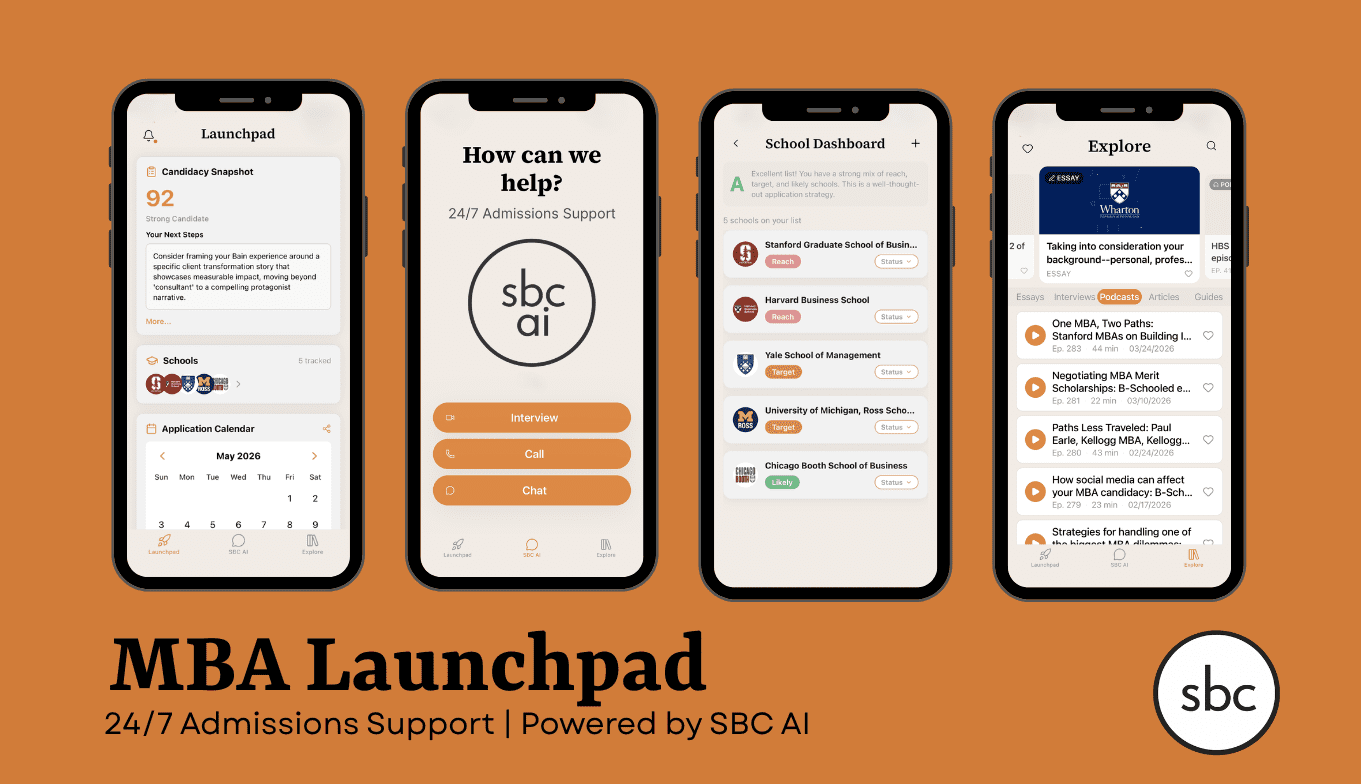
Don’t sleep on our latest product, MBA Launchpad by SBC! This AI-powered admissions assistant is built on 25+ years of real SBC admissions data and offers candidacy assessment, school list strategy, and essay guidance, available 24/7. Premium features are currently free. Download it on the App Store or Google Play.
Here’s a snapshot of the caliber of expertise on our SBC team.











Ashley
Ashley is a former MBA Admissions Board Member for Harvard Business School (HBS), where she interviewed and evaluated thousands of business school applicants for over a six year tenure. Ashley holds an MBA from HBS. During her HBS years, Ashley was the Sports Editor for the Harbus and a member of the B-School Blades Ice Hockey Team. After HBS, she worked in Marketing at the Gillette Company on Male and Female shaving ...
×Pauline
A former associate director of admissions at Harvard Business School, Pauline served on the HBS MBA Admissions Board full-time for four years. She evaluated and interviewed HBS applicants, both on-campus and globally. Pauline's career has included sales and marketing management roles with Coca-Cola, Gillette, Procter & Gamble, and IBM. For over 10 years, Pauline has expertly guided MBA applicants, and her clients h ...
×Laura
Laura comes from the MBA Admissions Board at Harvard Business School (HBS) and is an HBS MBA alumnus. In her HBS Admissions role, she evaluated and interviewed hundreds of business school candidates, including internationals, women, military and other applicant pools, for five years. Prior to her time as a student at HBS, Laura began her career in advertising and marketing in Chicago at Leo Burnett where she worked on th ...
×Andrea
Andrea served as the Associate Director of MBA Admissions at Harvard Business School (HBS) for over five years. In this role, she provided strategic direction for student yield-management activities and also served as a full member of the admissions committee. In 2007, Andrea launched the new 2+2 Program at Harvard Business School – a program targeted at college junior applicants to Harvard Business School. Andrea has also served as a Career Coach for Harvard Business School for both cu ...
×Jennifer
Jennifer served as Admissions Officer at the Stanford (GSB) for five years. She holds an MBA from Stanford (GSB) and a B.S. in Chemical Engineering from University of Illinois Urbana-Champaign. Jennifer has over 15 years experience in guiding applicants through the increasingly competitive admissions process into top MBA programs. Having read thousands and thousands of essays and applications while at Stanford (GSB) Admiss ...
×Davina
Davina received her MBA from Stanford's Graduate School of Business (GSB), with a certificate in Public Management, and her BA in Psychology from UC Berkeley. Davina is an experienced strategic planning leader, facilitator, and business case writer who spent more than 15 years building culture, entrepreneurship, and leadership initiatives across Stanford University and the Stanford Graduate School of Business. She designed ...
×Erin
Erin served in key roles in MBA Admissions--as Director at Haas School of Business at UC Berkeley and Assistant Director at Stanford's Graduate School of Business (GSB). Erin served on the admissions committee at each school and has read thousands of applications in her career. At Haas, she served for seven years in roles that encompassed evaluation, outreach, and diversity and inclusion. During her tenure in Admissions at GSB, she was responsible for candidate evaluation, applicant outreach, ...
×Susie
Susie comes from the Admissions Office of the Stanford Graduate School of Business where she reviewed and evaluated hundreds of prospective students’ applications. She holds an MBA from Stanford’s GSB and a BA from Stanford in Economics. Prior to advising MBA applicants, Susie held a variety of roles over a 15-year period in capital markets, finance, and real estate, including as partner in one of the nation’s most innovative finance and real estate investment organizations. In that r ...
×Dione
Dione holds an MBA degree from Stanford Business School (GSB) and a BA degree from Stanford University, where she double majored in Economics and Communication with concentrations in journalism and sociology. Dione has served as an Admissions reader and member of the Minority Admissions Advisory Committee at Stanford. Dione is an accomplished and respected advocate and thought leader on education and diversity. She is ...
×Anthony
Anthony served as the Associate Director of MBA Admissions at the Wharton School at the University of Pennsylvania, where he dedicated over 10 years of expertise. During his time as a Wharton Admissions Officer, he read and reviewed thousands of applications and helped bring in a class of 800+ students a year. Anthony has traveled both domestically and internationally to recruit a ...
×Meghan
Meghan served as the Associate Director of Admissions and Marketing at the Wharton MBA’s Lauder Institute, a joint degree program combining the Wharton MBA with an MA in International Studies. In her role on the Wharton MBA admissions committee, Meghan advised domestic and international applicants; conducted interviews and information sessions domestically and overseas in Asia, Central and South America, and Europe; and evaluated applicants for admission to the program. Meghan also managed ...
×Amy
Amy comes from the Wharton School of the University of Pennsylvania where she was Associate Director. Amy devoted 12 years at the Wharton School, working closely with MBA students and supporting the admissions team. During her tenure at Wharton, Amy served as a trusted adviser to prospective applicants as well as admitted and matriculated students. She conducted admissions chats with applicants early in the admissions ...
×Ally
Ally brings six years of admissions experience to the SBC team, most recently as an Assistant Director of Admission for the full-time MBA program at Columbia Business School (CBS). During her time at Columbia, Ally was responsible for reviewing applications, planning recruitment events, and interviewing candidates for both the full-time MBA program and the Executive MBA program. She traveled both internationally and dome ...
×Emma
Emma comes from the MBA Admissions Office at Columbia Business School (CBS), where she was Associate Director. Emma conducted dozens of interviews each cycle for the MBA and EMBA programs, as well as coordinating the alumni ambassador interview program. She read and evaluated hundreds of applications each cycle, delivered information sessions to audiences across the globe, and advised countless waitlisted applicants. ×
Dana
Dana served as Assistant Director of Admissions at Columbia Business School for the Full-Time MBA program and has over 10 years of experience working in higher education. Known as a scrupulous file reader, Dana reviewed countless applications and assisted in rendering final decisions for the Admissions Committee at CBS. While leading information sessions at Columbia and on the road, Dana met and advised myriad applicants� ...
×Holly
Holly worked as a member of the NYU Stern MBA Admissions team for seven years and holds an MBA from NYU Stern. In her tenure as Director of NYU MBA Admissions, Holly worked closely with admissions teams from Columbia, Michigan Ross, UVA Darden, Cornell Johnson, Berkeley Haas, Yale SOM, and Duke Fuqua on recruiting events domestically and internationally. On the NYU Stern admissions committee, Holly conducted interviews, planned and hosted events, and trained staff on reading and interviewi ...
×Written by Yvonne Milosevic and reviewed by Stacy Blackman. Learn more about our former admissions officers on the SBC admissions team page.