Harvard MBA Essay Advice for the 2026-2027 Admissions Season
Harvard Business School requires three short MBA essays for the Class of 2029 applicants: business-minded (300 words), leadership-focused (250 words), and growth-oriented (250 words). Each maps to a trait HBS screens for, together showing how you make decisions, develop others, and grow through curiosity. Your goal with this Harvard MBA essay set is to move or inspire the AdCom—and maybe even surprise them.
Quick Summary
- HBS reads for self-awareness over achievement, so the why behind each story matters more than the accomplishment itself.
- With roughly 800 words total, every sentence has to pull weight. Open with a specific decision or moment, not a throat-clearing thesis about your passion.
- Read and plan the trio to support one cohesive narrative. The strongest submissions share a throughline the admissions committee can pick up and pull on.
What are the Harvard MBA essay prompts?
HBS replaced its iconic single open-ended essay a few seasons ago with this trio of focused questions, and the format is now well established. The questions offer more structure than the old essay, but they still demand the same depth of reflection and storytelling. Each prompt connects to a core trait the school values:
Business-Minded (300 words): Please reflect on how your choices have influenced your career path and aspirations.
Leadership-Focused (250 words): What experiences have shaped how you invest in others and how you lead?
Growth-Oriented (250 words): Curiosity can be seen in many ways. Please share an example of how you have demonstrated curiosity and how that has influenced your growth.
Applicants also complete a 500-character short-answer question on post-MBA career goals, which is covered below.
Read together, the prompts tell HBS whether you are someone who makes intentional choices and creates impact, who elevates the people around you and learns from experience, and who is driven by curiosity and committed to lifelong learning.
A former HBS admissions officer on the SBC team puts it plainly: the essays are make-or-break. Plenty of candidates have acceptable credentials up to that point, and the essays are what set the whole application apart. HBS interviews are won in the essay phase.
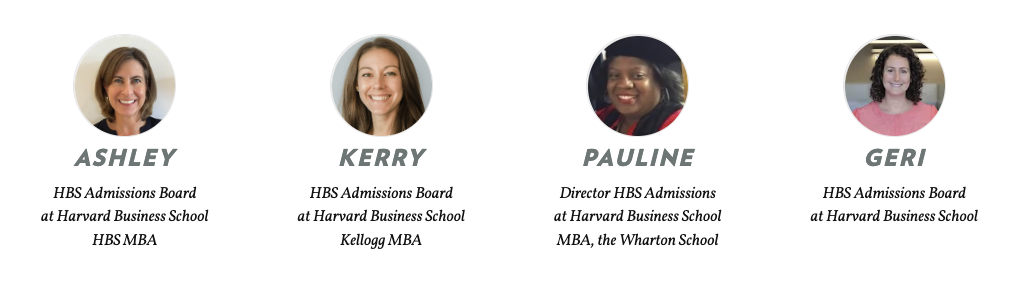
Connect with an SBC Principal Consultant to get expert feedback on how to make your HBS application unforgettable. Here’s a snapshot of the caliber of HBS expertise on our team:
How do you answer the HBS business-minded essay?
This first prompt resembles a typical career goals essay, but it emphasizes your decision-making process. HBS wants students who will change their organizations and the world, so think big, be ambitious, and show that you care.
Successful responses tend to home in on a core driving passion. This isn’t just about what you hope to accomplish. It’s about how your intentional choices have shaped your path. Use the space to reflect on how your career has unfolded, and more importantly, why. What informed each pivot or commitment? How have your experiences clarified the kind of leader you want to be, or the kind of change you hope to drive?
Your choices don’t have to be traditional, but they should show momentum and purpose. Even if your path hasn’t been linear, highlight the thoughtful decisions that align with your evolving goals. What is the throughline that connects your past to your future?
Finally, remember that business-minded people are also practical. Demonstrate a trajectory that signals upper-management potential and a drive to make an impact not just in business, but in society. This is your chance to connect your decisions with your future vision.
How do you answer the HBS leadership-focused essay?
HBS has always centered leadership and loves candidates with a track record of impact. This essay asks for evidence of your leadership potential, particularly in how you empower and elevate others. If your key achievements aren’t obvious from your resume or transcript, use this space to surface them.
Hardship can be a crucial part of growth. If you have faced challenges, embrace them and tell your story, focusing on the lessons learned rather than the difficulty itself. That said, this isn’t only about resilience or grit. It’s about how you show up for others. How have you mentored, coached, supported, or empowered the people around you? What values guide your approach, and which specific experiences shaped them?
The final part of the prompt looks forward to the kind of leader you want to become. Consider how you want your future team or company to perceive you, and what you hope to achieve together.
Another former HBS admissions officer on the SBC team describes the goal in these terms: By the end of the essay, the reader should feel so moved that they cannot wait to hear more of the story, ask questions, and be inspired.
How do you answer the HBS growth-oriented essay?
The final prompt emphasizes curiosity as a marker of a lifelong learner. Curious people want to understand how things work, solve problems, and develop themselves and their teams. This essay requires a concrete example, and both personal and career-oriented topics work well.
You might describe a time you went down a rabbit hole to solve a complex problem, sought out knowledge beyond what was expected, or explored something unfamiliar that stretched your worldview. Explain why you were interested, what you did to learn more, and what impact your learning had.
But curiosity alone is not enough. What matters here is how it changed you. Maybe it shifted your perspective, shaped how you approached a later challenge, or influenced how you lead and communicate. That’s where the growth comes in. Be specific and let your personality show. This is your opportunity to demonstrate how you think and how you evolve.
How do you answer the HBS career aspirations short answer?
Alongside the three essays, the application includes a brief career-aspirations component. You will select your intended post-MBA industry and function from drop-down menus, then expand in a short free-text box: “Briefly, tell us more about your career aspirations.” (500 characters)
Because the drop-downs already capture your industry and function, do not waste the box restating them. Use the space for the why and the direction the menus cannot show. Within the 500-character limit, name your immediate post-MBA target with enough specificity that the reader can picture it, then connect it to the longer-term impact you are working toward. Concrete beats sweeping. A grounded, specific aspiration reads as far more credible than a grand mission statement.
Keep it tight and active. This isn’t the place for backstory or a second career-goals essay. Think of it as the micro version of your business-minded essay: where you’re headed, and why it matters. When your business-minded essay and this short answer point in the same direction, the whole application reads as intentional rather than assembled.
How do you make all three HBS essays work together?
Taken together, the essays should present a cohesive picture of who you are: your mindset, your motivations, and your potential to lead and grow at HBS. Do not just check boxes. Assign one trait to each essay so they stay distinct, but let a single throughline connect them. Tell a story only you can tell, and make the reader want to continue the conversation in the interview.
Frequently Asked Questions About the Harvard MBA Essay Prompts
Can I use the same examples in my essays as I do on my resume?
No. Your resume shows what you did. The essays should show why you did it. Use this space for the qualitative material a resume cannot hold: your values, your thinking in a pivotal moment, and the experiences that shaped how you see the world. If an essay simply narrates a line from your resume, it’s not earning its place.
Should I include a “Why HBS?” section in my essays?
No. HBS already knows why strong candidates want to be there, so don’t spend your limited words praising the program. As our own HBS guidance puts it, that space is far too valuable to hand back to the school. Use every line to reveal something about you instead.
Can my HBS essay examples be personal rather than professional?
Yes. Personal, community, and extracurricular examples are all fair game, as long as the story is authentic, specific, and clearly tied to the trait the prompt is assessing. A community leadership moment can land as powerfully as a workplace one.
Do I need a perfect post-MBA plan before I apply?
No. HBS wants a clear sense of direction, but it’s also a place built for exploration, and plenty of students arrive with one plan and leave on a path they never anticipated. The essays reward a genuine point of view on where you want to go and why, not airtight certainty.
Show conviction about the problems you want to work on, and leave room for that vision to grow once you’re in the room with your classmates. HBS makes this point through its own students in a myth-busting article about the application process.
Is it okay to write about a failure or setback?
Yes, and it often helps. A setback handled with honesty signals maturity and growth, which is exactly what the leadership and growth prompts reward. Focus on the lesson and what you did differently afterward, rather than dwelling on the difficulty itself.
Next Steps
You don’t have to tackle the Harvard MBA essay set alone. The SBC team has supported a wide range of successful Harvard submissions over the years, and we would love to help shape your path too. Whether you want start-to-finish strategy, essay and resume editing, or targeted HBS interview prep, we have you covered.
Ready to take the next step? Contact us today for a free 15-minute advising session to talk strategy with a Principal SBC consultant.
MBA Launchpad
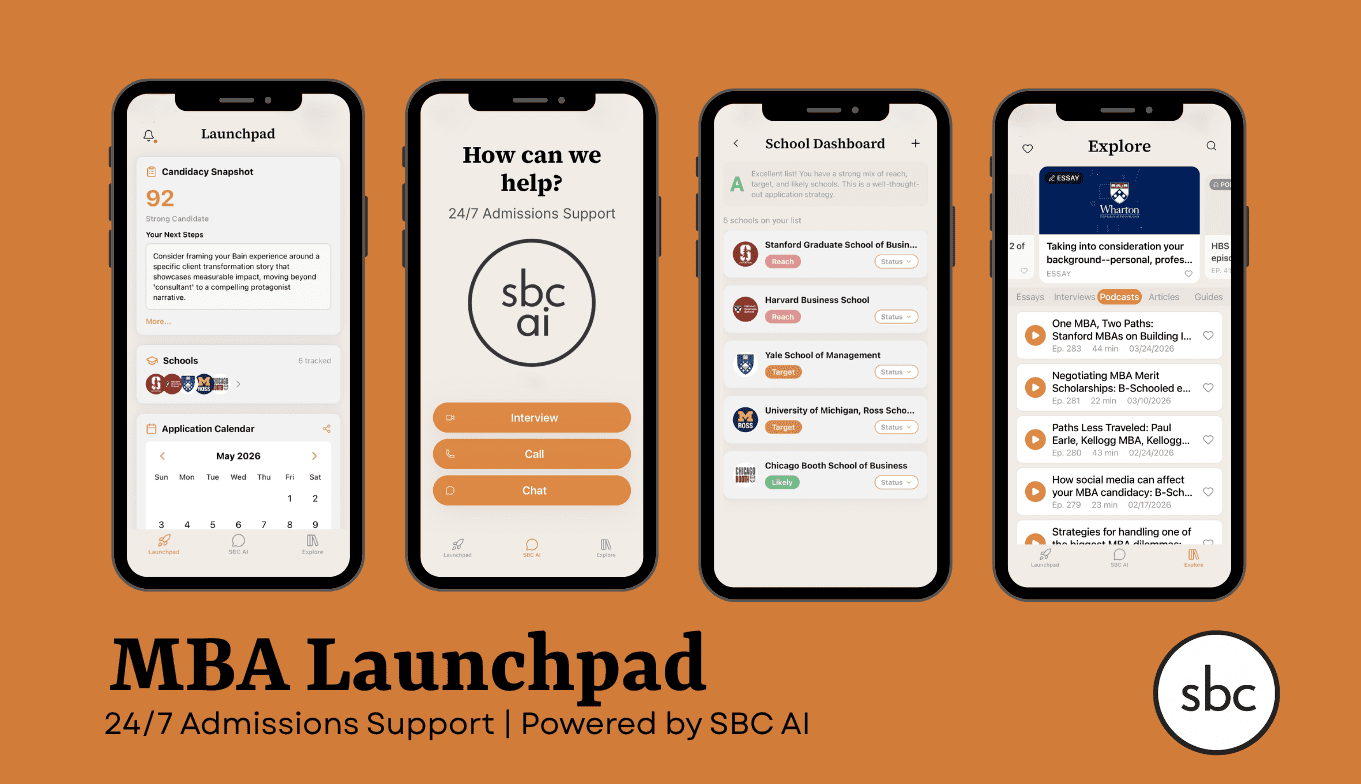
Don’t sleep on our latest product, MBA Launchpad by SBC. It’s your AI-powered admissions assistant, built on 25+ years of real SBC data. Candidacy assessment, school list strategy, essay guidance, and more are available 24/7 in your pocket. Download now on the App Store and Google Play.
Here’s a snapshot of the caliber of expertise on our SBC team.







Ashley
Ashley is a former MBA Admissions Board Member for Harvard Business School (HBS), where she interviewed and evaluated thousands of business school applicants for over a six year tenure. Ashley holds an MBA from HBS. During her HBS years, Ashley was the Sports Editor for the Harbus and a member of the B-School Blades Ice Hockey Team. After HBS, she worked in Marketing at the Gillette Company on Male and Female shaving ...
×Pauline
A former associate director of admissions at Harvard Business School, Pauline served on the HBS MBA Admissions Board full-time for four years. She evaluated and interviewed HBS applicants, both on-campus and globally. Pauline's career has included sales and marketing management roles with Coca-Cola, Gillette, Procter & Gamble, and IBM. For over 10 years, Pauline has expertly guided MBA applicants, and her clients h ...
×Laura
Laura comes from the MBA Admissions Board at Harvard Business School (HBS) and is an HBS MBA alumnus. In her HBS Admissions role, she evaluated and interviewed hundreds of business school candidates, including internationals, women, military and other applicant pools, for five years. Prior to her time as a student at HBS, Laura began her career in advertising and marketing in Chicago at Leo Burnett where she worked on th ...
×Andrea
Andrea served as the Associate Director of MBA Admissions at Harvard Business School (HBS) for over five years. In this role, she provided strategic direction for student yield-management activities and also served as a full member of the admissions committee. In 2007, Andrea launched the new 2+2 Program at Harvard Business School – a program targeted at college junior applicants to Harvard Business School. Andrea has also served as a Career Coach for Harvard Business School for both cu ...
×Jennifer
Jennifer served as Admissions Officer at the Stanford (GSB) for five years. She holds an MBA from Stanford (GSB) and a B.S. in Chemical Engineering from University of Illinois Urbana-Champaign. Jennifer has over 15 years experience in guiding applicants through the increasingly competitive admissions process into top MBA programs. Having read thousands and thousands of essays and applications while at Stanford (GSB) Admiss ...
×Davina
Davina received her MBA from Stanford's Graduate School of Business (GSB), with a certificate in Public Management, and her BA in Psychology from UC Berkeley. Davina is an experienced strategic planning leader, facilitator, and business case writer who spent more than 15 years building culture, entrepreneurship, and leadership initiatives across Stanford University and the Stanford Graduate School of Business. She designed ...
×Erin K.
Erin served in key roles in MBA Admissions--as Director at Haas School of Business at UC Berkeley and Assistant Director at Stanford's Graduate School of Business (GSB). Erin served on the admissions committee at each school and has read thousands of applications in her career. At Haas, she served for seven years in roles that encompassed evaluation, outreach, and diversity and inclusion. During her tenure in Admissions at GSB, she was responsible for candidate evaluation, applicant outreach, ...
×Susie
Susie comes from the Admissions Office of the Stanford Graduate School of Business where she reviewed and evaluated hundreds of prospective students’ applications. She holds an MBA from Stanford’s GSB and a BA from Stanford in Economics. Prior to advising MBA applicants, Susie held a variety of roles over a 15-year period in capital markets, finance, and real estate, including as partner in one of the nation’s most innovative finance and real estate investment organizations. In that r ...
×Dione
Dione holds an MBA degree from Stanford Business School (GSB) and a BA degree from Stanford University, where she double majored in Economics and Communication with concentrations in journalism and sociology. Dione has served as an Admissions reader and member of the Minority Admissions Advisory Committee at Stanford. Dione is an accomplished and respected advocate and thought leader on education and diversity. She is ...
×Anthony
Anthony served as the Associate Director of MBA Admissions at the Wharton School at the University of Pennsylvania, where he dedicated over 10 years of expertise. During his time as a Wharton Admissions Officer, he read and reviewed thousands of applications and helped bring in a class of 800+ students a year. Anthony has traveled both domestically and internationally to recruit a ...
×Meghan
Meghan served as the Associate Director of Admissions and Marketing at the Wharton MBA’s Lauder Institute, a joint degree program combining the Wharton MBA with an MA in International Studies. In her role on the Wharton MBA admissions committee, Meghan advised domestic and international applicants; conducted interviews and information sessions domestically and overseas in Asia, Central and South America, and Europe; and evaluated applicants for admission to the program. Meghan also managed ...
×Amy
Amy comes from the Wharton School of the University of Pennsylvania where she was Associate Director. Amy devoted 12 years at the Wharton School, working closely with MBA students and supporting the admissions team. During her tenure at Wharton, Amy served as a trusted adviser to prospective applicants as well as admitted and matriculated students. She conducted admissions chats with applicants early in the admissions ...
×Ally
Ally brings six years of admissions experience to the SBC team, most recently as an Assistant Director of Admission for the full-time MBA program at Columbia Business School (CBS). During her time at Columbia, Ally was responsible for reviewing applications, planning recruitment events, and interviewing candidates for both the full-time MBA program and the Executive MBA program. She traveled both internationally and dome ...
×Emma
Emma comes from the MBA Admissions Office at Columbia Business School (CBS), where she was Associate Director. Emma conducted dozens of interviews each cycle for the MBA and EMBA programs, as well as coordinating the alumni ambassador interview program. She read and evaluated hundreds of applications each cycle, delivered information sessions to audiences across the globe, and advised countless waitlisted applicants. ×
Dana
Dana served as Assistant Director of Admissions at Columbia Business School for the Full-Time MBA program and has over 10 years of experience working in higher education. Known as a scrupulous file reader, Dana reviewed countless applications and assisted in rendering final decisions for the Admissions Committee at CBS. While leading information sessions at Columbia and on the road, Dana met and advised myriad applicants� ...
×Holly
Holly worked as a member of the NYU Stern MBA Admissions team for seven years and holds an MBA from NYU Stern. In her tenure as Director of NYU MBA Admissions, Holly worked closely with admissions teams from Columbia, Michigan Ross, UVA Darden, Cornell Johnson, Berkeley Haas, Yale SOM, and Duke Fuqua on recruiting events domestically and internationally. On the NYU Stern admissions committee, Holly conducted interviews, planned and hosted events, and trained staff on reading and interviewi ...
×Written by SBC Consultant Amy. Reviewed by Stacy Blackman. Learn more about our former admissions officers on the SBC admissions team page.