What an MBA in Luxury Brand Management Really Offers

New York. Paris. Milan. These cities increasingly define where business and culture collide. As heritage fashion houses and beauty conglomerates reinvent themselves for a digital-first, values-driven generation, the luxury industry has become one of the most complex global ecosystems in business. Enter the MBA in luxury brand management.
This degree blends creative storytelling with quantitative muscle. The modern luxury leader must be fluent in design language, brand psychology, and financial acumen, while simultaneously building cultural capital and balancing the books.
For the right candidate, the MBA in luxury brand management equips graduates to steer one of the most emotionally charged industries on the planet.
Wondering whether a luxury-focused MBA makes sense for you? Our consultants can help you evaluate your options.
Why an MBA in Luxury Brand Management Matters Today
Luxury is no longer built solely on craftsmanship and exclusivity. Strategy, data, and differentiation are the tools of the trade. Growth is now fueled by sustainability commitments, generative AI, and cross-market storytelling, all of which require a new breed of leader.
The future of luxury depends on people who can:
- Speak both languages — creative and commercial.
- Use analytics to elevate desire rather than dilute it.
- Scale storytelling globally — from Paris boutiques to Seoul concept stores to Fifth Avenue flagships.
As luxury brands act more like tech companies and tech brands borrow the aura of luxury, the need for business leaders who can move between those worlds is undeniable.
The Luxury MBA Dilemma: Specialized Focus or General Prestige?
Every aspiring luxury leader eventually hits the same crossroad: Should I pursue a specialized MBA that immerses me in luxury from day one, or a general MBA that keeps my career options open?
This decision is more about identity than curriculum. Are you ready to define yourself as a luxury insider, or do you still want the range to pivot across industries?

The Case for a Specialized Luxury Degree
Programs like NYU Stern’s Luxury & Retail MBA, ESSEC’s Master in Luxury Management, and SDA Bocconi’s MAFED are ideal for candidates who know this is their lane. These folks have seen how business decisions shape brand DNA, and they want to lead from that intersection of art and commerce.
Students work directly with companies such as Cartier, Gucci, and Prada on brand development and customer experience initiatives. These programs appeal to those who crave immediate proximity to luxury’s creative core.
The benefits:
- Immediate immersion. The curriculum is designed around the luxury value chain, from supply strategy to experiential marketing.
- Insider access. Students collaborate directly with executives from LVMH, Kering, and Chanel on live cases and capstone projects.
- Cohort synergy. You’re surrounded by peers who speak the same language of aesthetics, innovation, and brand storytelling.
- Credibility boost. For career-switchers, specialization signals commitment and shortens the learning curve.
The trade-off: specialized programs are shorter (often one year) and narrower in scope. You’ll graduate with industry fluency but less time to explore internships or pivot sectors. It’s a depth-over-breadth decision for those ready to commit.

The Case for a General MBA with a Luxury Focus
Meanwhile, some applicants are excited about this industry but want to maintain a broader business lens. Schools like HEC Paris, INSEAD, London Business School, and Columbia Business School allow students to personalize their experience through electives like Luxury Strategy or Consumer Behavior, brand consulting projects, and treks to fashion capitals.
The advantages:
- Breadth and versatility. You gain the complete MBA toolkit: finance, analytics, leadership, operations.
- Broader recruiting access. Consulting, tech, and private-equity firms remain on the table — all of which increasingly touch luxury sectors.
- Pivot flexibility. If luxury turns out to be your passion project rather than your long-term lane, you still have universal credentials.
This route suits strategic creatives who want to understand luxury’s cultural codes but still value optionality and scale. If you’re drawn to the idea of studying in one of the world’s luxury capitals, you may also want to explore why so many applicants are increasingly considering the lure of an MBA in Europe. Many of these programs offer unparalleled access to fashion, beauty, and design ecosystems that don’t exist anywhere else.
The Emotional Equation
What makes this choice difficult is that it’s both professional and personal. Neither choice is wrong; they reflect different comfort levels with certainty.
- A specialized MBA says, I’m ready to make my name in this industry.
- A general MBA says, “I’m still exploring the intersections of creativity and commerce.“
If you’ve always analyzed why certain products feel premium or how design and storytelling shape consumer trust, the specialized route may feel like home. However, if you view luxury as one expression of a broader fascination with brand psychology and innovation, a general MBA gives you the space to explore before you commit.
The Hybrid Strategy
Of course, there’s a middle ground, and many students are creating it now. They join general MBAs but build luxury specializations on their own through clubs, projects, and internships.
At HEC Paris, that might mean earning the Luxury Certificate while networking with Kering, and at London Business School, it’s leading the Retail, Luxury and Consumer Goods Club. Meanwhile, students at INSEAD might pursue a field project on emerging luxury in Asia.
The best luxury MBAs—specialized or not—are the ones that give you freedom to shape your own brand.
Programs Redefining Luxury Education
HEC Paris
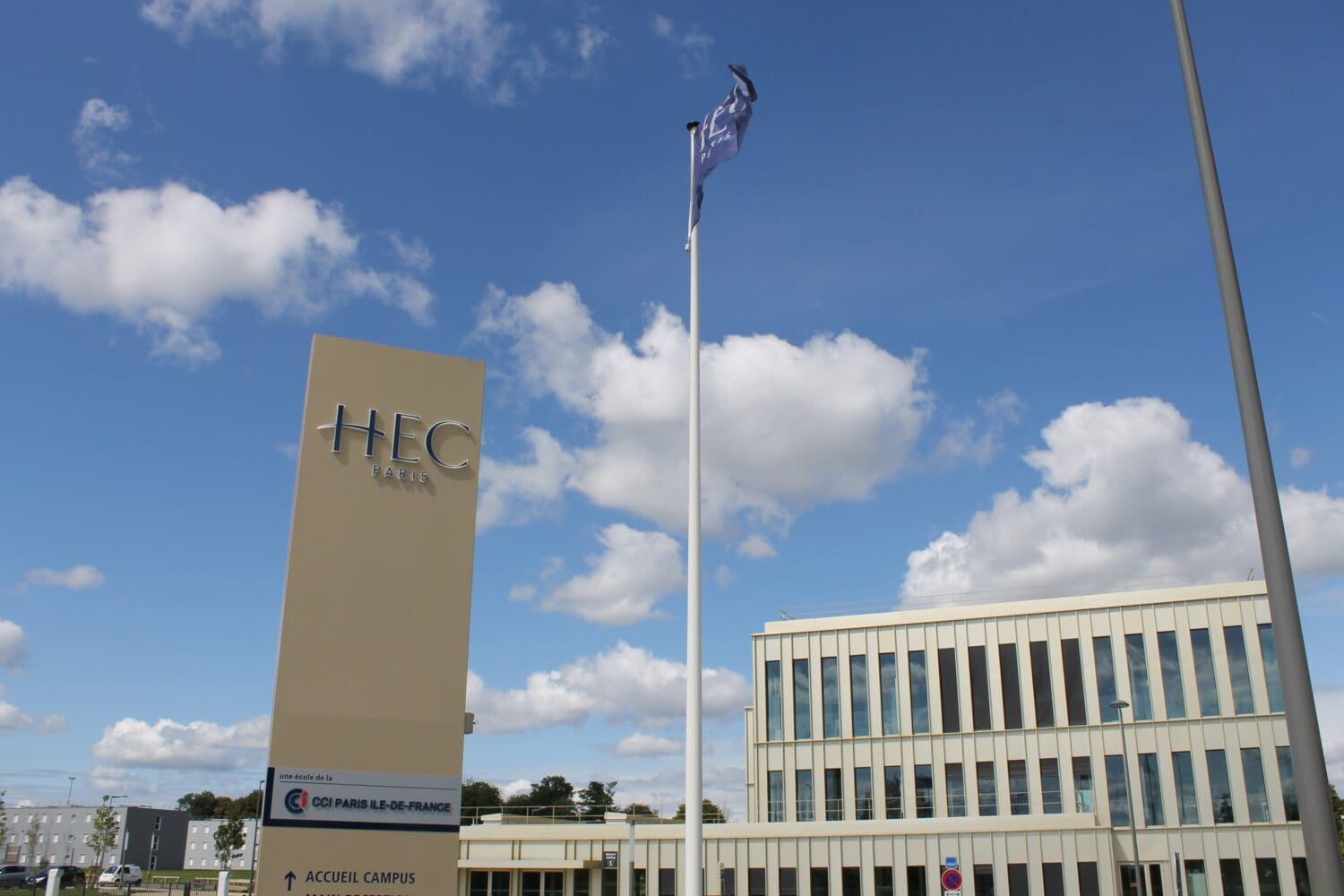
HEC Paris anchors its luxury reputation through deep ties to LVMH, Chanel, and Hermès. The Luxury Certificate and brand-strategy electives blend tradition with modern marketing science. Its proximity to Paris makes it the natural classroom for anyone seeking the European heart of luxury.
NYU Stern
Located steps from SoHo and Madison Avenue, NYU Stern’s Luxury & Retail MBA is the only one-year, full-time MBA of its kind in the U.S. Courses like Retail Strategy & Analytics and Luxury Marketing meet fieldwork with Estée Lauder and Ralph Lauren. Students graduate fluent in both brand emotion and business transformation — ready to lead at the industry’s digital frontier.
INSEAD and London Business School
INSEAD’s tri-campus format (France, Singapore, Abu Dhabi) and LBS’s London base attract MBAs who want to translate luxury strategy across cultures. Both offer electives in consumer behavior, retail innovation, and entrepreneurship—perfect for consultants or brand builders with international ambitions.
Career Outcomes and ROI
Graduates from these programs rarely chase the highest starting salaries. Still, the financial returns are more substantial than most applicants assume.
Corporate luxury roles—such as brand management, merchandising, and strategy—typically start around $110K–$150K in the U.S. (or €80K–€120K in Europe), with bonuses and attractive travel and product perks. Those entering consulting roles focused on fashion, beauty, or retail command the same compensation bands as other consultants, often $175K–$190K plus performance bonuses.

Graduates joining rotational or leadership programs at companies like LVMH, Richemont, or L’Oréal often advance quickly. Within five years, many reach Director or VP-level positions with total compensation that rivals peers in tech or consumer goods. And for entrepreneurial graduates, the upside of launching a niche fashion, beauty, or retail-tech brand can be exponential.
The true ROI of a luxury-focused MBA is about trajectory and access. Alumni gain entry to global networks, earn early credibility in a notoriously insular industry, and often find themselves steering product launches or brand transformations with outsized visibility.
In other words, the payoff is both tangible and positional: financial growth paired with the chance to shape how the world defines modern luxury.
So—Which Path Is Right for You?
If you’re fascinated by how brands create value beyond the balance sheet and often catch yourself dissecting why certain products or experiences inspire loyalty, you already think like a future leader in luxury. A specialized MBA in luxury brand management may make sense if you’re ready to commit exclusively to the luxury sector from day one.
But you don’t need a narrowly defined degree to validate that instinct.
For many applicants, a general MBA from a top global program—combined with carefully chosen electives, international projects, and consistent engagement with industry insiders—strikes the right balance between breadth and focus.
This approach builds the strategic versatility every senior executive needs while allowing you to carve out expertise in luxury, fashion, or retail innovation.
Whichever route you choose, success in this field comes down to clarity of vision and authenticity of purpose — qualities that stand out to both AdComs and luxury recruiters.
At Stacy Blackman Consulting, our team can help you connect your professional story to the creative and strategic energy that defines today’s luxury business. Contact us today for a free 15-minute evaluation of your candidacy with a Senior Admissions Consultant.
Here’s a snapshot of the caliber of expertise on our SBC team.













Ashley
Ashley is a former MBA Admissions Board Member for Harvard Business School (HBS), where she interviewed and evaluated thousands of business school applicants for over a six year tenure. Ashley holds an MBA from HBS. During her HBS years, Ashley was the Sports Editor for the Harbus and a member of the B-School Blades Ice Hockey Team. After HBS, she worked in Marketing at the Gillette Company on Male and Female shaving ...
×Pauline
A former associate director of admissions at Harvard Business School, Pauline served on the HBS MBA Admissions Board full-time for four years. She evaluated and interviewed HBS applicants, both on-campus and globally. Pauline's career has included sales and marketing management roles with Coca-Cola, Gillette, Procter & Gamble, and IBM. For over 10 years, Pauline has expertly guided MBA applicants, and her clients h ...
×Laura
Laura comes from the MBA Admissions Board at Harvard Business School (HBS) and is an HBS MBA alumnus. In her HBS Admissions role, she evaluated and interviewed hundreds of business school candidates, including internationals, women, military and other applicant pools, for five years. Prior to her time as a student at HBS, Laura began her career in advertising and marketing in Chicago at Leo Burnett where she worked on th ...
×Andrea
Andrea served as the Associate Director of MBA Admissions at Harvard Business School (HBS) for over five years. In this role, she provided strategic direction for student yield-management activities and also served as a full member of the admissions committee. In 2007, Andrea launched the new 2+2 Program at Harvard Business School – a program targeted at college junior applicants to Harvard Business School. Andrea has also served as a Career Coach for Harvard Business School for both cu ...
×Jennifer
Jennifer served as Admissions Officer at the Stanford (GSB) for five years. She holds an MBA from Stanford (GSB) and a B.S. in Chemical Engineering from University of Illinois Urbana-Champaign. Jennifer has over 15 years experience in guiding applicants through the increasingly competitive admissions process into top MBA programs. Having read thousands and thousands of essays and applications while at Stanford (GSB) Admiss ...
×Davina
Davina received her MBA from Stanford's Graduate School of Business (GSB), with a certificate in Public Management, and her BA in Psychology from UC Berkeley. Davina is an experienced strategic planning leader, facilitator, and business case writer who spent more than 15 years building culture, entrepreneurship, and leadership initiatives across Stanford University and the Stanford Graduate School of Business. She designed ...
×Erin K.
Erin served in key roles in MBA Admissions--as Director at Haas School of Business at UC Berkeley and Assistant Director at Stanford's Graduate School of Business (GSB). Erin served on the admissions committee at each school and has read thousands of applications in her career. At Haas, she served for seven years in roles that encompassed evaluation, outreach, and diversity and inclusion. During her tenure in Admissions at GSB, she was responsible for candidate evaluation, applicant outreach, ...
×Susie
Susie comes from the Admissions Office of the Stanford Graduate School of Business where she reviewed and evaluated hundreds of prospective students’ applications. She holds an MBA from Stanford’s GSB and a BA from Stanford in Economics. Prior to advising MBA applicants, Susie held a variety of roles over a 15-year period in capital markets, finance, and real estate, including as partner in one of the nation’s most innovative finance and real estate investment organizations. In that r ...
×Dione
Dione holds an MBA degree from Stanford Business School (GSB) and a BA degree from Stanford University, where she double majored in Economics and Communication with concentrations in journalism and sociology. Dione has served as an Admissions reader and member of the Minority Admissions Advisory Committee at Stanford. Dione is an accomplished and respected advocate and thought leader on education and diversity. She is ...
×Anthony
Anthony served as the Associate Director of MBA Admissions at the Wharton School at the University of Pennsylvania, where he dedicated over 10 years of expertise. During his time as a Wharton Admissions Officer, he read and reviewed thousands of applications and helped bring in a class of 800+ students a year. Anthony has traveled both domestically and internationally to recruit a ...
×Meghan
Meghan served as the Associate Director of Admissions and Marketing at the Wharton MBA’s Lauder Institute, a joint degree program combining the Wharton MBA with an MA in International Studies. In her role on the Wharton MBA admissions committee, Meghan advised domestic and international applicants; conducted interviews and information sessions domestically and overseas in Asia, Central and South America, and Europe; and evaluated applicants for admission to the program. Meghan also managed ...
×Amy
Amy comes from the Wharton School of the University of Pennsylvania where she was Associate Director. Amy devoted 12 years at the Wharton School, working closely with MBA students and supporting the admissions team. During her tenure at Wharton, Amy served as a trusted adviser to prospective applicants as well as admitted and matriculated students. She conducted admissions chats with applicants early in the admissions ...
×Ally
Ally brings six years of admissions experience to the SBC team, most recently as an Assistant Director of Admission for the full-time MBA program at Columbia Business School (CBS). During her time at Columbia, Ally was responsible for reviewing applications, planning recruitment events, and interviewing candidates for both the full-time MBA program and the Executive MBA program. She traveled both internationally and dome ...
×Emma
Emma comes from the MBA Admissions Office at Columbia Business School (CBS), where she was Associate Director. Emma conducted dozens of interviews each cycle for the MBA and EMBA programs, as well as coordinating the alumni ambassador interview program. She read and evaluated hundreds of applications each cycle, delivered information sessions to audiences across the globe, and advised countless waitlisted applicants. ×
Dana
Dana served as Assistant Director of Admissions at Columbia Business School for the Full-Time MBA program and has over 10 years of experience working in higher education. Known as a scrupulous file reader, Dana reviewed countless applications and assisted in rendering final decisions for the Admissions Committee at CBS. While leading information sessions at Columbia and on the road, Dana met and advised myriad applicants� ...
×Holly
Holly worked as a member of the NYU Stern MBA Admissions team for seven years and holds an MBA from NYU Stern. In her tenure as Director of NYU MBA Admissions, Holly worked closely with admissions teams from Columbia, Michigan Ross, UVA Darden, Cornell Johnson, Berkeley Haas, Yale SOM, and Duke Fuqua on recruiting events domestically and internationally. On the NYU Stern admissions committee, Holly conducted interviews, planned and hosted events, and trained staff on reading and interviewi ...
×


