MBB Consulting in 2027: Salaries, Hiring Trends & the MBA

MBB consulting refers to McKinsey & Company, Boston Consulting Group (BCG), and Bain & Company, the three most prestigious strategy firms and a top destination for MBA graduates. Post-MBA base pay at all three rises to $200,000 for hires starting in 2027, and after a two-year slowdown, the firms say MBA hiring is steady or growing.
For many applicants we advise, MBB is the job they’re leaving for business school or the one they hope to land after it. This guide covers pay, hiring trends, common myths, and how consultants stand out in MBA admissions, drawing on earlier insights from Davis Nguyen, founder of My Consulting Offer, and advice from the former admissions officers on the Stacy Blackman Consulting team.
Quick Summary
- If you’re applying to business school from MBB, assume you’re in the most crowded part of the pool. Your application needs a clear story, proof that you’ve progressed faster than your peers, and interests no other consultant can claim.
- If MBB is your post-MBA goal, plan to recruit for a first-year summer internship. That’s where the firms now do most of their MBA hiring, and the process starts earlier than many admits expect.
- Build AI fluency and a defined specialty into your pitch. The firms still hire generalists, but candidates with deep industry knowledge who work comfortably with AI tools have an edge.
What Is MBB Consulting, and What Does the Career Path Look Like?
MBB consulting refers to strategy work at McKinsey, BCG, and Bain, the three firms widely seen as the most prestigious in management consulting. Consulting has long carried weight across the MBA world: applicants, admissions officers, career centers, and the employers who recruit on campus.
Job titles vary by firm, but the MBB consulting ladder generally runs:
- Pre-MBA consultant: Business Analyst (McKinsey), Associate (BCG), or Associate Consultant (Bain)
- Post-MBA consultant: Associate (McKinsey) or Consultant (BCG and Bain). You don’t need an MBA to reach this level, but it’s the most common entry point for MBAs.
- Manager: Engagement Manager, Project Leader, or Case Team Leader
- Principal: Sometimes called Senior Manager or Associate Partner
- Partner or Director
Not every MBB role is client-facing in the traditional sense. The firms also run specialist teams for data, AI, and digital work, such as McKinsey’s QuantumBlack and BCG X. These roles suit candidates with deep technical skills, and their pay and promotion paths can differ from the generalist consulting track.

How Much Does MBB Consulting Pay After an MBA?
MBB consulting remains one of the best-paying first jobs for MBA graduates. For the current hiring class, total first-year pay for a post-MBA consultant ranges from about $262,000 at McKinsey to $285,000 at Bain, according to Management Consulted’s 2026 salary data, as reported by GMAC.
| Firm | Post-MBA title | Base salary | Signing bonus | Performance bonus | First-year total |
|---|---|---|---|---|---|
| Bain & Company | Consultant | $192,000 | $30,000 | Up to $63,000 | Up to $285,000 |
| BCG | Consultant | $190,000 | Up to $30,000 | Up to $47,500 | Up to $267,500 |
| McKinsey & Company | Associate | $192,000 | $30,000 | Up to $40,000 | Up to $262,000 |
Consulting also pays MBAs at or near the top of the market. The median consulting base at most leading programs was $190,000 for the Class of 2025 (see the school table below), compared with $175,000 for finance hires at Chicago Booth.
Are MBB Consulting Salaries Going Up in 2027?
All three firms will pay a $200,000 base salary to post-MBA hires starting in 2027, Management Consulted reported in late October 2026. None of the firms announced the raise; Management Consulted confirmed it through candidate offer letters. That’s a 4.2% increase at McKinsey and Bain and 5.3% at BCG, which had trailed its rivals by $2,000. Pre-MBA base pay rises to $120,000 at all three.
It’s the first MBB starting-pay increase since August 2022. Base pay had held flat for three straight hiring classes as the firms weighed how AI would reshape the traditional consulting pyramid. Bonus figures for the 2027 class haven’t been published yet, so first-year totals for those hires aren’t confirmed.
Is MBB Consulting Still the Most Coveted Consulting Career?
MBB still tops most wish lists, though its lead has narrowed. When Nguyen’s team asked new clients to name their dream firm, he said, a large majority answered McKinsey, Bain, or BCG. Even then, preference for MBB was lower than it used to be, because specialist firms have emerged and more candidates want those specialties.
Nguyen’s clients regularly turned down MBB offers for a better fit. One client from a social impact background listed McKinsey as her dream firm but signed with Dalberg, a top social impact consultancy. Another MBA declined a BCG offer to join a life sciences consulting firm whose exit opportunities better matched her long-term goals. “We see this happen many times each month,” Nguyen said.
Tech is also chasing the same people. “FAANG/tech companies and even startups are competing more and more for similar candidates,” Nguyen said. “Even our clients debate between signing their consulting or their tech offer.” That pull has only grown stronger.
According to Management Consulted, big tech is hiring again, and AI labs such as OpenAI and Anthropic are courting the same candidates with pre-IPO equity. It cites that pressure as one reason MBB raised starting pay for 2027. The firms aren’t short on talent, though: applications to MBB remain at or near record highs, and the firms receive far more qualified candidates than they can hire.
How Hard Is It to Get an MBB Consulting Offer?
By the numbers, an MBB offer is harder to land than a seat at Harvard Business School. McKinsey CEO Bob Sternfels said on HBR’s IdeaCast in January 2026 that the firm receives over a million applications a year, and it hires roughly 1% of applicants. BCG and Bain are similarly selective, at about 1%. Candidates from target schools fare better: Hacking the Case Interview, a case-prep firm, estimates their acceptance rate at 3% to 5%, while non-target candidates sit below 1%.
Pass rates vary by firm, office, and title, so treat these figures as rough benchmarks rather than precise odds.
How Is MBB Consulting Hiring Changing?
MBB consulting hiring went through a sharp correction after the pandemic boom. BCG canceled its U.S. full-time MBA recruiting cycles for two straight years, and Bain paid incoming hires $40,000 to delay their start dates. By the time the Class of 2024 graduated, 22 of 24 tracked MBA programs had seen consulting placement fall.
The picture has since stabilized. In a July 2026 Poets & Quants report, recruiting leaders at all three firms said MBA hiring is steady or growing. Bain said its next summer associate class will be its second-largest ever. McKinsey said its intern and full-time hiring targets are up. BCG described hiring as “in line with historic norms and growth.”
How AI is changing MBB hiring
AI is reshaping both the interviews and the work itself. McKinsey began piloting an AI interview in some U.S. final rounds in late 2025, with candidates working a case alongside Lilli, its internal AI platform. By July 2026, McKinsey told Management Consulted that candidates use the free version of ChatGPT and that the AI interview counts as much as any other. McKinsey is also piloting an interview with an AI-generated client for select final-round candidates.
Bain runs its own AI case in some offices, giving candidates 40 minutes with ChatGPT, Excel, and PowerPoint before they present and defend a recommendation. Inside the firms, Sternfels said in January 2026 that McKinsey runs about 25,000 AI agents alongside 40,000 people.
Other MBB hiring trends to know
- Specialists are gaining ground. Generalists are still hired, but firms increasingly prefer candidates with deep industry or functional expertise, especially in tech and healthcare. Bain’s industry hires have grown at double-digit rates each year, according to Keith Bevans, the firm’s global head of consultant recruiting.
- Summer internships drive MBA hiring. Most MBB hiring for MBAs now runs through first-year summer internships, with a smaller and more selective pool of full-time offers for second-years.
- Recruiting starts earlier and takes longer. MBB firms now hire 12 to 18 months ahead, so first-year MBAs need to be networking and preparing for cases soon after they arrive on campus. The process also takes longer, with offers arriving months later than they once did.
- Online assessments widen the funnel. Tools like McKinsey’s Solve game let firms screen many more candidates, including people from schools and regions the firms once didn’t visit.
- Non-traditional backgrounds are more welcome. Online assessments and remote interviews, which took off in 2020, mean incoming classes no longer come almost entirely from Harvard, Wharton, and Stanford.
Which MBB Consulting Firm Has the Best Work-Life Balance?
Your team shapes your hours more than the firm does. “Your team and the team project drives the project scope,” Nguyen explained. As a whole, McKinsey consultants tend to log more hours than peers at other firms, but McKinsey also has one of the best leave-of-absence programs, so the trade-off isn’t simple.
If you want strategy work with better-than-average hours, Nguyen suggested internal consulting. Options range from a consulting firm’s own internal strategy team to corporate strategy groups at companies like Capital One.
How Do McKinsey, BCG, Bain, and Deloitte Compare?
The MBB firms, often grouped with Deloitte as “MBBD,” share similar pay and prestige but differ in culture, structure, and MBA sponsorship terms.
| McKinsey | BCG | Bain | Deloitte | |
|---|---|---|---|---|
| Post-MBA starting title | Associate | Consultant | Consultant | Senior Consultant |
| Academic prerequisites | No hard score cut-offs | No hard score cut-offs | No hard score cut-offs | No hard score cut-offs |
| MBA sponsorship | Yes, for former Business Analysts; commit 2 years post-MBA | Yes, for former Associates; commit 2 years post-MBA | Yes, for former Associate Consultants; commit 2 years post-MBA, with interest penalty for reneging | Yes, through GSAP; 2-year tenure, 2 partner sponsors, and panel approval; return 1 year for 50% reimbursement or 2 years for 100% |
| Reputation | “The CEO Factory” | The intellectual, research-driven firm | The scrappy, results-driven firm | The fourth sibling with the broadest service lines |
What Are the Stereotypes of Each MBB Consulting Firm?
None of the four sets hard GMAT, GRE, or GPA cut-offs, and none requires a specific professional background, since consultants can be hired as generalists. For post-MBA roles, the firms assume at least one to two years of work experience, which business schools largely screen for already.
Culturally, think of McKinsey, BCG, and Bain as three siblings:
- McKinsey is the oldest: founded first, with the largest global footprint and the confidence that comes with the most experience. It’s nicknamed “The CEO Factory” for the many alumni who have led major companies, including Alphabet CEO Sundar Pichai, former Morgan Stanley CEO James Gorman, and former Vodafone CEO Vittorio Colao. McKinsey holds that best practices apply across companies and industries, which supports its global staffing model.
- BCG is the nerdy middle child. Its founders rejected the idea that one playbook fits every client and took a more academic, rigorous approach, producing frameworks like the growth-share matrix. BCG aims to tailor every engagement to the client’s context.
- Bain is the eager youngest sibling, smaller and known for creative, results-focused work. Bain hires more heavily at the undergraduate and master’s level, giving it a pyramid-shaped staff structure. McKinsey and BCG have a diamond shape, with post-MBA consultants forming the widest layer.
What Are the Best Consulting Firms Outside MBB?
That depends on what you’re optimizing for, Nguyen said. The top healthcare consulting firm may differ from the firm with the best training in a particular city. Well-regarded non-MBB options include strategy firms such as Kearney, L.E.K. Consulting, and Oliver Wyman; the strategy arms of the Big Four, such as EY-Parthenon and Strategy&; and boutique or industry-specific firms in areas like life sciences, social impact, and technology.
What Are the Exit Opportunities After MBB Consulting?
MBB consulting opens doors across nearly every industry, and tech has overtaken finance as a leading destination. A June 2026 Management Consulted study of 2,393 MBB job changes, covered by Poets&Quants, found that nearly half of exits landed in VP or Director roles. Common paths include:
- Tech: strategy, operations, analytics, or product roles at established or public companies
- Startups: founder, chief of staff, operations, product, business development, or marketing roles
- Private equity and venture capital: investing and portfolio operations roles
- Large corporations: from biotech to consumer goods to transportation, depending on your consulting experience
- Nonprofits: strategy roles
Other exits gaining popularity include independent consulting, internal roles at your own firm (such as moving from Bain’s case teams to an internal practice), politics, and the arts, including writing.
Which MBA Programs Send the Most Graduates Into Consulting?
Placement rebounded at most leading schools for the Class of 2025 after a steep drop the year before. Tuck, Kellogg, and Darden send the largest shares of their classes into consulting, while Stanford sends the smallest.
| School | Class of 2024 | Class of 2025 | Median consulting base salary |
|---|---|---|---|
| Dartmouth Tuck | 44% | 41% | $190,000 |
| Northwestern Kellogg | 35% | 38% | $190,000 |
| UVA Darden | 42.5% | 37.3% | $190,000 |
| Chicago Booth | 33.8% | 36.7% | $190,000 |
| Duke Fuqua | 39% | 34% | $190,000 |
| Columbia Business School | 30.6% | 33.2% | $190,000 |
| MIT Sloan | 32.1% | 32.3% | $190,000 |
| Wharton | 25.2% | 28.2% | $190,000 |
| Berkeley Haas | 25% | 26.8% | $190,000 |
| Harvard Business School | 18% | 21% | $190,000 |
| Stanford GSB | 14% | 11% | $192,000 |
Source: School employment reports. Class of 2025 data is the most recent available. Schools typically release Class of 2026 employment reports in late November and December.
How Can MBB Consultants Stand Out in MBA Applications?
MBA programs value the problem-solving, analytical, and critical-thinking skills MBB consulting builds. What they don’t value is any air of entitlement. Because consultants apply in such large numbers, the bar for standing out is higher.
A former HBS admissions officer on our SBC team puts it plainly: “Consultants are the bread and butter of Harvard’s MBA program, and there is an assumption that this is THE desired profile. The reality is that this subset of the population is heavily oversubscribed. If you come from a consulting background, you must be able to demonstrate your unique leadership abilities and that you are progressing at a pace ahead of your peers. You should have something that uniquely defines you in addition to having outstanding academic stats.”
The former Stanford admissions officers on our team say, “The GSB is looking for best performers or an interesting twist. Having pursued a paradigm-shift effort at work or otherwise is often helpful. Highlight differences such as special talents, experience, adversity, to separate from the pack.” Above all, be an interesting person outside of work.
The former Wharton admissions officer on our team recommends that applicants “demonstrate strong interpersonal skills in the Team Based Discussion interview as a vital way to stand out from the traditional applicant pool.” Firm sponsorship, feeder-firm leverage, and passions shown through an externship or secondment also help.

What Do Successful MBA Essays About Consulting Goals Look Like?
These excerpts come from successful MBA applicants who included consulting in their career plans:
“To prepare myself to tackle social problems, my short-term goal is to work on strategic issues for companies across multiple industries in management consulting, for a firm such as Booz & Co. in its Strategy and Leadership practice. I see management consulting as a boot camp in problem-solving which will help me face the challenges of running a social venture.”
“In order to succeed as a venture capitalist, in the short-term I plan to complete an MBA from Kellogg and work as a management consultant for a strategy firm specializing in technology companies. This consulting experience will broaden my exposure to multiple disciplines of growth strategy, business operations, finance and resource management. I believe that a successful technology company is born out of a complex interplay between a deep understanding of technical knowledge and creative insight of an entrepreneur.”
“My long-term career goal is to give back to the small business community by building on my Columbia education and short-term post MBA goals – tackling business problems in management consulting. My current experience as an entrepreneur has allowed me to experience several different aspects of business, including marketing, accounting, management, etc. which I believe will help me contribute to the Columbia classroom and my goals. These goals are my passions and I hope to achieve them within 10 to 15 years.”
“Those who know me will also tell you that my career goal is to follow this passion, becoming a Management Consultant for a company like Bain in its Travel, Hospitality & Leisure practice. After gaining the skillset necessary at a larger firm, I plan to transition to a smaller, niche consulting firm in the industry, eventually achieving the rank of Partner. There, I will lead the practice to ultimately help our clients offer rewarding travel experiences.”

What Myths Stop MBAs From Landing MBB Consulting Offers?
Many MBA students “pre-reject” themselves from MBB consulting based on false beliefs, Nguyen says. Five of the most common myths:
- “I don’t have a big-name school or company on my resume.”
- “I was rejected before, so I will be rejected again.”
- “I didn’t have a business background before business school, so I won’t be considered.”
- “My GMAT/GRE is low, so I will be automatically rejected.”
- “I had a low undergraduate GPA, so I am wasting my time applying.”
Recruiting in Year 1 vs. Year 2
Firms fill most of their hiring goals through first-year summer internships, then use second-year recruiting for any extra growth, which gives Year 1 the better odds. You can still land a full-time offer in Year 2, and many of Nguyen’s clients have. If you’re considering consulting, though, he recommended recruiting in Year 1, both to improve your chances and to learn a process that works differently from other industries.

Reapplying after a rejection
A past rejection can work in your favor if you show growth. “Firms actually like it when you have a sustained interest in consulting and, in between your applications, show the progress you have made,” Nguyen said. Many of his clients were rejected a year, or even a few months, before starting their MBA and then received offers as MBA students.
Recruiting from outside a target school
Firms once recruited only from a core list of business schools. As hiring has become more regional, local offices now choose which schools to recruit from. Nguyen has worked with clients from schools outside the T15 and from part-time MBA programs who still received offers from McKinsey and other top firms. “There is more to the recruiting process than the business school you attended,” he said. The key is reaching out to the right people and showing the right traits in your application.
How your city preference affects your odds
The office you list affects your chances of getting an interview and an offer, since each office hires to its own needs.
Can I Get an MBB Consulting Offer Without Attending a Target School?
Yes. Firms once recruited only from a core list of business schools. As hiring has become more regional, local offices now choose which schools to recruit from. Nguyen has clients who attended schools outside the T15, or part-time MBA programs, and still received offers from McKinsey and other top firms. “There is more to the recruiting process than the business school you attended,” he says. Reach out to the right people and show the right traits in your application.
Ready to Make Your Move Into MBB Consulting?
This guide was prepared with insights from My Consulting Offer, which is to aspiring consultants what Stacy Blackman Consulting is to aspiring MBAs. My Consulting Offer is a team of former McKinsey, Bain, and BCG recruiters and consultants who work with candidates one-on-one, step by step, to land interviews and pass them. To date, 85% of their clients have become management consultants at McKinsey, Bain, BCG, and other top firms. If you’re interested in MBB consulting, check out how My Consulting Offer can help you.

Frequently Asked Questions About MBB Consulting
Is the $200,000 base the whole MBB pay package?
The $200,000 figure for 2027 starts is base salary only. MBB packages also include a signing bonus (about $30,000 for the current class) and a performance bonus that currently tops out at $40,000 at McKinsey, $47,500 at BCG, and $63,000 at Bain. Bonus figures for 2027 hires haven’t been published, so expect first-year totals above the current $262,000 to $285,000 range only if bonus structures hold.
Will working at MBB get me into HBS or Stanford?
An MBB background earns respect from admissions committees, but it also puts you in the most oversubscribed part of the applicant pool. Top programs admit consultants who show faster-than-peer progression, leadership that goes beyond the case team, and a story or interest that sets them apart from the many other consultants applying.
Do I need technical AI skills to pass MBB interviews now?
The firms want to see judgment with AI tools: how you frame the problem, check the output, and own the final recommendation. McKinsey’s AI interview gives candidates the free version of ChatGPT, and Bain’s AI case adds Excel and PowerPoint. Practice working a case with a chatbot so the format feels familiar before your final round.
Is MBB consulting still worth it if AI is shrinking the consulting pyramid?
The firms are betting on MBAs: all three raised starting pay for 2027 and say MBA hiring is steady or growing. MBB still offers high pay, fast skill-building across industries, and strong exits into tech, private equity, startups, and corporate leadership. The trade-offs are long hours, frequent travel, and a demanding up-or-out culture, so weigh the fit with your long-term goals.
Stacy Blackman Consulting offers multiple services to meet your MBA application needs, from our All-In Partnership to hourly help reviewing your MBA resume. Contact us today for a free 15-minute advising session to talk strategy with a Principal SBC consultant. Meanwhile, here’s a snapshot of the caliber of expertise on our SBC team.
MBA Launchpad
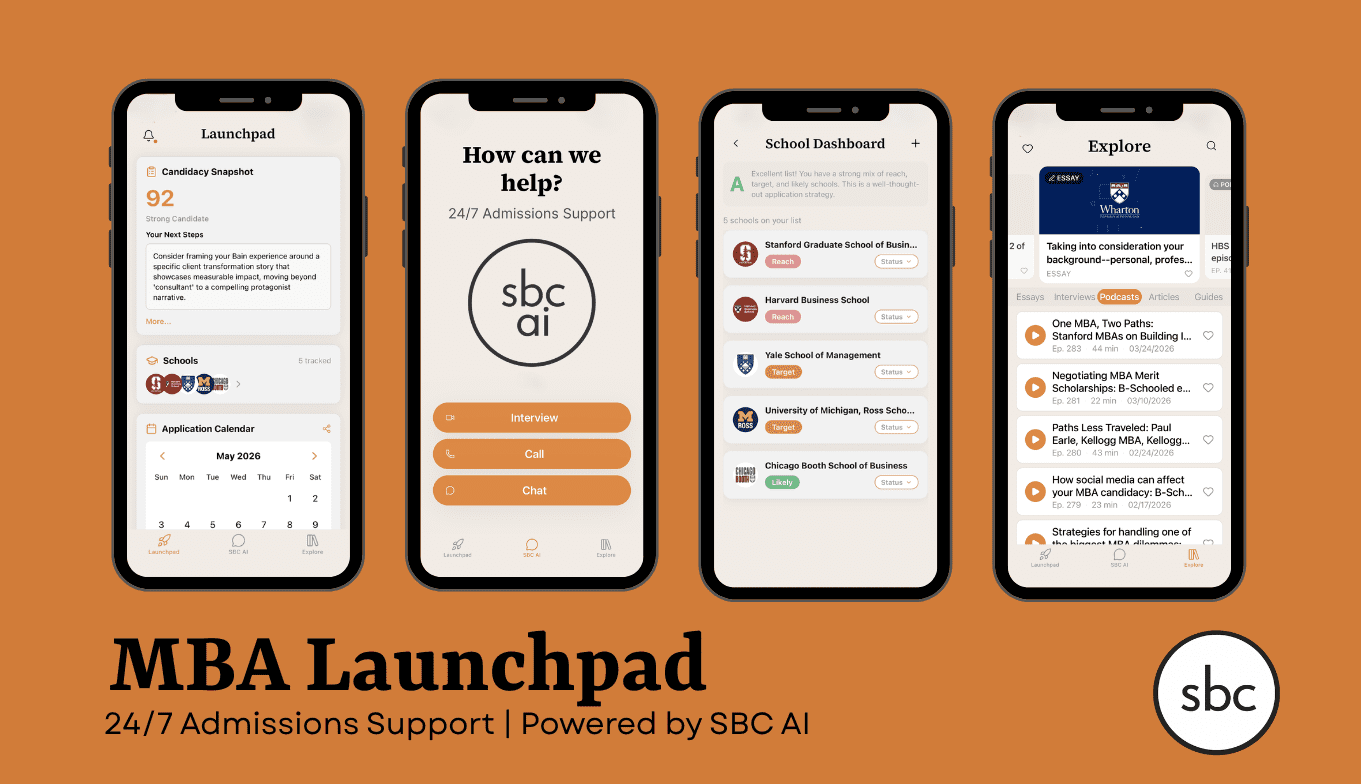
If consulting is your post-MBA goal, the schools you choose shape your odds. MBA Launchpad by SBC is an AI-powered admissions assistant built on 25+ years of real SBC admissions data. Compare programs on base income after graduation, class size, admit rate, academic specialties, and more, then use it to assess your candidacy, build a balanced school list, and pressure-test your essay strategy 24/7. Premium features are currently free. Download it on the App Store or Google Play.
Here’s a snapshot of the caliber of expertise on our SBC team.










Ashley
Ashley is a former MBA Admissions Board Member for Harvard Business School (HBS), where she interviewed and evaluated thousands of business school applicants for over a six year tenure. Ashley holds an MBA from HBS. During her HBS years, Ashley was the Sports Editor for the Harbus and a member of the B-School Blades Ice Hockey Team. After HBS, she worked in Marketing at the Gillette Company on Male and Female shaving ...
×Pauline
A former associate director of admissions at Harvard Business School, Pauline served on the HBS MBA Admissions Board full-time for four years. She evaluated and interviewed HBS applicants, both on-campus and globally. Pauline's career has included sales and marketing management roles with Coca-Cola, Gillette, Procter & Gamble, and IBM. For over 10 years, Pauline has expertly guided MBA applicants, and her clients h ...
×Laura
Laura comes from the MBA Admissions Board at Harvard Business School (HBS) and is an HBS MBA alumnus. In her HBS Admissions role, she evaluated and interviewed hundreds of business school candidates, including internationals, women, military and other applicant pools, for five years. Prior to her time as a student at HBS, Laura began her career in advertising and marketing in Chicago at Leo Burnett where she worked on th ...
×Andrea
Andrea served as the Associate Director of MBA Admissions at Harvard Business School (HBS) for over five years. In this role, she provided strategic direction for student yield-management activities and also served as a full member of the admissions committee. In 2007, Andrea launched the new 2+2 Program at Harvard Business School – a program targeted at college junior applicants to Harvard Business School. Andrea has also served as a Career Coach for Harvard Business School for both cu ...
×Jennifer
Jennifer served as Admissions Officer at the Stanford (GSB) for five years. She holds an MBA from Stanford (GSB) and a B.S. in Chemical Engineering from University of Illinois Urbana-Champaign. Jennifer has over 15 years experience in guiding applicants through the increasingly competitive admissions process into top MBA programs. Having read thousands and thousands of essays and applications while at Stanford (GSB) Admiss ...
×Davina
Davina received her MBA from Stanford's Graduate School of Business (GSB), with a certificate in Public Management, and her BA in Psychology from UC Berkeley. Davina is an experienced strategic planning leader, facilitator, and business case writer who spent more than 15 years building culture, entrepreneurship, and leadership initiatives across Stanford University and the Stanford Graduate School of Business. She designed ...
×Erin
Erin served in key roles in MBA Admissions--as Director at Haas School of Business at UC Berkeley and Assistant Director at Stanford's Graduate School of Business (GSB). Erin served on the admissions committee at each school and has read thousands of applications in her career. At Haas, she served for seven years in roles that encompassed evaluation, outreach, and diversity and inclusion. During her tenure in Admissions at GSB, she was responsible for candidate evaluation, applicant outreach, ...
×Susie
Susie comes from the Admissions Office of the Stanford Graduate School of Business where she reviewed and evaluated hundreds of prospective students’ applications. She holds an MBA from Stanford’s GSB and a BA from Stanford in Economics. Prior to advising MBA applicants, Susie held a variety of roles over a 15-year period in capital markets, finance, and real estate, including as partner in one of the nation’s most innovative finance and real estate investment organizations. In that r ...
×Dione
Dione holds an MBA degree from Stanford Business School (GSB) and a BA degree from Stanford University, where she double majored in Economics and Communication with concentrations in journalism and sociology. Dione has served as an Admissions reader and member of the Minority Admissions Advisory Committee at Stanford. Dione is an accomplished and respected advocate and thought leader on education and diversity. She is ...
×Anthony
Anthony served as the Associate Director of MBA Admissions at the Wharton School at the University of Pennsylvania, where he dedicated over 10 years of expertise. During his time as a Wharton Admissions Officer, he read and reviewed thousands of applications and helped bring in a class of 800+ students a year. Anthony has traveled both domestically and internationally to recruit a ...
×Meghan
Meghan served as the Associate Director of Admissions and Marketing at the Wharton MBA’s Lauder Institute, a joint degree program combining the Wharton MBA with an MA in International Studies. In her role on the Wharton MBA admissions committee, Meghan advised domestic and international applicants; conducted interviews and information sessions domestically and overseas in Asia, Central and South America, and Europe; and evaluated applicants for admission to the program. Meghan also managed ...
×Amy
Amy comes from the Wharton School of the University of Pennsylvania where she was Associate Director. Amy devoted 12 years at the Wharton School, working closely with MBA students and supporting the admissions team. During her tenure at Wharton, Amy served as a trusted adviser to prospective applicants as well as admitted and matriculated students. She conducted admissions chats with applicants early in the admissions ...
×Ally
Ally brings six years of admissions experience to the SBC team, most recently as an Assistant Director of Admission for the full-time MBA program at Columbia Business School (CBS). During her time at Columbia, Ally was responsible for reviewing applications, planning recruitment events, and interviewing candidates for both the full-time MBA program and the Executive MBA program. She traveled both internationally and dome ...
×Emma
Emma comes from the MBA Admissions Office at Columbia Business School (CBS), where she was Associate Director. Emma conducted dozens of interviews each cycle for the MBA and EMBA programs, as well as coordinating the alumni ambassador interview program. She read and evaluated hundreds of applications each cycle, delivered information sessions to audiences across the globe, and advised countless waitlisted applicants. ×
Dana
Dana served as Assistant Director of Admissions at Columbia Business School for the Full-Time MBA program and has over 10 years of experience working in higher education. Known as a scrupulous file reader, Dana reviewed countless applications and assisted in rendering final decisions for the Admissions Committee at CBS. While leading information sessions at Columbia and on the road, Dana met and advised myriad applicants� ...
×Holly
Holly worked as a member of the NYU Stern MBA Admissions team for seven years and holds an MBA from NYU Stern. In her tenure as Director of NYU MBA Admissions, Holly worked closely with admissions teams from Columbia, Michigan Ross, UVA Darden, Cornell Johnson, Berkeley Haas, Yale SOM, and Duke Fuqua on recruiting events domestically and internationally. On the NYU Stern admissions committee, Holly conducted interviews, planned and hosted events, and trained staff on reading and interviewi ...
×Written by Esther Magna and reviewed by Stacy Blackman. Learn more about our former admissions officers on the SBC admissions team page.