B-Schooled Podcast Episode #311: Anthony Ritz on Reasoning Traps with Averages
Anthony Ritz, SBC’s director of test prep, is back on B-Schooled for another live round of GMAT critical reasoning with Stacy. If you caught episode #301 on indicator words, you know the format. Anthony reads an official question aloud, and Stacy works through it in real time. Listeners are invited to pause, set a two-minute timer, and play along. Stacy gamely plays guinea pig again, and hearing her reason out loud is half the fun. Both questions are included below, so you can try them before you listen.

This time the focus is on one logical flaw that kept turning up as Anthony classified over 1,100 official GMAT questions. Thirty of them hinge on it. The flaw involves averages, which can look reassuring while saying very little about what most people in a group are doing. Anthony also shares a striking side result from that project. After studying episode #301, Claude’s accuracy on boldface questions jumped from 84% to 98%.
From there, Anthony explains why the most popular wrong answer on the first question falls apart. He lays out the difference between mean and median in plain terms and brings a few memorable real-world examples, including one that proves nearly everyone has an above-average number of legs. Then he hands Stacy a tougher official question built on the same trap, where the correct answer seems to point the wrong way.
For GMAT and GRE test takers, the lesson is a pattern worth watching for. When a critical reasoning argument leans on an average, take a closer look. Anthony calls this data literacy, and he argues that anyone reading statistics needs it. It’s a useful skill beyond test day, too, especially when you’re sizing up a school’s average salary figures.
Try the GMAT Critical Reasoning Questions from Episode #311
Give each question two minutes before you listen to Stacy and Anthony work through it.
Question 1
Debater: The average amount of overtime per month worked by an employee in the manufacturing division of the Haglut Corporation is 14 hours. Most employees of the Haglut Corporation work in the manufacturing division. Furthermore, the average amount of overtime per month worked by any employee in the company generally does not fluctuate much from month to month. Therefore, each month, most employees of the Haglut Corporation almost certainly work at least some overtime.
The debater’s argument is most vulnerable to criticism on which of these grounds?
A. It takes for granted that the manufacturing division is a typical division of the corporation with regard to the average amount of overtime its employees work each month.
B. It takes for granted that if a certain average amount of overtime is worked each month by each employee of the Haglut Corporation, then approximately the same amount of overtime must be worked each month by each employee of the manufacturing division.
C. It confuses a claim from which the argument’s conclusion about the Haglut Corporation would necessarily follow with a claim that would follow from the argument’s conclusion only with a high degree of probability.
D. It overlooks the possibility that even if, on average, a certain amount of overtime is worked by the members of some group, many members of that group may work no overtime at all.
E. It overlooks the possibility that even if most employees of the corporation work some overtime each month, any one corporate employee may, in some months, work no overtime.
Question 2
Educational Theorist: Recent editorials have called for limits on the amount of homework assigned to schoolchildren younger than 12. They point out that free-time activities play an important role in childhood development and that homework in large quantities can severely restrict children’s free time, hindering their development. But the actual average homework time for children under 12—little more than 30 minutes per night—leaves plenty of free time. In reality, therefore, the editorials’ rationale cannot justify the restriction they advocate.
Which of the following, if true, would most seriously call into question the educational theorist’s conclusion?
A. Some teachers give as homework assignments work of a kind that research suggests is most effective educationally when done in class.
B. For children younger than 12, regularly doing homework in the first years of school has no proven academic value, but many educators believe that it fosters self-discipline and time management.
C. Some homework assignments are related to free-time activities that children engage in, such as reading or hobbies.
D. A substantial proportion of schoolchildren under 12, particularly those in their first few years of school, have less than 10 minutes of homework assigned per night.
E. Some free-time activities teach children skills or information that they later find useful in their schoolwork.
Questions from GMAC’s Official Guide.
Listen to B-Schooled episode #311 here, or on your favorite podcast app.
B-Schooled is available on most major podcast apps, including:
Prefer to read? View the transcript here.
Please subscribe to the B-Schooled podcast so you don’t miss a thing. If there’s something you’d like us to cover in a future episode, please email podcast@stacyblackman.com. We’d love to hear from you.
MBA Launchpad
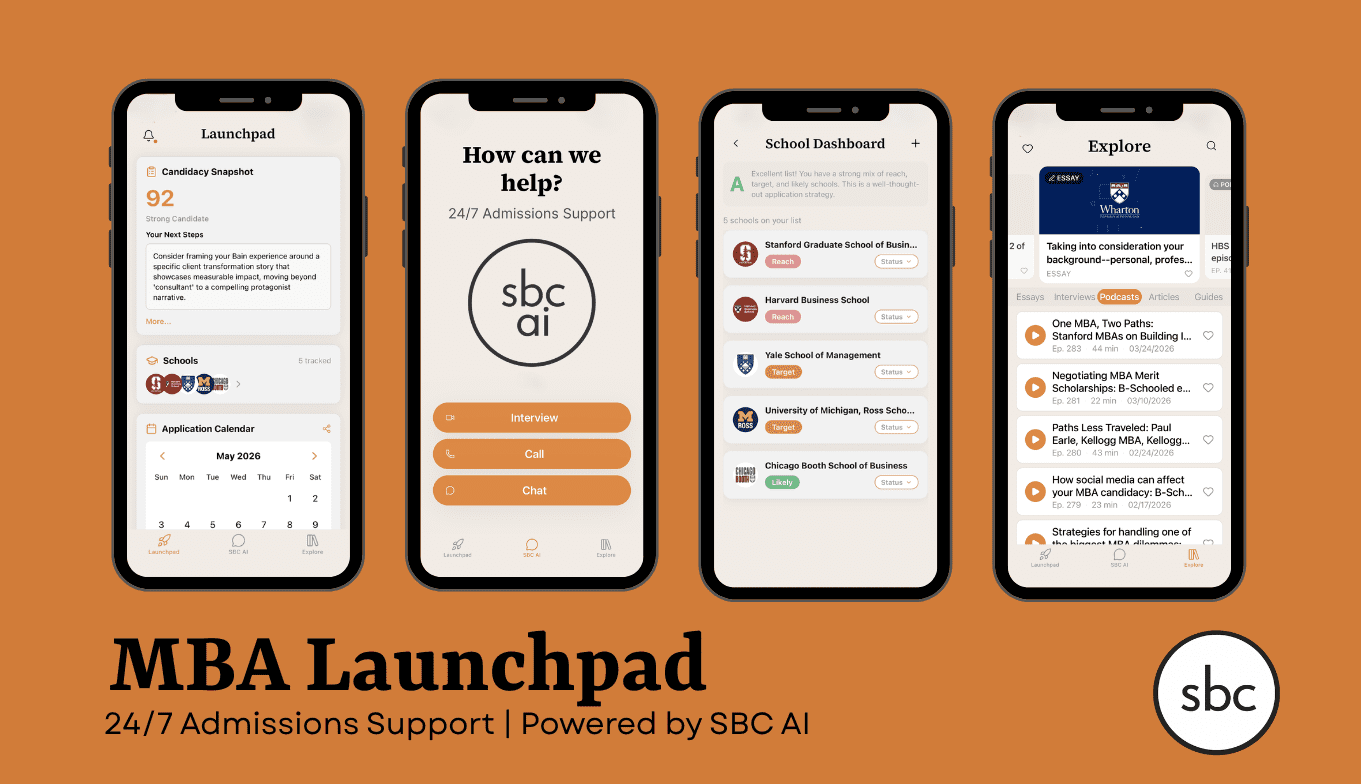
Don’t sleep on our latest product, MBA Launchpad by SBC! Our AI-powered admissions assistant is built on 25+ years of real SBC admissions data, and it lets you compare top programs on class size, admit rate, average GPA and test scores, teaching style, culture, and more. Once you’re applying, it can also help you practice for your MBA interviews. Premium features are currently free. Download it on the App Store or Google Play.
Here’s a snapshot of the caliber of expertise on our SBC team.
















Ashley
Ashley is a former MBA Admissions Board Member for Harvard Business School (HBS), where she interviewed and evaluated thousands of business school applicants for over a six year tenure. Ashley holds an MBA from HBS. During her HBS years, Ashley was the Sports Editor for the Harbus and a member of the B-School Blades Ice Hockey Team. After HBS, she worked in Marketing at the Gillette Company on Male and Female shaving ...
×Pauline
A former associate director of admissions at Harvard Business School, Pauline served on the HBS MBA Admissions Board full-time for four years. She evaluated and interviewed HBS applicants, both on-campus and globally. Pauline's career has included sales and marketing management roles with Coca-Cola, Gillette, Procter & Gamble, and IBM. For over 10 years, Pauline has expertly guided MBA applicants, and her clients h ...
×Laura
Laura comes from the MBA Admissions Board at Harvard Business School (HBS) and is an HBS MBA alumnus. In her HBS Admissions role, she evaluated and interviewed hundreds of business school candidates, including internationals, women, military and other applicant pools, for five years. Prior to her time as a student at HBS, Laura began her career in advertising and marketing in Chicago at Leo Burnett where she worked on th ...
×Andrea
Andrea served as the Associate Director of MBA Admissions at Harvard Business School (HBS) for over five years. In this role, she provided strategic direction for student yield-management activities and also served as a full member of the admissions committee. In 2007, Andrea launched the new 2+2 Program at Harvard Business School – a program targeted at college junior applicants to Harvard Business School. Andrea has also served as a Career Coach for Harvard Business School for both cu ...
×Jennifer
Jennifer served as Admissions Officer at the Stanford (GSB) for five years. She holds an MBA from Stanford (GSB) and a B.S. in Chemical Engineering from University of Illinois Urbana-Champaign. Jennifer has over 15 years experience in guiding applicants through the increasingly competitive admissions process into top MBA programs. Having read thousands and thousands of essays and applications while at Stanford (GSB) Admiss ...
×Davina
Davina received her MBA from Stanford's Graduate School of Business (GSB), with a certificate in Public Management, and her BA in Psychology from UC Berkeley. Davina is an experienced strategic planning leader, facilitator, and business case writer who spent more than 15 years building culture, entrepreneurship, and leadership initiatives across Stanford University and the Stanford Graduate School of Business. She designed ...
×Erin
Erin served in key roles in MBA Admissions--as Director at Haas School of Business at UC Berkeley and Assistant Director at Stanford's Graduate School of Business (GSB). Erin served on the admissions committee at each school and has read thousands of applications in her career. At Haas, she served for seven years in roles that encompassed evaluation, outreach, and diversity and inclusion. During her tenure in Admissions at GSB, she was responsible for candidate evaluation, applicant outreach, ...
×Susie
Susie comes from the Admissions Office of the Stanford Graduate School of Business where she reviewed and evaluated hundreds of prospective students’ applications. She holds an MBA from Stanford’s GSB and a BA from Stanford in Economics. Prior to advising MBA applicants, Susie held a variety of roles over a 15-year period in capital markets, finance, and real estate, including as partner in one of the nation’s most innovative finance and real estate investment organizations. In that r ...
×Dione
Dione holds an MBA degree from Stanford Business School (GSB) and a BA degree from Stanford University, where she double majored in Economics and Communication with concentrations in journalism and sociology. Dione has served as an Admissions reader and member of the Minority Admissions Advisory Committee at Stanford. Dione is an accomplished and respected advocate and thought leader on education and diversity. She is ...
×Anthony
Anthony served as the Associate Director of MBA Admissions at the Wharton School at the University of Pennsylvania, where he dedicated over 10 years of expertise. During his time as a Wharton Admissions Officer, he read and reviewed thousands of applications and helped bring in a class of 800+ students a year. Anthony has traveled both domestically and internationally to recruit a ...
×Meghan
Meghan served as the Associate Director of Admissions and Marketing at the Wharton MBA’s Lauder Institute, a joint degree program combining the Wharton MBA with an MA in International Studies. In her role on the Wharton MBA admissions committee, Meghan advised domestic and international applicants; conducted interviews and information sessions domestically and overseas in Asia, Central and South America, and Europe; and evaluated applicants for admission to the program. Meghan also managed ...
×Amy
Amy comes from the Wharton School of the University of Pennsylvania where she was Associate Director. Amy devoted 12 years at the Wharton School, working closely with MBA students and supporting the admissions team. During her tenure at Wharton, Amy served as a trusted adviser to prospective applicants as well as admitted and matriculated students. She conducted admissions chats with applicants early in the admissions ...
×Ally
Ally brings six years of admissions experience to the SBC team, most recently as an Assistant Director of Admission for the full-time MBA program at Columbia Business School (CBS). During her time at Columbia, Ally was responsible for reviewing applications, planning recruitment events, and interviewing candidates for both the full-time MBA program and the Executive MBA program. She traveled both internationally and dome ...
×Emma
Emma comes from the MBA Admissions Office at Columbia Business School (CBS), where she was Associate Director. Emma conducted dozens of interviews each cycle for the MBA and EMBA programs, as well as coordinating the alumni ambassador interview program. She read and evaluated hundreds of applications each cycle, delivered information sessions to audiences across the globe, and advised countless waitlisted applicants. ×
Dana
Dana served as Assistant Director of Admissions at Columbia Business School for the Full-Time MBA program and has over 10 years of experience working in higher education. Known as a scrupulous file reader, Dana reviewed countless applications and assisted in rendering final decisions for the Admissions Committee at CBS. While leading information sessions at Columbia and on the road, Dana met and advised myriad applicants� ...
×Holly
Holly worked as a member of the NYU Stern MBA Admissions team for seven years and holds an MBA from NYU Stern. In her tenure as Director of NYU MBA Admissions, Holly worked closely with admissions teams from Columbia, Michigan Ross, UVA Darden, Cornell Johnson, Berkeley Haas, Yale SOM, and Duke Fuqua on recruiting events domestically and internationally. On the NYU Stern admissions committee, Holly conducted interviews, planned and hosted events, and trained staff on reading and interviewi ...
×