How to Get Into Harvard Business School
Learning how to get into Harvard Business School starts with the three characteristics HBS says every student shares: business-minded, leadership-focused, and growth-oriented. Strong scores and a polished resume get you considered. Admits stand out by showing all three traits across their essays, resume, recommendations, and interview, with honest reflection on how they’ve grown and invested in others.
Quick Summary
- Use HBS’s three characteristics as a lens for your whole application. Your resume, recommendations, and short answers should support the same story your essays tell.
- Give each short essay a different story, and spend most of your words on what you learned and how you changed.
- Watch your tone. Confidence without arrogance tells the admissions committee how you’ll show up in the case-method classroom.
What Does It Take to Get Into Harvard Business School?
Statistically, Harvard Business School is one of the most competitive MBA programs in the world. Every year, thousands of applicants with elite test scores and blue-chip resumes are turned away. Successful candidates set themselves apart by convincingly showing that they fit the characteristics HBS looks for.
Harvard’s MBA admissions committee is assessing who will have the greatest long-term impact. That means understanding not only what you’ve done, but how you’ve grown, invested in others, and engaged with the world around you along the way.
At Stacy Blackman Consulting, we’ve helped more clients earn admission to HBS than to any other program. Our team includes several former HBS Admissions Board members who have reviewed thousands of applications and interviewed hundreds of candidates. Drawing from years of client data and insider experience, we’ve identified the attributes that consistently define Harvard Business School admits, and how you can convey them in your own story.
Curious about your chances of getting into a top B-school like HBS? Contact us for a free 15-minute advising session with an SBC Principal Consultant to talk strategy.
What Is HBS Looking For in the Current Admissions Cycle?
Harvard Business School’s mission is to educate leaders who make a difference in the world. After roughly a decade of a single open-ended essay, HBS moved to three short essays in the 2024-2025 cycle. It refined the wording of the first two prompts the following year. Those prompts remain unchanged for 2026-2027, and each one maps directly to one of the school’s three stated characteristics.
“While it’s important to us that our students’ perspectives vary, they all share three characteristics. Our students are: business-minded, leadership-focused, and growth-oriented,” the school states.
These prompts push applicants toward deeper self-reflection, asking them to articulate not only what they’ve achieved but why it matters. Below, we break down each characteristic, what HBS looks for in your application, and how our successful admits have demonstrated it, based on our review of hundreds of HBS admit profiles.
How Do You Show HBS You’re Business-Minded?
HBS wants people who see business as a force for good: people eager to improve companies, industries, and the world, whether in the private, public, or nonprofit sector. The school says it looks for three things in your application to judge this: your interpersonal skills, your quantitative abilities, and how you plan to create impact through business.
Analytical horsepower sits at the center of being business-minded. The AdCom needs evidence that you can thrive in HBS’s rigorous, case-based classroom, and it looks for that evidence across your whole application, not just your test score.
“Academic, analytical, and quantitative prowess is crucial, as HBS AdCom will look at the applicant’s GPA and test score. HBS AdCom will also comb through transcripts and consider the skills the applicant exercised and built in his or her work experiences,” says SBC consultant Andrea, who served on the HBS Admissions Board for five years.
HBS accepts either the GMAT or the GRE and has no preference between them. Your work history matters just as much: the analytical skills you’ve built on the job can reinforce, or make up for, what your transcript and scores show. Your interpersonal skills come through in how you describe working with colleagues, clients, and teams in your resume, employment entries, and essays.

Do You Need an Ivy League Degree to Get Into HBS?
The school pedigree of Harvard Business School admits varies considerably. Our past successful clients have included graduates of universities across Asia, Europe, Latin America, and the Middle East.
| Duke | University of Minnesota |
| Vanderbilt | Brown |
| Princeton | Waseda (Tokyo) |
| UC Santa Barbara | Harvard |
| Williams | Yale |
| U Sao Paulo | UC Berkeley |
| Cornell | Boston University |
| Wesleyan | Middle East University |
| UVA | U Maryland |
| UT Austin | Michigan |
| Univ. Warwick (UK) | Dartmouth |
| U Penn | UCLA |
As this range of alma maters shows, there’s no single pipeline into Harvard Business School. What matters is how you’ve made the most of the opportunities you had. To better understand the numbers behind the competition, check out our analysis of HBS acceptance rates.
HBS is explicit that a business inclination shows up in people from many professional and educational backgrounds, not only traditional business ones. The school welcomes applicants with humanities and STEM degrees, too. So even if your college classes weren’t quant-heavy, there are other ways to show you can handle the program’s intellectual rigor.
“Strong work experience can compensate for lack of quant classes in college,” Andrea notes.
Listen to B-Schooled Podcast Episode #97: HBS FAQs (and Life Advice) with Dawn
How Should You Connect Your Career Choices to Your Goals?
Being business-minded is also forward-looking. HBS wants to understand how you plan to create impact, which is why the Business-Minded essay asks you to reflect on how your choices have shaped your career path and aspirations. Admissions officers want to see clear logic connecting where you’ve been, the decisions you made along the way, and where you want to go next.
SBC consultant Yvette, an HBS graduate who has collaborated on writing HBS cases, encourages applicants to show a journey rather than a single career move. “It’s not enough to say, here’s one thing I did, but you want to think about at least two steps that you took,” she says. Those steps might be a shift in function, industry, project type, or employer, each tied back to the experiences that shaped you.
She also urges applicants to share the vision behind their goals. Whether you want to make partner or launch a company, “there is usually a vision behind that of something you want to change or you want to impact.”
Common Pitfalls for this Essay:
- Stating facts instead of reflection. “I grew up in a family where various religions collided” is a fact, Yvette explains. The reflection is what it did to you: “Growing up in a family where religions collided at the dinner table made me really appreciate and see discussions as fruitful.”
- Assuming your goals must be altruistic. Every business can have a positive or negative impact on its customers, employees, communities, or the environment. You don’t need a nonprofit path to show you want to do good.
- Saying you’ll figure it out during the MBA. “That is a little bit like saying, you know, just let me in, admit me, trust me, I’ll figure it out,” Yvette says.
- Writing a “Why HBS” essay. The prompt doesn’t ask for it. As Chandler, a Stanford GSB alum, social impact CEO, and longtime host of SBC’s B-Schooled podcast, put it, “Harvard knows that Harvard is amazing. Harvard doesn’t need you to tell it how amazing it is. Harvard wants to hear about you.”
How Do You Show HBS You’re Leadership-Focused?
HBS looks for people who aspire to lead others toward making a difference, and who understand that lasting organizations depend on developing and nurturing diverse teams. The school says outright that you don’t need a formal leadership role to make a difference, and it deliberately admits many kinds of leaders, from front-line managers to startup founders to behind-the-scenes thought leaders. In your application, HBS says your leadership impact may show up most clearly in extracurriculars, community initiatives, or your professional work.
“Leadership can look a lot of different ways,” notes Andrea. For instance, “Capital L” leadership is one form. These are people in positions of authority, whose roles convey that they are leading the parade.
But we also see HBS admits who are “small-L” leaders. Irrespective of their actual job titles, these professionals are strategic, innovative, and proactive. Small-L leaders step up when needed and thrive when times are hard. Plus, they demonstrate leadership traits over time and can show that track record to HBS throughout their application.
Capital L leadership may include examples such as fraternity president, Eagle Scout, student council president, or varsity soccer team captain. Small-L examples include starting a recycling program in your dorm or launching a community garden to source local produce. Maybe you served as an effective role model and mentor at your firm, or developed a new way to approach building a financial model at your bank.
In a nutshell, Andrea says, “You saw a need, and you filled that need.” Harvard wants to see potential for large-scale impact, regardless of whether you’ve had the title yet. The ability to mobilize others and persist when challenges arise signals the kind of growth trajectory HBS values.
What Does HBS Mean by Investing in Others?
The current Leadership-Focused essay asks what experiences have shaped how you invest in others and how you lead. That wording matters. Alongside your results, HBS wants to understand how you develop, support, and elevate the people around you.
Yvette advises including “an example or a reflection on how you invest a valuable resource such as time or knowledge for the benefit of others.” Tutoring classmates, mentoring a new analyst, or opening doors for peers all count, as long as there’s a clear benefit for others.
Chandler reminds applicants that leadership isn’t limited to managing people. “You don’t have to personally manage three direct reports to be a leader,” he says. Cross-functional working groups, task forces, nonprofit boards, sports teams, and military service can all provide strong examples.
Specificity Matters
- Show a pattern. Yvette suggests linking experiences, such as leading the finance club and later bringing recruiters to campus, to show leadership is a habit rather than a one-off.
- Pick a “Goldilocks moment.” A childhood anecdote can open the essay, but your core example should come from a time when you were building MBA-relevant skills like collaboration and communication.
- Say “I,” not “we.” “It’s great to give credit, but you also need to be clear about what you did,” Yvette says.
- Don’t be too generic. Yvette warns against a polished success story that reads like something an AI tool would produce. The examples that truly teach you something tend to include problem solving, setbacks, and even failure.
- Answer every part of the question. Make it obvious you’re addressing both how you invest in others and how you lead. Chandler suggests echoing the prompt’s language so a fast-reading admissions officer can’t miss it.
Leadership examples should appear throughout the entire HBS application, not just the essay. That includes your short responses on work experience entries, your activities and awards, your resume, and your recommendations. “Leadership is demonstrated not only in the roles and titles held, elections won, etc., but also in how you interact with others and ways in which you’ve made an impact alone or with others,” Andrea explains.
How Do You Show HBS You’re Growth-Oriented?
HBS wants students who broaden their perspectives through creative problem solving, active listening, and lively discussion. The case and field methods only work when curious students listen and learn from faculty and classmates while contributing ideas of their own. In your application, HBS says it will look at how you have grown and developed, and how you engage with the world around you.
How Can You Demonstrate Intellectual Curiosity?
Intellectual curiosity sits at the heart of this characteristic. The Growth-Oriented essay asks you to share an example of how you have demonstrated curiosity and how it has influenced your growth.
“Intellectual curiosity and horsepower are buried in there. This can come across as dorky, but to HBS, dorky is good!” Andrea says.
Andrea continues, “Research projects, thesis projects, reading and interests you develop on your own all qualify under horsepower. One’s quest to satiate his/her intellectual curiosity needs to shine through for the HBS application. This comes across in extracurriculars, awards, on the resume, and certainly in the HBS essay.”
Examples of “dorky-is-good” across our SBC client pool include:
- Pursuing research projects that weren’t required
- Taking on TA positions
- Working in a lab and writing a paper with a professor
- Opting to do original research for a thesis
- Developing a new curriculum with a faculty member
“This can be on display throughout the application. But the essay is a great place to really get a sense that a candidate thinks about the issues deeply and is on a quest to satisfy intellectual curiosity,” Andrea explains.
HBS loves lifelong learners. Whether your curiosity leads you into data science, philosophy, or social impact, what matters is the authenticity and consistency of your intellectual drive, and what it changed about you.
Yvette’s Content Tips:
- Focus on the why. “Hyper focus on the why something made you curious,” she says, rather than describing a place or event anyone would find interesting.
- Show a pursuit. “Curiosity is not a one-time thing.” Show how you kept following it over time.
- Find growth along the way. Growth often happens during the journey, not only at the end. Make sure the growth you describe “delights” and fits the kind of classmate and leader you’ll be.
Keep context to a minimum. Yvette suggests no more than two lines of background, and pushing yourself to use more “I” statements than feels natural so the essay stays about you.
If no example comes to mind right away, revisit the stories you already carry. Chandler points out that a successful initiative may have started with a moment of curiosity. Yvette adds that reframing a formative memory this way “is not unauthentic. That is self-reflection and a big part of how you get to great stories.”
Why Does Tone Matter in Your HBS Application?
Growth-oriented candidates make the people around them better, too. “Personal qualities encompass ethics, morals, values, judgment, and ego,” Andrea notes. That becomes especially significant if you’re invited to interview. She simplifies it as: “How you will play in the sandbox that is the HBS classroom.”
HBS’s collaborative learning model depends on students who contribute without dominating. The AdCom wants candidates who elevate classroom discussions and enrich the experience for peers from all backgrounds.
Andrea also says this comes through less in what you say than in the overall tone of how you say it. HBS doesn’t want egotistical or arrogant types in the program, and the written application is the first place readers have their antennae up for it. Remember: Harvard’s readers aren’t just assessing achievements. They’re assessing judgment. The tone of your writing offers an early glimpse into how you’ll show up as a classmate.
For example, take the applicant from a common demographic (investment banker) who comes from Darien, Connecticut, studied at an elite undergrad, and has traveled the world. That applicant must be very careful with the tone of their application and essays. The AdCom will be looking out for arrogance rooted in privileged life circumstances and choices.
“Talking in a braggy manner and discussing an over-the-top lifestyle would take the applicant out of the running. Instead, I recommend trying to present an unexpected application that shows real depth around how he makes a positive impact in the communities in which he’s spent time,” Andrea says.
It takes a lot to rise to the top of oversubscribed applicant populations. Therefore, if you are in an overpopulated pool, you must do things that set you apart from that herd.
What Are the HBS Essay Questions for 2026-2027?
Nowhere is this three-part framework tested more directly than in the essays. While resumes and transcripts prove competence, the essays are where the AdCom decides whether it wants to meet you.
Applicants to the Class of 2029 answer three prompts, 800 words in total:
| Essay | Prompt | Limit |
|---|---|---|
| Business-Minded | Please reflect on how your choices have influenced your career path and aspirations. | 300 words |
| Leadership-Focused | What experiences have shaped how you invest in others and how you lead? | 250 words |
| Growth-Oriented | Curiosity can be seen in many ways. Please share an example of how you have demonstrated curiosity and how that has influenced your growth. | 250 words |
The application also includes a short Post-MBA Goals section where you describe your career aspirations. Make sure it points in the same direction as your Business-Minded essay.
Andrea reveals that the essays are make-or-break for HBS. So many applicants have acceptable credentials up to that point. The essays set the application apart and earn the candidate an interview.
“Go deep. Get personal. Make sure the reader feels genuineness and authenticity. Make them get goosebumps while they are reading,” Andrea suggests. “At the end of the essay, the reader should feel so moved that they want to meet you immediately.”
How Do You Write Strong HBS Essays in 250 to 300 Words?
With only 250 to 300 words per essay, there’s no room to recount your whole resume. Our advice for the current format:
- Treat the three essays as a set. Each should reveal something new. Avoid reusing the same story, and make sure together they give a full picture of who you are.
- Choose one or two defining moments per essay and go deep. Depth and reflection beat a list of accomplishments.
- Answer the question HBS actually asks. The Business-Minded essay is about your choices, not your job descriptions. The Leadership-Focused essay is about how you invest in others, not just what your team delivered. The Growth-Oriented essay is about curiosity and what it changed in you.
- Show reflection, not just success. Andrea cautions that HBS essays cannot simply be a story of successes and accomplishments. Readers want to see how you think, what you learned, and how you’ve changed.
- Let your tone do work. Confidence without arrogance signals how you’ll show up in the classroom.
Strategies Culled from the B-Schooled Podcast:
- Think of the essays as chapters in a book. Each can stand alone, Yvette says, but “together they’re telling a story about you.” You might introduce a person or experience in one essay and develop it in another.
- Expect long first drafts. Chandler tells clients their early drafts may run 900 to 1,000 words before they’re whittled down to the limit.
- Apply the “so what” test. After each sentence, ask why it’s there. If it doesn’t reveal what you thought, felt, struggled with, or learned, or provide essential context, cut it.
- Don’t repeat yourself. Unpack a meaningful experience once rather than referencing it in several places, and use the remaining space to show another side of you.
- Aim for the four C’s. Chandler’s three C’s are concise, cohesive, and compelling. After talking with Yvette, he added a fourth: connective. “One thing you’re trying to do with these essays is to build a connection with that admissions officer,” he says.
That emotional resonance is what separates strong essays from unforgettable ones. The essays readers remember tend to have purpose, vulnerability, and conviction. Ultimately, the most successful essays leave readers with one clear thought: this person will make a difference.
Read SBC’s collection of successful Harvard Business School essays.
Frequently Asked Questions About Getting Into Harvard Business School
Will a below-average GMAT or GRE score keep me out of HBS?
A score below the class median puts more weight on the rest of your record, and the admissions committee looks for analytical evidence across your whole application. Strengthen your case by describing the quantitative work you own in your employment entries and asking a recommender to speak to your analytical skills. If your transcript is light on quant, a recent business or statistics course with a strong grade can also help.
I’m a consultant or banker. Does applying from a crowded applicant pool hurt my chances?
Your pool sets a higher bar for standing out, since many of your peers will have similar resumes and similar deal or client stories. Lean on what only you can tell: the choices behind your career path, the people you’ve invested in, and the interests you’ve pursued outside work. Pay close attention to tone, too. Readers notice quickly when privilege or polish starts to sound like entitlement.
Is it risky to write about a failure or an unresolved challenge?
Applicants often worry that a setback will make them look weak, so they submit polished success stories that tell HBS very little. Readers learn far more from how you handled a problem that didn’t go your way. Keep the setup brief, own your part in it, and spend most of your words on what you changed afterward. An experience that’s still unfolding works too, as long as you can show what it has already taught you.
Should my essays repeat the highlights from my resume?
Repeating your resume wastes the limited space HBS gives you. The admissions committee reads your resume, employment entries, and activities alongside the essays, so treat each part as new evidence. Your resume can show the scope of a role, while an essay explains the decision that took you there or what you learned from a teammate. Together they should add up to one consistent picture of you.
What Is the Most Important Thing to Remember When Applying to HBS?
A successful HBS application weaves together a story that shows you’re business-minded, leadership-focused, and growth-oriented. Whether your impact plays out on a trading floor, in a startup, or in your community, the key is to show how you’ve already begun making a difference and how an HBS MBA will amplify that trajectory.
Understanding how to get into Harvard Business School means recognizing that the AdCom is searching for more than excellence on paper. It is looking for principled leaders who are curious, invest in the people around them, and are committed to creating value beyond themselves. The process demands introspection and authenticity, but for those who do the hard work of reflection, the payoff is transformative.
At Stacy Blackman Consulting, we have seen firsthand that no two paths to HBS are alike. Yet every admit we have worked with shared one thing: a clear sense of purpose. With strategic storytelling, honest self-assessment, and expert guidance, you can turn your ambition into action and take the next step toward making a difference in the world.
Stacy Blackman Consulting offers multiple services to meet your MBA application needs, from our All-In Partnership to hourly help reviewing your MBA resume. Contact us today for a free 15-minute advising session to talk strategy with a Principal SBC consultant.
MBA Launchpad
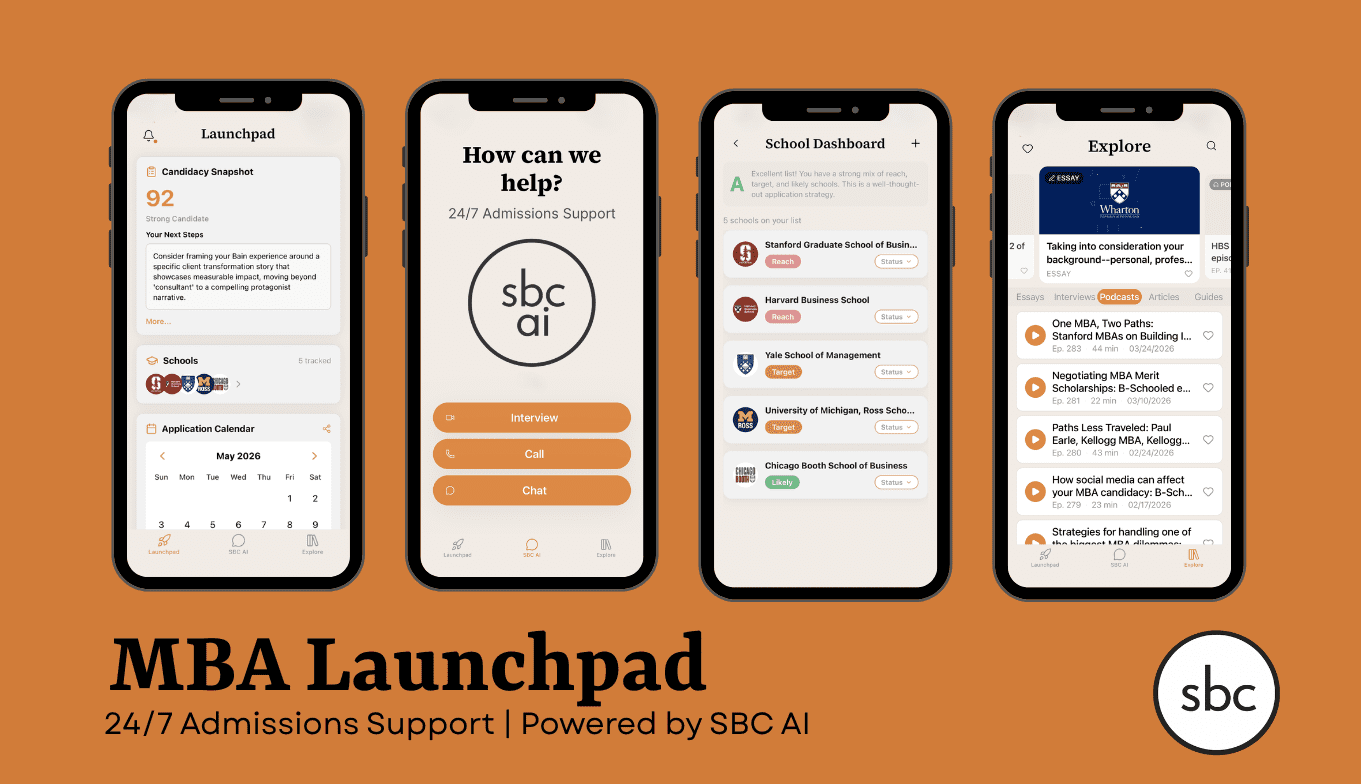
Don’t sleep on our latest product, MBA Launchpad by SBC! Our AI-powered admissions assistant is built on 25+ years of real SBC admissions data, and it lets you compare HBS, Stanford, and other top programs on class size, admit rate, average GPA and test scores, teaching style, culture, and more. Once you’re applying, it can also help you practice for your HBS interview. Premium features are currently free. Download it on the App Store or Google Play.
Here’s a snapshot of the caliber of expertise on our SBC team.











Ashley
Ashley is a former MBA Admissions Board Member for Harvard Business School (HBS), where she interviewed and evaluated thousands of business school applicants for over a six year tenure. Ashley holds an MBA from HBS. During her HBS years, Ashley was the Sports Editor for the Harbus and a member of the B-School Blades Ice Hockey Team. After HBS, she worked in Marketing at the Gillette Company on Male and Female shaving ...
×Pauline
A former associate director of admissions at Harvard Business School, Pauline served on the HBS MBA Admissions Board full-time for four years. She evaluated and interviewed HBS applicants, both on-campus and globally. Pauline's career has included sales and marketing management roles with Coca-Cola, Gillette, Procter & Gamble, and IBM. For over 10 years, Pauline has expertly guided MBA applicants, and her clients h ...
×Laura
Laura comes from the MBA Admissions Board at Harvard Business School (HBS) and is an HBS MBA alumnus. In her HBS Admissions role, she evaluated and interviewed hundreds of business school candidates, including internationals, women, military and other applicant pools, for five years. Prior to her time as a student at HBS, Laura began her career in advertising and marketing in Chicago at Leo Burnett where she worked on th ...
×Andrea
Andrea served as the Associate Director of MBA Admissions at Harvard Business School (HBS) for over five years. In this role, she provided strategic direction for student yield-management activities and also served as a full member of the admissions committee. In 2007, Andrea launched the new 2+2 Program at Harvard Business School – a program targeted at college junior applicants to Harvard Business School. Andrea has also served as a Career Coach for Harvard Business School for both cu ...
×Jennifer
Jennifer served as Admissions Officer at the Stanford (GSB) for five years. She holds an MBA from Stanford (GSB) and a B.S. in Chemical Engineering from University of Illinois Urbana-Champaign. Jennifer has over 15 years experience in guiding applicants through the increasingly competitive admissions process into top MBA programs. Having read thousands and thousands of essays and applications while at Stanford (GSB) Admiss ...
×Davina
Davina received her MBA from Stanford's Graduate School of Business (GSB), with a certificate in Public Management, and her BA in Psychology from UC Berkeley. Davina is an experienced strategic planning leader, facilitator, and business case writer who spent more than 15 years building culture, entrepreneurship, and leadership initiatives across Stanford University and the Stanford Graduate School of Business. She designed ...
×Erin
Erin served in key roles in MBA Admissions--as Director at Haas School of Business at UC Berkeley and Assistant Director at Stanford's Graduate School of Business (GSB). Erin served on the admissions committee at each school and has read thousands of applications in her career. At Haas, she served for seven years in roles that encompassed evaluation, outreach, and diversity and inclusion. During her tenure in Admissions at GSB, she was responsible for candidate evaluation, applicant outreach, ...
×Susie
Susie comes from the Admissions Office of the Stanford Graduate School of Business where she reviewed and evaluated hundreds of prospective students’ applications. She holds an MBA from Stanford’s GSB and a BA from Stanford in Economics. Prior to advising MBA applicants, Susie held a variety of roles over a 15-year period in capital markets, finance, and real estate, including as partner in one of the nation’s most innovative finance and real estate investment organizations. In that r ...
×Dione
Dione holds an MBA degree from Stanford Business School (GSB) and a BA degree from Stanford University, where she double majored in Economics and Communication with concentrations in journalism and sociology. Dione has served as an Admissions reader and member of the Minority Admissions Advisory Committee at Stanford. Dione is an accomplished and respected advocate and thought leader on education and diversity. She is ...
×Anthony
Anthony served as the Associate Director of MBA Admissions at the Wharton School at the University of Pennsylvania, where he dedicated over 10 years of expertise. During his time as a Wharton Admissions Officer, he read and reviewed thousands of applications and helped bring in a class of 800+ students a year. Anthony has traveled both domestically and internationally to recruit a ...
×Meghan
Meghan served as the Associate Director of Admissions and Marketing at the Wharton MBA’s Lauder Institute, a joint degree program combining the Wharton MBA with an MA in International Studies. In her role on the Wharton MBA admissions committee, Meghan advised domestic and international applicants; conducted interviews and information sessions domestically and overseas in Asia, Central and South America, and Europe; and evaluated applicants for admission to the program. Meghan also managed ...
×Amy
Amy comes from the Wharton School of the University of Pennsylvania where she was Associate Director. Amy devoted 12 years at the Wharton School, working closely with MBA students and supporting the admissions team. During her tenure at Wharton, Amy served as a trusted adviser to prospective applicants as well as admitted and matriculated students. She conducted admissions chats with applicants early in the admissions ...
×Ally
Ally brings six years of admissions experience to the SBC team, most recently as an Assistant Director of Admission for the full-time MBA program at Columbia Business School (CBS). During her time at Columbia, Ally was responsible for reviewing applications, planning recruitment events, and interviewing candidates for both the full-time MBA program and the Executive MBA program. She traveled both internationally and dome ...
×Emma
Emma comes from the MBA Admissions Office at Columbia Business School (CBS), where she was Associate Director. Emma conducted dozens of interviews each cycle for the MBA and EMBA programs, as well as coordinating the alumni ambassador interview program. She read and evaluated hundreds of applications each cycle, delivered information sessions to audiences across the globe, and advised countless waitlisted applicants. ×
Dana
Dana served as Assistant Director of Admissions at Columbia Business School for the Full-Time MBA program and has over 10 years of experience working in higher education. Known as a scrupulous file reader, Dana reviewed countless applications and assisted in rendering final decisions for the Admissions Committee at CBS. While leading information sessions at Columbia and on the road, Dana met and advised myriad applicants� ...
×Holly
Holly worked as a member of the NYU Stern MBA Admissions team for seven years and holds an MBA from NYU Stern. In her tenure as Director of NYU MBA Admissions, Holly worked closely with admissions teams from Columbia, Michigan Ross, UVA Darden, Cornell Johnson, Berkeley Haas, Yale SOM, and Duke Fuqua on recruiting events domestically and internationally. On the NYU Stern admissions committee, Holly conducted interviews, planned and hosted events, and trained staff on reading and interviewi ...
×Written by Yvonne Milosevic. Reviewed by Stacy Blackman. Learn more about our former admissions officers on the SBC admissions team page.