The 2026 U.S. News MBA Rankings Are Here
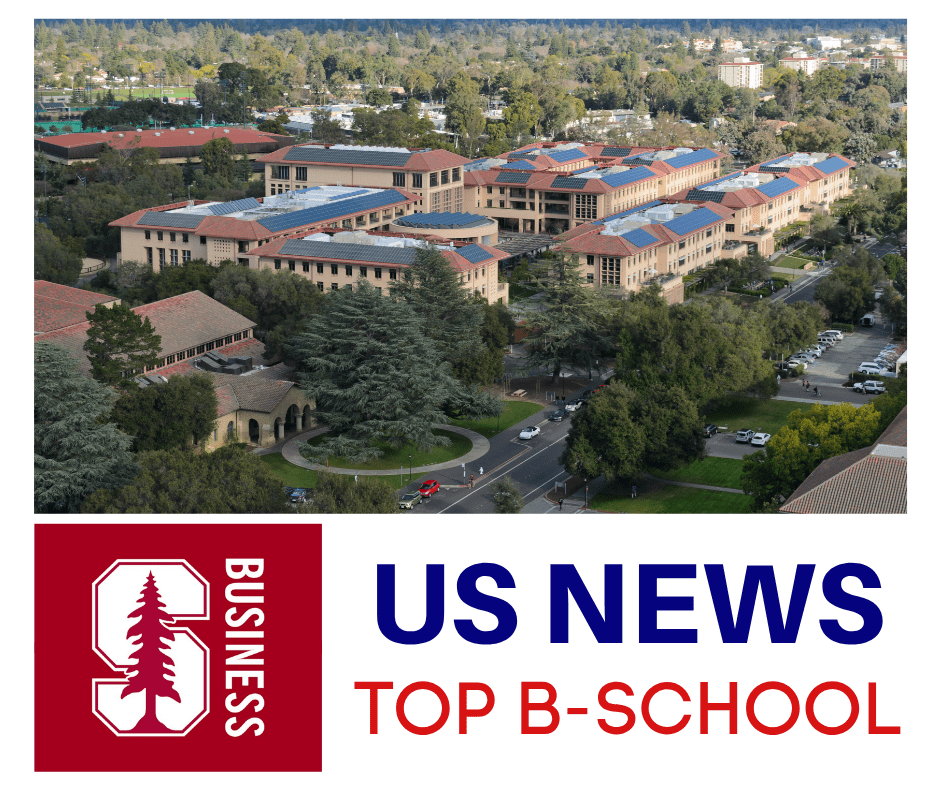
It’s April, which means one thing in MBA admissions: U.S. News & World Report has released its annual rankings, and everyone has opinions. This year’s list has a familiar face at the top, a quiet comeback story at #4, and one placement number that stopped us mid-scroll.
According to the 2026 U.S. News MBA rankings, Stanford GSB reclaims sole possession of #1, nudging last year’s leader, the Wharton School, into second place. Chicago Booth rises to third. And in one of the more notable developments this cycle, Harvard Business School rebounds two spots into a tie for fourth with Northwestern Kellogg—which, after a period of peak momentum that included a #2 finish last year, has cooled slightly.
Here’s the full Top 20 US News MBA Rankings:
#1: Stanford Graduate School of Business
#2: Wharton School (University of Pennsylvania)
#3: Chicago Booth School of Business
#4 (tie): Harvard Business School
#4 (tie) Northwestern Kellogg School of Management
#6: MIT Sloan School of Management
#7 (tie): Columbia Business School
#7 (tie): NYU Stern School of Business
#9: Dartmouth Tuck School of Business
#10: UC Berkeley Haas School of Business
#11 (tie): UVA Darden School of Business
#11 (tie): Yale School of Management
#13: Michigan Ross School of Business
#14: Duke Fuqua School of Business
#15: Cornell Johnson Graduate School of Management
#16 (tie): CMU Tepper School of Business
#16 (tie): Vanderbilt Owen Graduate School of Management
#18 (tie): UCLA Anderson School of Management
#18 (tie): UT Austin McCombs School of Business
#20: University of Washington Foster School of Business
Same core cast. New order. But look closer, and the signals are worth paying attention to.
Curious about your chances at a top MBA program? Contact us to talk strategy with a free 15-minute advising session with an SBC Principal Consultant.
By the Numbers: Top 10 at a Glance
The table below draws directly from U.S. News school profiles. Employment figures reflect the percentage of graduates employed three months after graduation—a more complete picture than at-graduation rates, which can lag significantly at programs with heavy tech, entrepreneurship, and deferred-start recruiting pipelines. Salary figures are average base salary only and do not include signing bonuses.
| School | Rank | Acceptance | 3-Mo. Placement | Avg. Base Salary |
|---|---|---|---|---|
| Stanford GSB | #1 | 7% | 81% | $190K |
| Wharton | #2 | 18.6% | 87% | $179K |
| Chicago Booth | #3 | 27.3% | 87.8% | $172K |
| Harvard Business School | #4 (tie) | 11.2% | 84.4% | $180K |
| Kellogg | #4 (tie) | 28% | 85.5% | $167K |
| MIT Sloan | #6 | 18.8% | 87.1% | $173K |
| Columbia Business School | #7 (tie) | 25.7% | 90.4% | $170K |
| NYU Stern | #7 (tie) | 23.6% | 86% | $168K |
| Dartmouth Tuck | #9 | 28.3% | 86.9% | $168K |
| UC Berkeley Haas | #10 | 21.4% | 84.1% | $164K |
Source: U.S. News & World Report, 2026 Best Business Schools. Employment data reflects three-month post-graduation rates for 2024 and 2025 graduating classes combined. Salary reflects average base salary only.
The numbers tell a more nuanced story than the rankings alone. A few things worth flagging before we dig in. Stanford’s 7% acceptance rate stands in a category of its own. The next most selective program is Harvard at 11.2%, followed by a band of programs ranging from 18% to 28%. Worth knowing: the acceptance rate accounts for only 2% of a school’s total U.S. News score.
Columbia’s 90.4% three-month employment rate is the highest in the entire top 10—and it isn’t close. That’s a genuinely strong placement story, almost certainly driven by proximity to Wall Street and a deep finance recruiting pipeline.
The two West Coast schools, Stanford and Haas, post the lowest at-graduation employment rates in the top 10 at 53.7% and 62.6%, respectively. Both recover well at three months (81% and 84.1%). The pattern reflects Bay Area tech recruiting timelines, not a weakness in placement.
Kellogg’s base salary of $167,151 is the lowest of the top five, sitting nearly $24,000 behind Stanford. That gap is less about program quality than program mix. Kellogg places heavily into general management, marketing, and consulting roles that skew toward relationship-driven rather than finance-heavy compensation structures.
What’s Behind the 2026 U.S. News MBA Rankings Shakeups?
Half of every school’s score (50%) comes from Attainment Success: employment rates at graduation (7%), employment at three months (13%), mean starting salary and bonus (20%), and salary by profession (10%). The other half splits between quality assessments from peers and recruiters (25%) and student selectivity metrics (25%).
U.S. News held all ranking factors and weights identical to the prior two editions. What changed are individual schools’ underlying data points—the reshuffling at the top reflects real shifts in outcomes, not rule changes.
Stanford’s return to #1 reflects exactly what this formula rewards. The GSB posts the highest average base salary in the top 10 at $190,109, and its yield rate has held above 80% for years—a figure only Harvard can match.
Harvard’s rebound to #4 is a meaningful improvement. The 84.4% three-month employment rate this cycle is a significant uptick from the 76.9% figure in last year’s cycle. Harvard’s base salary of $180,889 has also closed the gap on Stanford considerably.
As a Kellogg MBA herself, Stacy has watched this school’s trajectory closely for decades—and the numbers reflect a program settling confidently into its tier after a genuine climb, not one in retreat. Last year’s post called it “Kellogg’s moment.” This year’s data suggests that moment wasn’t a spike. A tie for #4 in U.S. News is where a great program lands in a very competitive field.
Dartmouth Tuck drops three places to #9. Its 86.9% three-month employment rate and strong placement record remain intact. The drop likely reflects fractional score changes rather than any meaningful shift in program quality. UC Berkeley Haas holds at #10, maintaining its position as the highest-ranked public institution on the list.
Should You Trust These Rankings?
Here’s the straightforward answer: use them as a starting point, not a compass.
U.S. News commands more influence over public perception of MBA quality than any other ranking. That influence is real. But the formula captures a narrow slice of what makes a program valuable. Yield rates, endowment strength, fellowship generosity, and career trajectory over five or ten years: none of these appear in the calculation.
The proliferation of ties throughout this year’s list—at #4, #7, #11, #16, and #18—is a reminder of how difficult it is to meaningfully separate programs that are genuinely close in quality. The difference between #11 and #15 is unlikely to register in any hiring decision you’ll encounter after graduation.
One expansion worth noting: U.S. News this year significantly broadened its specialty rankings, featuring more than six times as many schools in subject areas like finance, marketing, and management. If you’re targeting a specific functional track, those specialty lists are worth your time.
The Bottom Line for Applicants
Stanford is #1. Wharton is #2. Harvard is back in the top five. And a cluster of strong programs between #11 and #20 are separated by margins that won’t register in any recruiter’s thinking about where you went.
The question that actually matters isn’t which school topped this year’s formula. It’s which school fits your goals, learning style, and vision for where you want to be five years after graduation. Stacy shares her take on exactly that in the reel below.
If you want to go deeper on how to think about rankings as one input rather than a directive, B-Schooled podcast episodes 155 and 157 are well worth your time:
B-Schooled Podcast Episode #155: 12 School Selection Considerations *Beyond* Rankings (Part 1)
B-Schooled Podcast Episode #157: 12 School Selection Considerations *Beyond* the Rankings (Pt. 2)
ROI is personal. Prestige is one variable among many. The best MBA program for you is the one that gets you where you want to go, not the one that topped a formula.
If you’re sorting through your school list and wondering where you fit, contact us for a free 15-minute advising session with a Principal SBC consultant.
For context on how this year’s results compare to last cycle, see our 2025 U.S. News MBA Rankings breakdown.
Stacy Blackman Consulting offers a range of services to meet your MBA application needs. From our All-In Partnership to interview prep, essay editing, resume review, and much more, we’ve got you covered. Contact us today for a free 15-minute advising session.
Here’s a snapshot of the caliber of expertise on our SBC team.









Ashley
Ashley is a former MBA Admissions Board Member for Harvard Business School (HBS), where she interviewed and evaluated thousands of business school applicants for over a six year tenure. Ashley holds an MBA from HBS. During her HBS years, Ashley was the Sports Editor for the Harbus and a member of the B-School Blades Ice Hockey Team. After HBS, she worked in Marketing at the Gillette Company on Male and Female shaving ...
×Pauline
A former associate director of admissions at Harvard Business School, Pauline served on the HBS MBA Admissions Board full-time for four years. She evaluated and interviewed HBS applicants, both on-campus and globally. Pauline's career has included sales and marketing management roles with Coca-Cola, Gillette, Procter & Gamble, and IBM. For over 10 years, Pauline has expertly guided MBA applicants, and her clients h ...
×Laura
Laura comes from the MBA Admissions Board at Harvard Business School (HBS) and is an HBS MBA alumnus. In her HBS Admissions role, she evaluated and interviewed hundreds of business school candidates, including internationals, women, military and other applicant pools, for five years. Prior to her time as a student at HBS, Laura began her career in advertising and marketing in Chicago at Leo Burnett where she worked on th ...
×Andrea
Andrea served as the Associate Director of MBA Admissions at Harvard Business School (HBS) for over five years. In this role, she provided strategic direction for student yield-management activities and also served as a full member of the admissions committee. In 2007, Andrea launched the new 2+2 Program at Harvard Business School – a program targeted at college junior applicants to Harvard Business School. Andrea has also served as a Career Coach for Harvard Business School for both cu ...
×Jennifer
Jennifer served as Admissions Officer at the Stanford (GSB) for five years. She holds an MBA from Stanford (GSB) and a B.S. in Chemical Engineering from University of Illinois Urbana-Champaign. Jennifer has over 15 years experience in guiding applicants through the increasingly competitive admissions process into top MBA programs. Having read thousands and thousands of essays and applications while at Stanford (GSB) Admiss ...
×Davina
Davina received her MBA from Stanford's Graduate School of Business (GSB), with a certificate in Public Management, and her BA in Psychology from UC Berkeley. Davina is an experienced strategic planning leader, facilitator, and business case writer who spent more than 15 years building culture, entrepreneurship, and leadership initiatives across Stanford University and the Stanford Graduate School of Business. She designed ...
×Erin K.
Erin served in key roles in MBA Admissions--as Director at Haas School of Business at UC Berkeley and Assistant Director at Stanford's Graduate School of Business (GSB). Erin served on the admissions committee at each school and has read thousands of applications in her career. At Haas, she served for seven years in roles that encompassed evaluation, outreach, and diversity and inclusion. During her tenure in Admissions at GSB, she was responsible for candidate evaluation, applicant outreach, ...
×Susie
Susie comes from the Admissions Office of the Stanford Graduate School of Business where she reviewed and evaluated hundreds of prospective students’ applications. She holds an MBA from Stanford’s GSB and a BA from Stanford in Economics. Prior to advising MBA applicants, Susie held a variety of roles over a 15-year period in capital markets, finance, and real estate, including as partner in one of the nation’s most innovative finance and real estate investment organizations. In that r ...
×Dione
Dione holds an MBA degree from Stanford Business School (GSB) and a BA degree from Stanford University, where she double majored in Economics and Communication with concentrations in journalism and sociology. Dione has served as an Admissions reader and member of the Minority Admissions Advisory Committee at Stanford. Dione is an accomplished and respected advocate and thought leader on education and diversity. She is ...
×Anthony
Anthony served as the Associate Director of MBA Admissions at the Wharton School at the University of Pennsylvania, where he dedicated over 10 years of expertise. During his time as a Wharton Admissions Officer, he read and reviewed thousands of applications and helped bring in a class of 800+ students a year. Anthony has traveled both domestically and internationally to recruit a ...
×Meghan
Meghan served as the Associate Director of Admissions and Marketing at the Wharton MBA’s Lauder Institute, a joint degree program combining the Wharton MBA with an MA in International Studies. In her role on the Wharton MBA admissions committee, Meghan advised domestic and international applicants; conducted interviews and information sessions domestically and overseas in Asia, Central and South America, and Europe; and evaluated applicants for admission to the program. Meghan also managed ...
×Amy
Amy comes from the Wharton School of the University of Pennsylvania where she was Associate Director. Amy devoted 12 years at the Wharton School, working closely with MBA students and supporting the admissions team. During her tenure at Wharton, Amy served as a trusted adviser to prospective applicants as well as admitted and matriculated students. She conducted admissions chats with applicants early in the admissions ...
×Ally
Ally brings six years of admissions experience to the SBC team, most recently as an Assistant Director of Admission for the full-time MBA program at Columbia Business School (CBS). During her time at Columbia, Ally was responsible for reviewing applications, planning recruitment events, and interviewing candidates for both the full-time MBA program and the Executive MBA program. She traveled both internationally and dome ...
×Emma
Emma comes from the MBA Admissions Office at Columbia Business School (CBS), where she was Associate Director. Emma conducted dozens of interviews each cycle for the MBA and EMBA programs, as well as coordinating the alumni ambassador interview program. She read and evaluated hundreds of applications each cycle, delivered information sessions to audiences across the globe, and advised countless waitlisted applicants. ×
Dana
Dana served as Assistant Director of Admissions at Columbia Business School for the Full-Time MBA program and has over 10 years of experience working in higher education. Known as a scrupulous file reader, Dana reviewed countless applications and assisted in rendering final decisions for the Admissions Committee at CBS. While leading information sessions at Columbia and on the road, Dana met and advised myriad applicants� ...
×Holly
Holly worked as a member of the NYU Stern MBA Admissions team for seven years and holds an MBA from NYU Stern. In her tenure as Director of NYU MBA Admissions, Holly worked closely with admissions teams from Columbia, Michigan Ross, UVA Darden, Cornell Johnson, Berkeley Haas, Yale SOM, and Duke Fuqua on recruiting events domestically and internationally. On the NYU Stern admissions committee, Holly conducted interviews, planned and hosted events, and trained staff on reading and interviewi ...
×