10 Best Questions to Ask an MBA Student or Alum

The best way to understand what a business school is really like is to ask an MBA student or recent alum directly. Ask open-ended questions about why they chose the program, what the culture feels like, how career support paid off, and whether the degree was worth it. Their firsthand answers reveal what no brochure or ranking can.
Quick Summary
- Ask open-ended questions that invite stories. “What was that like?” gets you much further than anything answered with a simple yes or no.
- Talk to more than one person. A single student reflects their own goals and personality, while a range of voices reveals a program’s real character.
- Pay attention to what goes unsaid. Hesitation, caveats, and enthusiasm often tell you more about fit than a direct answer does.
Approach each conversation with curiosity, and treat the person’s time as a gift. The ten questions below move from why they enrolled, through what daily life is like, to whether they would do it all again.
Curious about your odds at a top program? Contact us for a free 15-minute advising session with an SBC Principal Consultant.
Why did you choose this MBA program?
This question uncovers the factors that actually drove their decision and the trade-offs they weighed along the way. Maybe they picked the program for a specific academic strength, a culture that felt like home, or a gut feeling after a campus visit. Their answer might point to reputation, curriculum, faculty, community, or location, and it may relate to personal values that no brochure captures. Listen for the reasoning behind their “why,” and consider whether the same factors line up with your own goals.
What was the admissions process like for you?
Admissions can differ a lot from school to school, and not only in deadlines or essay topics. Communication style, pacing, and how supported applicants feel all vary. Ask what stood out for them and whether anything surprised them. Did the process feel fair and personal, or stressful and impersonal? You will often pick up practical tips on interviews, timelines, and common mistakes to avoid. Their answer also shows how a school treats candidates before they ever enroll.
How would you describe the academic environment?
Understanding the academics goes well beyond whether classes are hard. Ask about the pace, how professors set expectations, and whether the curriculum encourages exploration or pushes students to specialize early. You can also ask how collaborative the classroom feels, whether classmates help each other, and what academic support exists when someone falls behind. Was the experience challenging in a way that stretched them, or simply overwhelming? Their perspective helps you judge whether the teaching style suits how you learn.
What is the campus culture and vibe like?
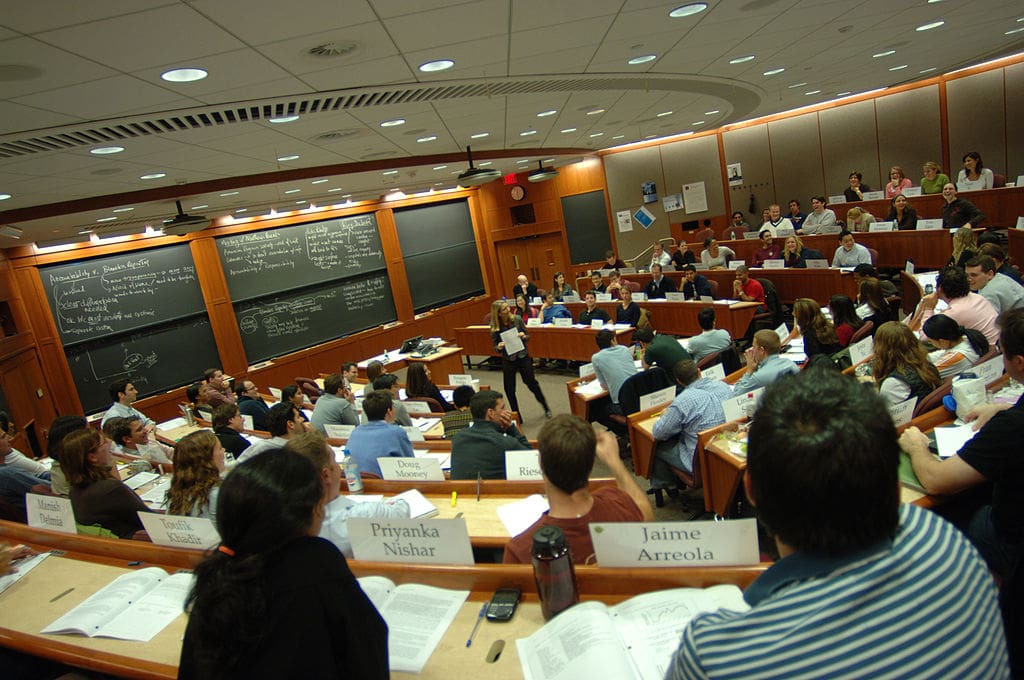
Culture shapes how it feels to be part of a program every day, in how people support one another, celebrate wins, and handle pressure. Ask what the atmosphere is really like. Are students competitive or collaborative? Are there strong communities around shared interests, identities, or backgrounds? What do people do for fun? Look for concrete examples that paint a picture, since those details tell you whether you would feel energized and at home.
What kind of networking and career support did you get?
Career outcomes and connections rank among the top reasons people pursue an MBA, yet the quality of these resources varies widely. Ask what actually moved the needle in their job search or career switch. Was the alumni network responsive? Did career services offer practical guidance or generic advice? Did the best opportunities come through on-campus recruiting, personal outreach, or good timing? Their answer reveals how well the program backs its students beyond the classroom.
How has the MBA changed your career direction or growth?
This question gets at the real-world impact behind the employment reports. Ask how the program shaped their choices, opened unexpected doors, or shifted what they wanted in the first place. Did it accelerate their path, help them pivot, or sharpen their long-term goals? You can also ask what success looked like for them personally and whether the degree helped them reach it. The answer often captures both professional value and personal growth.

What challenges did you face, and how did the school help?
Every program has its share of challenges, and many are hard to spot from the outside. Ask what felt difficult, whether that was the academic pace, a brutal recruiting season, or simply finding their footing socially. When they struggled, what pulled them through? Friends, professors, staff, or something else? Their answer gives you a realistic sense of what to expect and how the school shows up when things get hard.
How available and supportive were the faculty and staff?
Access to faculty and staff makes a real difference in how supported you feel throughout the program. Ask whether professors were approachable outside class and whether students felt comfortable reaching out for help or advice. Were there informal mentoring relationships, or did students have to advocate hard for themselves? You might also ask how involved administrators were in student life. These details show whether a school follows through on its promises of support.
Has the MBA been worth it for you, and why?
Return on investment means something different to everyone. For some, it comes down to salary or title; for others, it is confidence, network, or long-term mobility. Ask whether the degree felt worth it in hindsight and why. Did the payoff show up quickly, or build gradually through new opportunities and relationships? It is also worth asking whether they would make the same choice again, knowing what they know now.

Would you recommend this MBA program, and to whom?
Sometimes the simplest question draws out the most revealing answer. Ask whether they would recommend the program and, if so, to what kind of person. Was it the right fit for them, and who do they think it would not suit? Their response tends to be more candid than anything in the rankings or on a school’s website. Listen closely for hesitation, enthusiasm, and caveats, because that is usually where the real story lives.
Thoughtful conversations with students and alums can show you what truly sets a business school apart. Approach each one with curiosity and appreciation. Their perspectives help you weigh fit with more clarity and confidence as you map out your own MBA path.
Frequently Asked Questions About Talking to MBA Students
How do I find current MBA students or alumni to talk to?
Start with the school itself, since most admissions offices connect prospective applicants with student ambassadors and can point you toward club leaders. LinkedIn is the other workhorse. Search by program and graduation year, then send a short, specific note. Employers, undergraduate alumni networks, and admitted-student events all surface people happy to share their experience.
What is the best way to reach out to someone I don’t know?
A brief, personalized message works far better than a generic request for a call. Mention what drew you to their background, ask one or two focused questions, and keep the ask small, such as a 15-minute chat. People are much more willing to help when you have clearly done your homework and respect their time.
How many students should I talk to before deciding on a program?
Aim for at least three or four people per program so no single viewpoint skews your read. Try to reach a mix of first-years, second-years, and recent grads, along with people whose goals resemble yours. Patterns across several conversations tell you far more about a school than one especially enthusiastic or disappointed voice.
Is it okay to ask an MBA student about salary or job outcomes?
Career results are fair game, and most students expect the topic to come up. Frame it around their experience rather than personal numbers, for example, how recruiting worked in their industry or which resources helped most. That approach gets you useful detail without putting anyone on the spot.
Stacy Blackman Consulting offers a full range of services to support your MBA application journey—from our comprehensive All-In Partnership to targeted help with interviews, essays, and resumes. Contact us today to schedule your free 15-minute advising session with a Principal SBC consultant and start building your best possible application strategy.
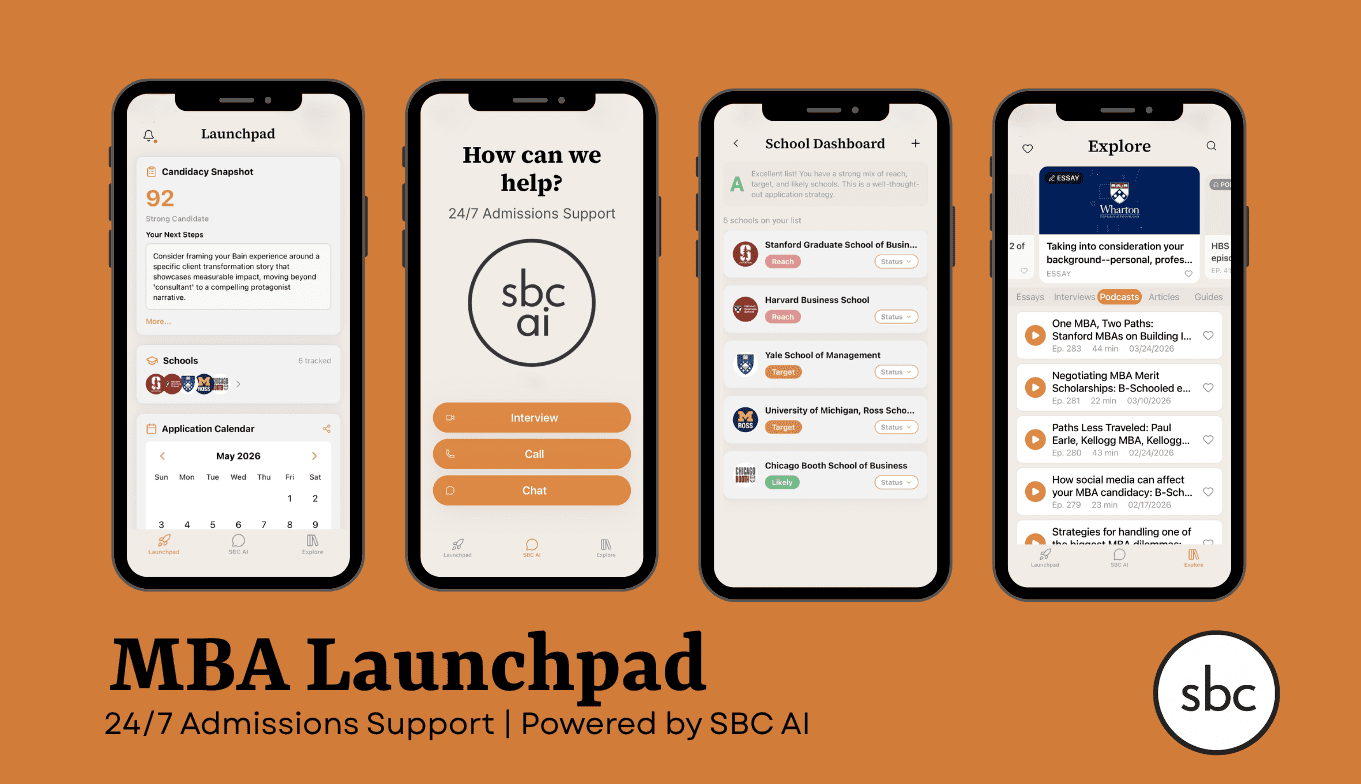
MBA Launchpad
Don’t sleep on our latest product, MBA Launchpad by SBC! It is an AI-powered admissions assistant built on more than 25 years of real SBC data, with candidacy assessment, school list strategy, and essay guidance available 24/7. Download it today on the App Store or Google Play.
Here’s a snapshot of the caliber of expertise on our SBC team.














Ashley
Ashley is a former MBA Admissions Board Member for Harvard Business School (HBS), where she interviewed and evaluated thousands of business school applicants for over a six year tenure. Ashley holds an MBA from HBS. During her HBS years, Ashley was the Sports Editor for the Harbus and a member of the B-School Blades Ice Hockey Team. After HBS, she worked in Marketing at the Gillette Company on Male and Female shaving ...
×Pauline
A former associate director of admissions at Harvard Business School, Pauline served on the HBS MBA Admissions Board full-time for four years. She evaluated and interviewed HBS applicants, both on-campus and globally. Pauline's career has included sales and marketing management roles with Coca-Cola, Gillette, Procter & Gamble, and IBM. For over 10 years, Pauline has expertly guided MBA applicants, and her clients h ...
×Laura
Laura comes from the MBA Admissions Board at Harvard Business School (HBS) and is an HBS MBA alumnus. In her HBS Admissions role, she evaluated and interviewed hundreds of business school candidates, including internationals, women, military and other applicant pools, for five years. Prior to her time as a student at HBS, Laura began her career in advertising and marketing in Chicago at Leo Burnett where she worked on th ...
×Andrea
Andrea served as the Associate Director of MBA Admissions at Harvard Business School (HBS) for over five years. In this role, she provided strategic direction for student yield-management activities and also served as a full member of the admissions committee. In 2007, Andrea launched the new 2+2 Program at Harvard Business School – a program targeted at college junior applicants to Harvard Business School. Andrea has also served as a Career Coach for Harvard Business School for both cu ...
×Jennifer
Jennifer served as Admissions Officer at the Stanford (GSB) for five years. She holds an MBA from Stanford (GSB) and a B.S. in Chemical Engineering from University of Illinois Urbana-Champaign. Jennifer has over 15 years experience in guiding applicants through the increasingly competitive admissions process into top MBA programs. Having read thousands and thousands of essays and applications while at Stanford (GSB) Admiss ...
×Davina
Davina received her MBA from Stanford's Graduate School of Business (GSB), with a certificate in Public Management, and her BA in Psychology from UC Berkeley. Davina is an experienced strategic planning leader, facilitator, and business case writer who spent more than 15 years building culture, entrepreneurship, and leadership initiatives across Stanford University and the Stanford Graduate School of Business. She designed ...
×Erin K.
Erin served in key roles in MBA Admissions--as Director at Haas School of Business at UC Berkeley and Assistant Director at Stanford's Graduate School of Business (GSB). Erin served on the admissions committee at each school and has read thousands of applications in her career. At Haas, she served for seven years in roles that encompassed evaluation, outreach, and diversity and inclusion. During her tenure in Admissions at GSB, she was responsible for candidate evaluation, applicant outreach, ...
×Susie
Susie comes from the Admissions Office of the Stanford Graduate School of Business where she reviewed and evaluated hundreds of prospective students’ applications. She holds an MBA from Stanford’s GSB and a BA from Stanford in Economics. Prior to advising MBA applicants, Susie held a variety of roles over a 15-year period in capital markets, finance, and real estate, including as partner in one of the nation’s most innovative finance and real estate investment organizations. In that r ...
×Dione
Dione holds an MBA degree from Stanford Business School (GSB) and a BA degree from Stanford University, where she double majored in Economics and Communication with concentrations in journalism and sociology. Dione has served as an Admissions reader and member of the Minority Admissions Advisory Committee at Stanford. Dione is an accomplished and respected advocate and thought leader on education and diversity. She is ...
×Anthony
Anthony served as the Associate Director of MBA Admissions at the Wharton School at the University of Pennsylvania, where he dedicated over 10 years of expertise. During his time as a Wharton Admissions Officer, he read and reviewed thousands of applications and helped bring in a class of 800+ students a year. Anthony has traveled both domestically and internationally to recruit a ...
×Meghan
Meghan served as the Associate Director of Admissions and Marketing at the Wharton MBA’s Lauder Institute, a joint degree program combining the Wharton MBA with an MA in International Studies. In her role on the Wharton MBA admissions committee, Meghan advised domestic and international applicants; conducted interviews and information sessions domestically and overseas in Asia, Central and South America, and Europe; and evaluated applicants for admission to the program. Meghan also managed ...
×Amy
Amy comes from the Wharton School of the University of Pennsylvania where she was Associate Director. Amy devoted 12 years at the Wharton School, working closely with MBA students and supporting the admissions team. During her tenure at Wharton, Amy served as a trusted adviser to prospective applicants as well as admitted and matriculated students. She conducted admissions chats with applicants early in the admissions ...
×Ally
Ally brings six years of admissions experience to the SBC team, most recently as an Assistant Director of Admission for the full-time MBA program at Columbia Business School (CBS). During her time at Columbia, Ally was responsible for reviewing applications, planning recruitment events, and interviewing candidates for both the full-time MBA program and the Executive MBA program. She traveled both internationally and dome ...
×Emma
Emma comes from the MBA Admissions Office at Columbia Business School (CBS), where she was Associate Director. Emma conducted dozens of interviews each cycle for the MBA and EMBA programs, as well as coordinating the alumni ambassador interview program. She read and evaluated hundreds of applications each cycle, delivered information sessions to audiences across the globe, and advised countless waitlisted applicants. ×
Dana
Dana served as Assistant Director of Admissions at Columbia Business School for the Full-Time MBA program and has over 10 years of experience working in higher education. Known as a scrupulous file reader, Dana reviewed countless applications and assisted in rendering final decisions for the Admissions Committee at CBS. While leading information sessions at Columbia and on the road, Dana met and advised myriad applicants� ...
×Holly
Holly worked as a member of the NYU Stern MBA Admissions team for seven years and holds an MBA from NYU Stern. In her tenure as Director of NYU MBA Admissions, Holly worked closely with admissions teams from Columbia, Michigan Ross, UVA Darden, Cornell Johnson, Berkeley Haas, Yale SOM, and Duke Fuqua on recruiting events domestically and internationally. On the NYU Stern admissions committee, Holly conducted interviews, planned and hosted events, and trained staff on reading and interviewi ...
×Written by Yvonne Milosevic. Reviewed by Stacy Blackman. Learn more about our former admissions officers on the SBC admissions team page.