What Do Admissions Committees Really Want from Military MBA Applicants?

Military MBA applicants are among the most attractive candidates at top business schools. Admissions committees value the leadership, discipline, and cross-cultural exposure that come with military service. Yet many applicants underestimate those strengths. This post covers what to highlight, what to avoid, and what’s actually possible, based on years of advising military applicants at SBC.
Key Takeways
- Military backgrounds are assets, not liabilities: schools apply a flexible lens on GPA, test scores, and age for this cohort.
- The biggest pitfall is jargon and vague achievements. Translate everything into human terms and make the people in your story visible.
- Genuine engagement with schools, strong recommendations, and a specific community angle can make the difference even when numbers are below the median.
If you come from a military background and you’re thinking about applying to a top MBA program, you may have stronger assets than you realize. Applicants with military experience are among the most attractive candidates at leading business schools, yet many arrive at the process convinced that their background is a liability. It isn’t. Not even close.
SBC consultant Margaret has deep experience guiding military MBA applicants to acceptances at every top program in the country. What follows draws on her hard-won expertise: the assets applicants consistently undervalue, the pitfalls that trip up even strong candidates, and the success stories that show what’s possible. That expertise now anchors Military MBA Admit, SBC’s dedicated service for service members and veterans applying to the country’s top programs.
And while this post was written with military applicants in mind, much of what we share applies to anyone applying from a non-traditional background. If you’re coming from the nonprofit sector, social enterprise, or any path that doesn’t follow the typical consulting-or-finance template, read on.
What Do MBA Admissions Committees Think of Military Applicants?
The first thing Margaret addresses with most of her military clients is the belief that they lack relevant experience. “A lot of the military clients I’ve worked with have started out thinking that it was not an asset for them, that they didn’t have business experience,” she explains. “But that’s not something that schools expect from them at all.”
AdComs are not comparing military applicants against candidates from banking or consulting. They’re evaluating a completely different profile. And that profile, when presented well, is deeply compelling.
Here are the most common misconceptions Margaret encounters, alongside the reality:
| The Misconception | The Reality |
|---|---|
| I don't have business experience. | AdComs don't expect it and don't compare you to finance or consulting applicants. |
| My post-MBA goals must relate to defense. | Most military applicants transition into consulting, finance, or tech. |
| My age or GPA will hurt me. | Schools apply a flexible lens; an eight-year military commitment explains a lot. |
| My overseas time isn't real international experience. | Deployments, joint exercises, and cultural immersion count more than you think. |
| My achievements are too hard to explain. | Any story can be translated into human terms, even classified work. |
One additional point worth underscoring: a military applicant with a strong GMAT and GPA is in an even stronger position than their peers. The flexible lens doesn’t mean schools don’t value strong numbers. It means those numbers aren’t disqualifying when the rest of the profile is exceptional.
What Unique Strengths Should Military MBA Applicants Highlight?
Margaret’s list of military applicant strengths is substantial, and each one connects directly to what top MBA programs are looking for. Leadership is the obvious starting point. “My old mentor used to say leadership is the number one driver of these school admissions. And nobody’s got leadership like military people do,” she notes.
But it’s not just having leadership experience. It’s the scale, the stakes, and the diversity of contexts: leading under fire, leading cross-cultural teams, leading when the outcome is not a quarterly report but someone’s safety.
Communication is a distinct and underappreciated asset. Military applicants have experience presenting to generals and simultaneously directing large teams. The range of that communication experience and the real-world consequences attached to it are something most applicants simply cannot offer.
Discipline is another. Margaret notes that military clients are, across the board, a pleasure to work with: no missed deadlines, no excuses.
“Nothing in these applications will be harder than what you’ve already done.” — Margaret, SBC Consultant
Diversity of exposure, particularly international exposure, is a major asset that many military applicants undervalue. Deployments, joint exercises with allied forces, and cultural immersion in places like Okinawa, Afghanistan, or the Philippines all translate directly to the cross-cultural fluency that MBA programs prize. Some applicants come away from these experiences speaking Arabic or Spanish. Many don’t fully appreciate how significant that is until Margaret points it out.
Technological expertise rounds out the picture. Margaret has worked with multiple applicants who served as engineering team leads on nuclear submarines, and with people in aviation, space, and intelligence technology, areas that are often the direct precursors to civilian commercial technologies. This kind of exposure is rare and differentiating.

What Are the Most Common Mistakes Military MBA Applicants Make?
The biggest challenge for military applicants, Margaret says, is communicating their story in language that resonates beyond the military context.
Jargon and acronyms are the most immediate barrier. Every industry has its internal shorthand, but military terminology can be especially opaque to civilian readers. Admissions directors assess how applicants use language in their essays and resumes as a signal of readiness to transition from the military to the private sector. The writing, in other words, is part of the evaluation. The fix is to translate everything into human terms and make sure the people in the story are visible. “Focus on the humans in the story” is advice Margaret returns to throughout her work with this cohort.
A related challenge arises for applicants who have worked in intelligence or classified operations. Their most impressive achievements may be things they literally cannot discuss. Margaret’s approach is to work around the specifics: draw on publicly known historical events to provide context, focus on the human dimensions of leadership and impact, and extract the story that can be told without compromising any classified information.
Recommendations present a third challenge. Military evaluators tend toward precise, unembellished language. On paper, that can read as lukewarm compared to recommendations from corporate environments where enthusiastic language is the norm. Margaret’s solution is to coach recommenders directly, encouraging them to explicitly express strong feelings about the applicant. Not to overstate, but to make sure the warmth doesn’t get lost in the translation to formal writing.
What Is the Best Advice for Military Applicants Applying to MBA Programs?
The best MBA applications from military candidates share a few qualities that have nothing to do with test scores or pedigree. Here’s the guidance that makes the biggest difference.
Write in first person and make the reader see the world through your eyes. Business school essays reward specificity and presence. Say what you saw, what you did, what changed in you.
Take stock of your international exposure. Many military applicants assume their overseas time doesn’t count as meaningful international experience because they weren’t deeply embedded in local culture. In practice, applicants have more cross-cultural experience than they realize. Joint exercises, language exposure, and engagement with local populations all count.
Don’t forget your presentations. Military professionals present constantly to superiors and subordinates alike, often with serious consequences attached. This is leadership experience. Treat it as such in your application.
Think carefully about your technological background and how it creates value in a post-MBA context. Defense contractors may not be recruiting heavily at MBA programs, but the analytical and technical frameworks military applicants bring translate directly into consulting, operations, and tech leadership roles.
Consider community engagement as an additional differentiator. Military life is inherently service-oriented, so you don’t need to manufacture a service narrative. But mentoring junior service members on financial literacy, tutoring in a local community, or taking on a leadership role outside your base can meaningfully round out your profile.
Finally: if there’s something about your story that defies the assumptions people make about military applicants, say so. Maybe your path to service was unexpected, or your identity or perspective runs counter to what someone might assume about a person in uniform.
Those moments of contrast, explained with honesty and self-awareness, are often the most memorable thing an admissions officer reads.

Success Stories From SBC’s MBA Military Applicants
Margaret shares two examples that illustrate the range of what military applicants can achieve.
One client grew up in a trailer park in the Midwest, the son of working-class parents who had experienced bankruptcy. He attended a local college, graduated with a 3.2 GPA, worked his way through school, and joined the Navy. When he applied to business school, he was over 28, and his GMAT was 720, well below the median at his target school. He was accepted to Harvard Business School.
What did he do right? He managed hundreds of subordinates and oversaw private contracts worth millions of dollars, a point that gave his resume a dimension most military applicants don’t have. He also taught robotics to inner-city girls, adding a genuine, specific community-engagement story. And he wrote his essays with honesty and directness. Not self-pity, not bravado. “Honest and humble” is how Margaret describes him. HBS recognized what it was seeing.
The second story involves a first-generation American whose family immigrated from Southeast Asia. He grew up in a small town where he was frequently bullied. His response was to do, as Margaret puts it, “the most American thing he could possibly do”: he joined the Marine Corps. And thrived there.
When he applied to an M7 school, his GMAT scores were a persistent problem. But he did something that many applicants skip: he visited campus, built relationships with people in the admissions office, and had genuine conversations. Then a deployment interrupted everything.
He contacted the people he’d been talking to, explained the situation, and asked what to do. They told him to submit what he had and retake the GMAT. He did, right before boarding his plane, and scored a 700. The program accepted him without an interview because of the sincerity of his engagement with the school.
Parting Advice for Military MBA Applicants
Margaret closes with something worth reading twice:
“You have given a huge hunk of your life to selfless service. We are grateful for your courage. We appreciate your sacrifice. And you’ve gotten a lot out of that experience as well. Schools are eager to have you in their classrooms. They’re eager to have you share your unique perspective with others. And it’s time for you now to take all of that experience and take it over to the next step in your life, to share it with others and share it with the world.”
If you’re a military applicant, that’s not marketing copy. That’s a description of how top MBA programs actually see you. So, dare to dream. Put in the work. Make a plan. The application process is demanding, but as Margaret says, nothing about it will be harder than what you’ve already done.
If you want a team that specializes in this work, we built Military MBA Admit for service members and veterans aiming at the top programs. Our consultants know how to translate military experience into an application that stands out, so get in touch or schedule a free 15-minute consultation to build a strategy rooted in your unique strengths.
Frequently Asked Questions
Do MBA programs actively recruit military applicants?
Yes. Top MBA programs actively seek military applicants because of the leadership experience, discipline, and diverse perspectives they bring to the classroom. Many programs have dedicated veterans initiatives, and admissions committees apply a flexible lens on metrics like GPA and test scores for this cohort.
Do military MBA applicants need to have business experience?
No. Admissions committees do not expect military applicants to have formal business experience. Managing large teams, overseeing contracts, and operating under high-stakes conditions all translate directly to business school expectations. The key is presenting that experience in language that resonates with civilian readers.
Can military applicants get into top MBA programs with a low GPA or GMAT?
Yes, though a stronger profile always helps. Schools understand that an eight-year military commitment affects when and how someone pursues their education. Applicants with below-median test scores or GPAs have been accepted to programs like HBS and Wharton when their overall profile, including leadership, community engagement, and essay quality, is compelling.
Does SBC offer admissions help specifically for military applicants?
Military MBA Admit is SBC’s dedicated service for service members and veterans targeting top MBA programs. You work with consultants who specialize in translating military experience into a competitive application, from candidacy assessment through essays, recommendations, and interviews.
MBA Launchpad
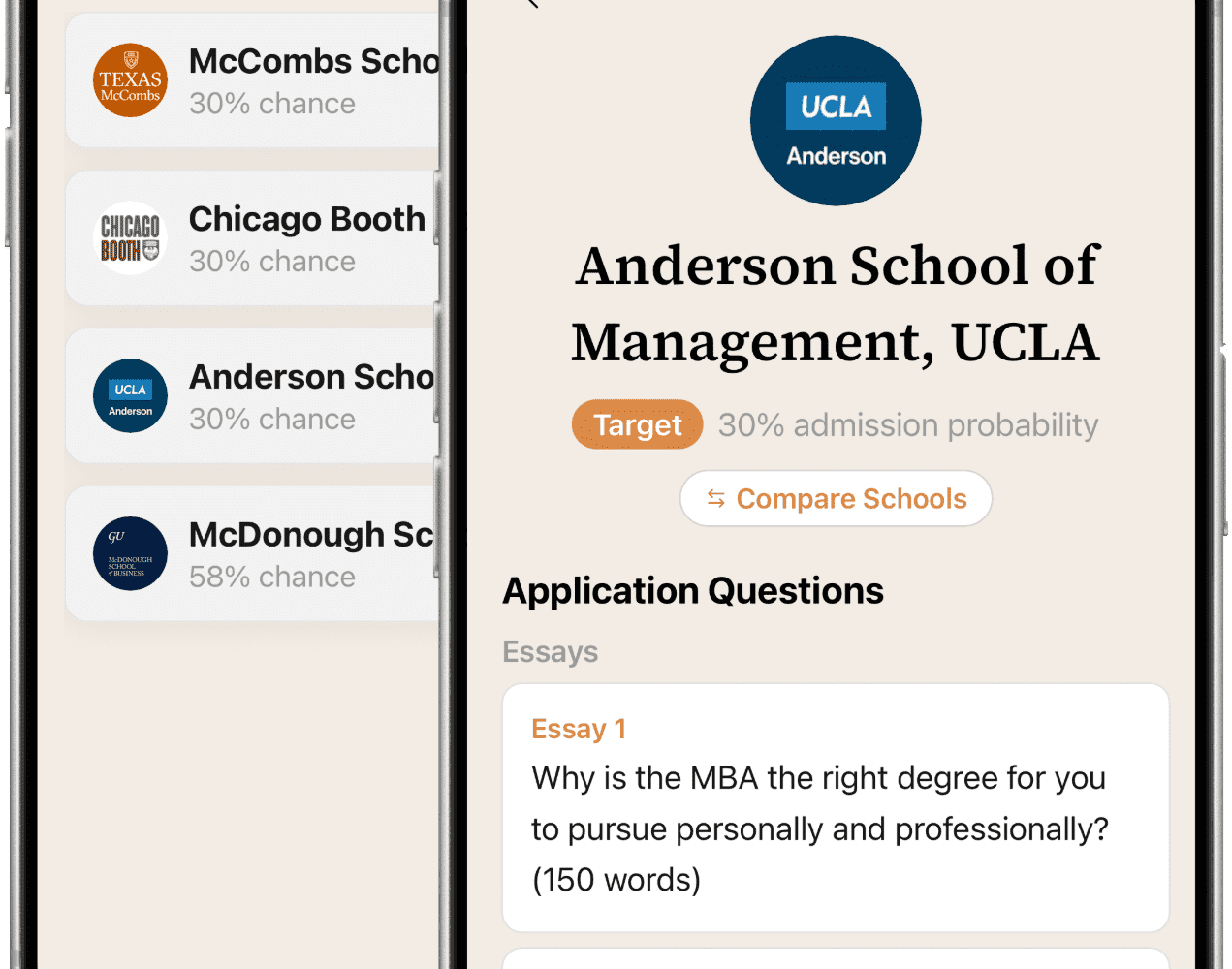
Don’t sleep on our latest product, MBA Launchpad by SBC. It’s your AI-powered admissions assistant, built on 25+ years of real SBC data. For service members and veterans, that means candidacy assessment, school list strategy, and essay guidance to help you translate your military experience into a competitive application, available 24/7 in your pocket wherever your service takes you. All premium features are free until September 1, 2026. Download now on the App Store and Google Play.
Here’s a snapshot of the caliber of expertise on our SBC team.










Ashley
Ashley is a former MBA Admissions Board Member for Harvard Business School (HBS), where she interviewed and evaluated thousands of business school applicants for over a six year tenure. Ashley holds an MBA from HBS. During her HBS years, Ashley was the Sports Editor for the Harbus and a member of the B-School Blades Ice Hockey Team. After HBS, she worked in Marketing at the Gillette Company on Male and Female shaving ...
×Pauline
A former associate director of admissions at Harvard Business School, Pauline served on the HBS MBA Admissions Board full-time for four years. She evaluated and interviewed HBS applicants, both on-campus and globally. Pauline's career has included sales and marketing management roles with Coca-Cola, Gillette, Procter & Gamble, and IBM. For over 10 years, Pauline has expertly guided MBA applicants, and her clients h ...
×Laura
Laura comes from the MBA Admissions Board at Harvard Business School (HBS) and is an HBS MBA alumnus. In her HBS Admissions role, she evaluated and interviewed hundreds of business school candidates, including internationals, women, military and other applicant pools, for five years. Prior to her time as a student at HBS, Laura began her career in advertising and marketing in Chicago at Leo Burnett where she worked on th ...
×Andrea
Andrea served as the Associate Director of MBA Admissions at Harvard Business School (HBS) for over five years. In this role, she provided strategic direction for student yield-management activities and also served as a full member of the admissions committee. In 2007, Andrea launched the new 2+2 Program at Harvard Business School – a program targeted at college junior applicants to Harvard Business School. Andrea has also served as a Career Coach for Harvard Business School for both cu ...
×Jennifer
Jennifer served as Admissions Officer at the Stanford (GSB) for five years. She holds an MBA from Stanford (GSB) and a B.S. in Chemical Engineering from University of Illinois Urbana-Champaign. Jennifer has over 15 years experience in guiding applicants through the increasingly competitive admissions process into top MBA programs. Having read thousands and thousands of essays and applications while at Stanford (GSB) Admiss ...
×Davina
Davina received her MBA from Stanford's Graduate School of Business (GSB), with a certificate in Public Management, and her BA in Psychology from UC Berkeley. Davina is an experienced strategic planning leader, facilitator, and business case writer who spent more than 15 years building culture, entrepreneurship, and leadership initiatives across Stanford University and the Stanford Graduate School of Business. She designed ...
×Erin K.
Erin served in key roles in MBA Admissions--as Director at Haas School of Business at UC Berkeley and Assistant Director at Stanford's Graduate School of Business (GSB). Erin served on the admissions committee at each school and has read thousands of applications in her career. At Haas, she served for seven years in roles that encompassed evaluation, outreach, and diversity and inclusion. During her tenure in Admissions at GSB, she was responsible for candidate evaluation, applicant outreach, ...
×Susie
Susie comes from the Admissions Office of the Stanford Graduate School of Business where she reviewed and evaluated hundreds of prospective students’ applications. She holds an MBA from Stanford’s GSB and a BA from Stanford in Economics. Prior to advising MBA applicants, Susie held a variety of roles over a 15-year period in capital markets, finance, and real estate, including as partner in one of the nation’s most innovative finance and real estate investment organizations. In that r ...
×Dione
Dione holds an MBA degree from Stanford Business School (GSB) and a BA degree from Stanford University, where she double majored in Economics and Communication with concentrations in journalism and sociology. Dione has served as an Admissions reader and member of the Minority Admissions Advisory Committee at Stanford. Dione is an accomplished and respected advocate and thought leader on education and diversity. She is ...
×Anthony
Anthony served as the Associate Director of MBA Admissions at the Wharton School at the University of Pennsylvania, where he dedicated over 10 years of expertise. During his time as a Wharton Admissions Officer, he read and reviewed thousands of applications and helped bring in a class of 800+ students a year. Anthony has traveled both domestically and internationally to recruit a ...
×Meghan
Meghan served as the Associate Director of Admissions and Marketing at the Wharton MBA’s Lauder Institute, a joint degree program combining the Wharton MBA with an MA in International Studies. In her role on the Wharton MBA admissions committee, Meghan advised domestic and international applicants; conducted interviews and information sessions domestically and overseas in Asia, Central and South America, and Europe; and evaluated applicants for admission to the program. Meghan also managed ...
×Amy
Amy comes from the Wharton School of the University of Pennsylvania where she was Associate Director. Amy devoted 12 years at the Wharton School, working closely with MBA students and supporting the admissions team. During her tenure at Wharton, Amy served as a trusted adviser to prospective applicants as well as admitted and matriculated students. She conducted admissions chats with applicants early in the admissions ...
×Ally
Ally brings six years of admissions experience to the SBC team, most recently as an Assistant Director of Admission for the full-time MBA program at Columbia Business School (CBS). During her time at Columbia, Ally was responsible for reviewing applications, planning recruitment events, and interviewing candidates for both the full-time MBA program and the Executive MBA program. She traveled both internationally and dome ...
×Emma
Emma comes from the MBA Admissions Office at Columbia Business School (CBS), where she was Associate Director. Emma conducted dozens of interviews each cycle for the MBA and EMBA programs, as well as coordinating the alumni ambassador interview program. She read and evaluated hundreds of applications each cycle, delivered information sessions to audiences across the globe, and advised countless waitlisted applicants. ×
Dana
Dana served as Assistant Director of Admissions at Columbia Business School for the Full-Time MBA program and has over 10 years of experience working in higher education. Known as a scrupulous file reader, Dana reviewed countless applications and assisted in rendering final decisions for the Admissions Committee at CBS. While leading information sessions at Columbia and on the road, Dana met and advised myriad applicants� ...
×Holly
Holly worked as a member of the NYU Stern MBA Admissions team for seven years and holds an MBA from NYU Stern. In her tenure as Director of NYU MBA Admissions, Holly worked closely with admissions teams from Columbia, Michigan Ross, UVA Darden, Cornell Johnson, Berkeley Haas, Yale SOM, and Duke Fuqua on recruiting events domestically and internationally. On the NYU Stern admissions committee, Holly conducted interviews, planned and hosted events, and trained staff on reading and interviewi ...
×Written by Yvonne Milosevic. Reviewed by Stacy Blackman. Learn more about our former admissions officers on the SBC admissions team page.
Image credit: Olawale Munna on Unsplash