Deans Admit AI in MBA Programs Is Lagging. Here’s How Applicants Can Get Ahead

Business school deans have a confession: AI is their schools’ biggest challenge, and only about one in five say their schools are well prepared for it. That’s the standout finding in AACSB’s 2026–27 survey of 558 b-school leaders. For elite MBA applicants, the uneven state of AI in MBA programs is an opening worth using in your essays, interviews, and school research.
Quick Summary
- Deans rank AI as their schools’ top challenge, so applicants who show strong AI judgment bring something top programs want in the classroom.
- You don’t need an AI-heavy resume to compete. Whatever your background, show clear thinking about how AI will shape your target industry and the role you want.
- Even top programs are still building their AI offerings. Ask current students how AI shows up in the core curriculum, and let the answers shape both your essays and your school list.
Deans know AI matters. They’re less sure they can deliver
Every three years, AACSB, the global accrediting body for business schools, asks deans to get candid about their jobs. In the 2026–27 AACSB Deans Survey, fielded from July 17 to August 24, 2026, 558 leaders from 75 countries and territories rated 49 parts of the role on how much each matters this year and how good they are at it.
AI produced the most striking mismatch. Deans rank AI and emerging technologies in teaching, learning, and research as their second-highest priority (4.54 out of 5), then rate their own proficiency at a modest 3.41. That 1.13-point gap is the widest in the survey, and AI also tops the list of skills deans most want to develop.
Their schools look no readier. When respondents graded institutional readiness across eight areas, AI scored lowest on preparedness (2.91), the only area to fall below the scale’s midpoint. Nearly three-quarters (74%) placed AI among their schools’ three biggest challenges, and 40% ranked it first, ahead of financial resilience.
Want help turning your AI experience into a standout application story? Talk to an SBC consultant.
What the AI gap means at top programs
The survey covers a broad mix of schools, and AACSB doesn’t break out results by ranking, so treat the numbers as an industry-wide picture. SBC’s read is that the pressure runs even hotter at the top. Elite programs build their brands on preparing future executives, and they’re competing to show their graduates can lead AI-driven organizations. Expect AI to keep featuring prominently in their curriculum announcements and recruiting pitches.
For applicants, that gap creates an opening. Admissions committees build each class deliberately, and schools still developing their AI muscle value students who can raise the level of the conversation. If you’ve rolled out an AI tool across a sales team, tested its limits on a diligence project, or wrestled with its risks in a regulated industry, you bring a perspective that enriches case discussions and team projects.
The opening extends beyond the classroom. Student-run AI clubs, conferences, hackathons, and faculty research projects give you ways to make an impact outside class, and showing how you’d get involved strengthens your answer to what you’ll bring to the community. Even without deep technical experience, you can explain how you’d use those resources to grow and how your industry knowledge would add to the mix.
How to make your AI experience stand out
If AI has been part of your work, give it substance. A line about “leveraging AI tools” tells the reader almost nothing about you. What stands out is a specific story: the business problem you tackled, how you used the tool, how you checked its output, and the measurable result.
Here’s how that difference looks on the page.
Generic: “I leveraged AI tools to improve efficiency across my team’s workflows.”
Specific: “Our team spent two days each month reconciling vendor invoices, so I built a workflow that used an AI model to flag mismatches. I spot-checked its first 200 results against manual reviews, adjusted the prompts where it missed edge cases, and cut the process to four hours while catching errors we’d previously overlooked.”
The second version works because it shows your judgment, from the problem you spotted to the safeguard you built. Catching an AI error, deciding a model wasn’t the right fit, or setting guardrails for your team all signal leadership as well as technical skill. Let your resume carry the results, and use your essays and interviews to explain the thinking behind them.
Keep that experience separate from how you write your application. Every school sets its own rules on AI use in essays, and those rules shift from cycle to cycle, so check each program’s current instructions for its AI disclosure policy before you draft.
Questions to ask about AI in MBA programs
The deans’ own scores show that AI in MBA programs is still a work in progress, even at highly ranked schools. Turn that into sharper school research. Look at how each program teaches AI in the core curriculum and in electives, whether it offers applied labs or practicum projects, which faculty research AI, and which tech employers recruit on campus.
Then go to the source. Coffee chats with current students, class visits, and info sessions are the best places to dig in. A few questions worth asking:
- Where does AI show up in the required core, and which courses treat it as a central topic?
- How do students use AI for case prep, team projects, and recruiting, and what classroom rules govern it?
- Which AI-focused electives, labs, or practicums have launched recently, and how hard is it to get a seat?
- Which employers are hiring graduates into AI-related roles, and how does the career office support that path?
- How are firms in your target industry using AI, and does the coursework reflect it?
Pay attention to how people answer. A named course, a specific student project, or a recent hire signals serious investment. Vague enthusiasm suggests a program still finding its footing. Those specifics also make excellent material for your “why this school” essay.
Save the deep probing for students and alumni. In an admissions interview, one thoughtful AI question at the end shows engagement without turning the conversation into an audit.
Frequently Asked Questions About AI in MBA Programs
I don’t work in tech. Will a lack of AI experience hurt me at top programs?
A non-tech background isn’t a handicap, and you may have more AI experience than you think. Using AI to speed up research, test marketing copy, or analyze operations data all counts if you can explain your judgment. If AI hasn’t shaped your work, don’t force it. Show curiosity about how it will change your target industry and the resources you’d use to build those skills.
Can I use AI to help write my MBA essays?
The answer depends on the school, and policies change from cycle to cycle. Some programs permit limited use for brainstorming or proofreading, sometimes with disclosure, while others ask you to certify that the writing is entirely your own. Read each program’s current essay instructions before you start, and when in doubt, do the drafting yourself. Your voice and self-reflection are exactly what admissions committees want to evaluate.
Should I mention a school’s AI initiatives in my “why this school” essay?
Mention them when they connect to your goals. A school’s AI courses or labs earn a place in your essay when you can explain what you’d do with them: the problem you want to work on, the faculty or project that fits, and how it moves you toward your post-MBA role. If AI isn’t central to your plan, spend those words on the resources that are.
How SBC Can Help
AI is reshaping what top programs look for, and the strongest applications show it with substance. SBC’s consultants, many of them former admissions officers, help you research elite MBA programs, position your experience, and present career goals that admissions committees find compelling. Contact us to talk through your application strategy.
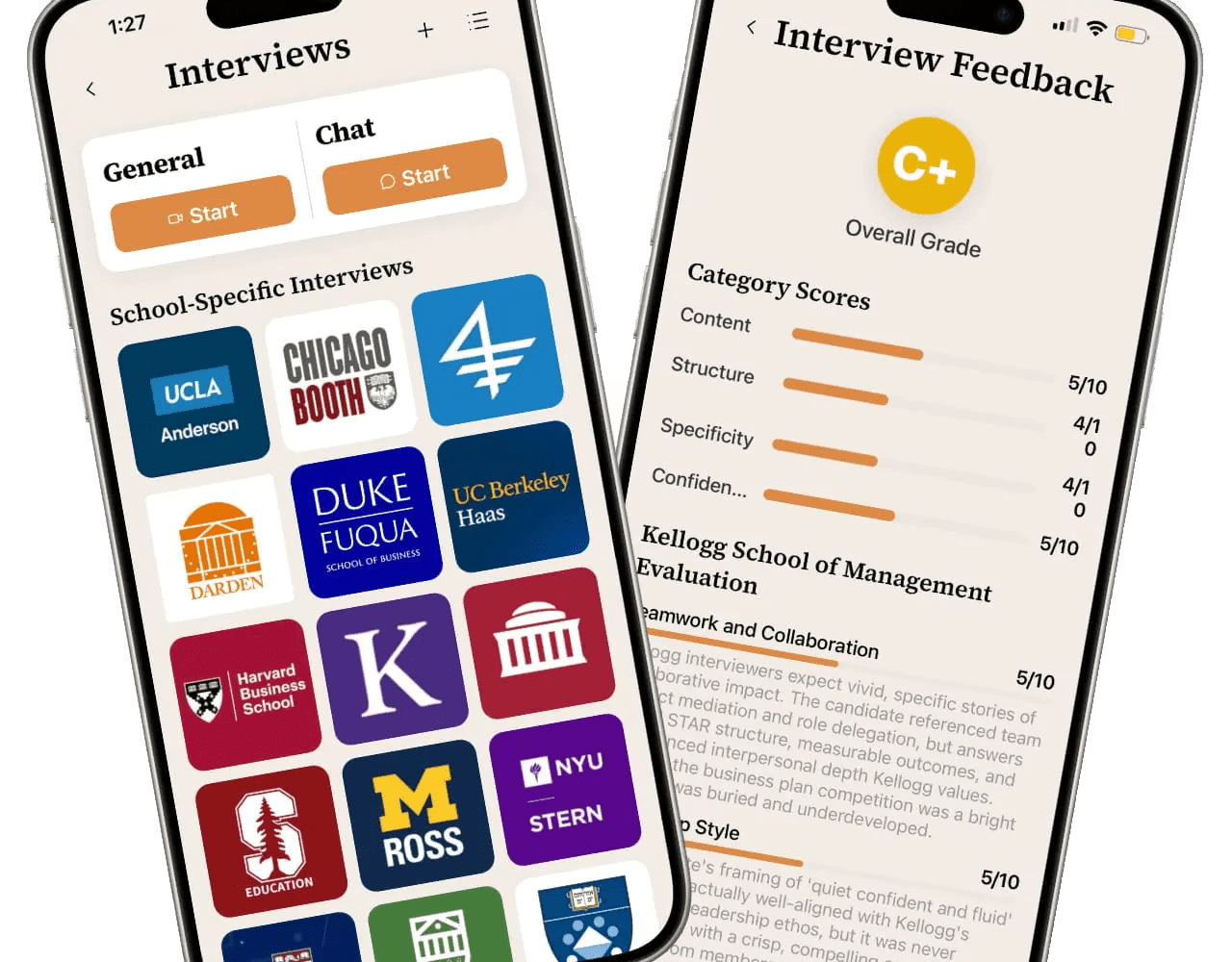
MBA Launchpad
Don’t sleep on our latest product, MBA Launchpad by SBC. This AI-powered admissions assistant is built on more than 25 years of real SBC data and offers candidacy assessment, school list strategy, and essay guidance 24/7. Premium features are currently free. Download it on the App Store or Google Play.
Here’s a snapshot of the caliber of expertise on our SBC team.





Ashley
Ashley is a former MBA Admissions Board Member for Harvard Business School (HBS), where she interviewed and evaluated thousands of business school applicants for over a six year tenure. Ashley holds an MBA from HBS. During her HBS years, Ashley was the Sports Editor for the Harbus and a member of the B-School Blades Ice Hockey Team. After HBS, she worked in Marketing at the Gillette Company on Male and Female shaving ...
×Pauline
A former associate director of admissions at Harvard Business School, Pauline served on the HBS MBA Admissions Board full-time for four years. She evaluated and interviewed HBS applicants, both on-campus and globally. Pauline's career has included sales and marketing management roles with Coca-Cola, Gillette, Procter & Gamble, and IBM. For over 10 years, Pauline has expertly guided MBA applicants, and her clients h ...
×Laura
Laura comes from the MBA Admissions Board at Harvard Business School (HBS) and is an HBS MBA alumnus. In her HBS Admissions role, she evaluated and interviewed hundreds of business school candidates, including internationals, women, military and other applicant pools, for five years. Prior to her time as a student at HBS, Laura began her career in advertising and marketing in Chicago at Leo Burnett where she worked on th ...
×Andrea
Andrea served as the Associate Director of MBA Admissions at Harvard Business School (HBS) for over five years. In this role, she provided strategic direction for student yield-management activities and also served as a full member of the admissions committee. In 2007, Andrea launched the new 2+2 Program at Harvard Business School – a program targeted at college junior applicants to Harvard Business School. Andrea has also served as a Career Coach for Harvard Business School for both cu ...
×Jennifer
Jennifer served as Admissions Officer at the Stanford (GSB) for five years. She holds an MBA from Stanford (GSB) and a B.S. in Chemical Engineering from University of Illinois Urbana-Champaign. Jennifer has over 15 years experience in guiding applicants through the increasingly competitive admissions process into top MBA programs. Having read thousands and thousands of essays and applications while at Stanford (GSB) Admiss ...
×Davina
Davina received her MBA from Stanford's Graduate School of Business (GSB), with a certificate in Public Management, and her BA in Psychology from UC Berkeley. Davina is an experienced strategic planning leader, facilitator, and business case writer who spent more than 15 years building culture, entrepreneurship, and leadership initiatives across Stanford University and the Stanford Graduate School of Business. She designed ...
×Erin
Erin served in key roles in MBA Admissions--as Director at Haas School of Business at UC Berkeley and Assistant Director at Stanford's Graduate School of Business (GSB). Erin served on the admissions committee at each school and has read thousands of applications in her career. At Haas, she served for seven years in roles that encompassed evaluation, outreach, and diversity and inclusion. During her tenure in Admissions at GSB, she was responsible for candidate evaluation, applicant outreach, ...
×Susie
Susie comes from the Admissions Office of the Stanford Graduate School of Business where she reviewed and evaluated hundreds of prospective students’ applications. She holds an MBA from Stanford’s GSB and a BA from Stanford in Economics. Prior to advising MBA applicants, Susie held a variety of roles over a 15-year period in capital markets, finance, and real estate, including as partner in one of the nation’s most innovative finance and real estate investment organizations. In that r ...
×Dione
Dione holds an MBA degree from Stanford Business School (GSB) and a BA degree from Stanford University, where she double majored in Economics and Communication with concentrations in journalism and sociology. Dione has served as an Admissions reader and member of the Minority Admissions Advisory Committee at Stanford. Dione is an accomplished and respected advocate and thought leader on education and diversity. She is ...
×Anthony
Anthony served as the Associate Director of MBA Admissions at the Wharton School at the University of Pennsylvania, where he dedicated over 10 years of expertise. During his time as a Wharton Admissions Officer, he read and reviewed thousands of applications and helped bring in a class of 800+ students a year. Anthony has traveled both domestically and internationally to recruit a ...
×Meghan
Meghan served as the Associate Director of Admissions and Marketing at the Wharton MBA’s Lauder Institute, a joint degree program combining the Wharton MBA with an MA in International Studies. In her role on the Wharton MBA admissions committee, Meghan advised domestic and international applicants; conducted interviews and information sessions domestically and overseas in Asia, Central and South America, and Europe; and evaluated applicants for admission to the program. Meghan also managed ...
×Amy
Amy comes from the Wharton School of the University of Pennsylvania where she was Associate Director. Amy devoted 12 years at the Wharton School, working closely with MBA students and supporting the admissions team. During her tenure at Wharton, Amy served as a trusted adviser to prospective applicants as well as admitted and matriculated students. She conducted admissions chats with applicants early in the admissions ...
×Ally
Ally brings six years of admissions experience to the SBC team, most recently as an Assistant Director of Admission for the full-time MBA program at Columbia Business School (CBS). During her time at Columbia, Ally was responsible for reviewing applications, planning recruitment events, and interviewing candidates for both the full-time MBA program and the Executive MBA program. She traveled both internationally and dome ...
×Emma
Emma comes from the MBA Admissions Office at Columbia Business School (CBS), where she was Associate Director. Emma conducted dozens of interviews each cycle for the MBA and EMBA programs, as well as coordinating the alumni ambassador interview program. She read and evaluated hundreds of applications each cycle, delivered information sessions to audiences across the globe, and advised countless waitlisted applicants. ×
Dana
Dana served as Assistant Director of Admissions at Columbia Business School for the Full-Time MBA program and has over 10 years of experience working in higher education. Known as a scrupulous file reader, Dana reviewed countless applications and assisted in rendering final decisions for the Admissions Committee at CBS. While leading information sessions at Columbia and on the road, Dana met and advised myriad applicants� ...
×Holly
Holly worked as a member of the NYU Stern MBA Admissions team for seven years and holds an MBA from NYU Stern. In her tenure as Director of NYU MBA Admissions, Holly worked closely with admissions teams from Columbia, Michigan Ross, UVA Darden, Cornell Johnson, Berkeley Haas, Yale SOM, and Duke Fuqua on recruiting events domestically and internationally. On the NYU Stern admissions committee, Holly conducted interviews, planned and hosted events, and trained staff on reading and interviewi ...
×Written by Yvonne Milosevic. Reviewed by Stacy Blackman. Learn more about our former admissions officers on the SBC admissions team page.


