Booth MBA Interview Tips for the 2026-2027 Admissions Season
The Booth MBA interview is a 45-minute virtual conversation with a member of the Chicago Booth community, offered by invitation only. This season, full-time applicants also complete a new two-question video simulation. To prepare, know your story cold, tie your goals to specific Booth resources, and come ready for a two-way exchange.
Quick Summary
- Booth uses the interview to test fit, so your “why Booth” answer has to name the parts of its flexible curriculum and community you’ll use and add to.
- Your interviewer may come from a completely different world than you, so translate your experience into plain terms that let an outsider see your impact.
- With Booth’s essays now capped at 300 characters, the interview is your best chance to tell your full story, so make sure it fits the application the committee rereads alongside your interviewer’s report.
What is the Booth MBA interview format for 2026-2027?
Round 1 interviews are already underway, and Round 2 applicants, whose applications are due January 7, 2027, should start preparing well before invitations arrive.
The University of Chicago Booth School of Business extends interview invitations after multiple members of the admissions committee have read your full application. Once invited, you’ll have a few weeks to schedule and complete your interview.
SBC consultant Kim, a former senior associate director of MBA admissions at Booth, explains that interviewers only receive the applicant’s resume. They haven’t seen your essays, test scores, or transcripts, and another former Booth admissions committee member on our team adds that many interviewers only skim the resume before the conversation starts.
“Current students and alums typically conduct interviews for Booth. An AdCom will rarely conduct an interview,” Kim says. Because your interviewer knows so little going in, the story you tell in the room has to stand on its own.
The biggest format change this season is that every interview is virtual, according to the admissions team’s October 2026 interview advice. Booth describes the interview as “a two-way exchange.” You’re evaluating the program while the interviewer evaluates you, and your questions at the end count toward the impression you leave.
Kim says clients and students consistently describe the conversation as “very casual, warm, and engaging.” Enjoy that, but stay sharp. A relaxed tone makes it easy to ramble or drift off message. And Booth still expects business professional attire, even on camera.
Chicago Booth is a top-tier program with a deep applicant pool, and the interview is where strong candidates set themselves apart. If you’d like a second set of eyes on your interview strategy, reach out to our team.
What is Booth’s new video simulation?
Full-time applicants who receive an interview invitation must also complete a video simulation. Using a third-party platform, you’ll record yourself answering two questions in real time. It’s separate from the interview, and the admissions team says you don’t need to prepare, since they want your candid responses. Nonetheless, don’t treat the simulation as an afterthought. The committee weighs your video responses alongside the interviewer’s report.
SBC clients who’ve completed the simulation this season tell us the questions vary from candidate to candidate. Some applicants drew behavioral prompts much like the ones they’d prepared for their interviews. Others got open-ended questions about their opinions, values, or personal tastes, which caught more than one applicant off guard. Before the simulation starts, Booth asks applicants to sign an honor code agreeing not to share the questions, so expect to go in without knowing what’s coming.
That’s why we’d take Booth at its word on content. Scripted answers won’t help when you can’t predict the prompt, and rehearsed responses lose the personality Booth is trying to see. Instead, practice answering a mix of behavioral questions and open-ended opinion questions on a timer, with no prep, so you get used to forming a point of view quickly and backing it up with a reason or an example. Record yourself talking to a camera with no one nodding back so you don’t get thrown off on the day. Also, check your lighting, audio, and connection the same way you would for the interview.
One practical warning from our clients: applicants have reported getting one retake, but several found the retake option didn’t work on their second question, even when they clicked in time. Treat every first take as your final answer.
What does Chicago Booth look for in the interview?
According to the admissions team, questions can cover your work experience and projects, how you work in teams, and how your short- and long-term goals connect to a Booth MBA. Beyond those topics, Booth wants to learn what you hope to accomplish, why its MBA suits you better than another, and how you’ll contribute to the community.
Underneath those questions, your interviewer is gauging character. “The interview is to test out more of those intangibles through questions,” Kim says, and she’s blunt about one of them: “Booth is looking for resilient people.” Meg, also a former senior associate director of MBA admissions at Booth, says the school “values the diversity of thought and doesn’t want a room full of people who think alike.”
In her words, “They want tension in the classroom in the best kind of way,” which is why Booth looks for “intellectually curious people, people with grit and resilience.” For applicants, that means it’s safe to hold a point of view. A considered opinion, backed by your reasoning, shows Booth how you think, and that skill matters on the video simulation’s open-ended questions too.
Your reasons for choosing Chicago Booth deserve more attention than most applicants give them. “Booth doesn’t want to feel like your backup school,” Kim warns. The curriculum is famously flexible, which means two students can leave with very different educations.
In our experience, the strongest Booth interviewees show they’ve already mapped their own path through the program. They can name the concentrations they’d pursue (Booth offers options ranging from Behavioral Science to Business Analytics to Entrepreneurship), the student groups they’d join or lead, and the classmates they’d learn from. A generic answer about Booth’s reputation in finance won’t tell your interviewer anything they don’t already know.
How should you prepare for the Chicago Booth MBA interview?
Build a set of flexible stories
Choose four or five experiences that show leadership, teamwork, a setback, and a moment when you changed someone’s mind. Practice telling each one in about two minutes, with enough context that a stranger can follow it. Because Booth’s questions range widely, you want stories you can adapt to different prompts rather than memorized answers to specific ones.
Answer succinctly, then let the interviewer dig
Booth’s admissions team asks applicants to keep answers straightforward while still giving full context, since tighter answers leave room for better follow-up questions. Meg’s advice for Booth essays applies here too: “separate your need to tell them from their need to know.”
In practice, that means leading with the point, giving one or two supporting details, and stopping. If your interviewer wants more, they’ll ask. The conversation goes fast, and rambling through your first answer costs you time you’ll want later.
Nail why an MBA, why now, and why Booth
Because your interviewer starts with little more than your resume, expect to make your core case from scratch. That matters even more this season. Booth replaced its classic long-form essays with four micro essays of 300 characters each and dropped its “Why Booth” prompt.
As Kim explains on a recent episode of B-Schooled, “I don’t think the information the school was getting was particularly unique.” The interview is now one of the few places to make a full case for Booth, and a generic answer won’t impress your interviewer any more than it impressed the admissions committee.
Our former Booth admissions committee members say every candidate should be ready to explain why they want an MBA, why now, and why Booth, with clearly defined short- and long-term goals.
Your trajectory should add up. Your undergraduate experience and career to date, plus a Booth MBA, should lead logically to your short-term goal, and that goal should set you up for your long-term one. If any link in that chain feels shaky when you say it out loud, fix it before the interview.
Know your resume cold, and reread your application
Your resume is the one document your interviewer has, so be ready to walk through it smoothly and explain every transition, including moves within the same company. Reread your application, too. Your interviewer hasn’t seen it, but the committee reads the interview report alongside everything you submitted. As Kim puts it, “the application has to work as a whole,” so your goals and stories should fit with your micro essays and the rest of your file.
Prepare questions the website can’t answer
Booth encourages applicants to come with specific questions, and it’s one of the easiest places to stand out. Since your interviewer is likely a student or alum, ask about their own experience. How did they choose their concentrations? What surprised them about the culture? Which part of Booth do prospective students underestimate? Questions like these show you’ve done your homework and can start a conversation your interviewer will remember.

Set up your space and test your tech
Pick a quiet, well-lit spot with a neat background and test your camera, audio, and connection ahead of time. Confirm the time zone, since interviewers may be located anywhere, and log on a few minutes early. If the connection freezes mid-answer, stay calm and pick up where you left off. How you handle a glitch says something about you, too.
How should you tailor your Booth interview to your background?
Booth interviews applicants from every background, and the challenge differs by profile. Veterans and others from specialized fields need to translate their experience for an interviewer who has never worked in their world. Leave out the jargon and spell out the stakes, including how many people you led, what was at risk, and what changed because of your decisions.
Applicants from consulting, finance, and other well-represented industries face the opposite problem. Their resumes look a lot like everyone else’s, so their personality and specific plans for Booth have to set them apart. Career switchers need a believable bridge: which skills transfer, which ones Booth will build, and why this path leads to the goal. For more on how current students handled these challenges, see advice from three first-years on The Booth Experience, Booth’s student blog.
Veterans can find more tailored guidance at Military MBA Admit, SBC’s service for military and veteran MBA applicants.
What questions might you encounter in a Booth MBA interview?
Booth’s interviews are conversational, and the mix of questions depends on your interviewer. SBC clients’ reports from past cycles show the range. One client who interviewed with an alum fielded almost no behavioral questions, and the conversation centered on their resume, role, and reasons for business school. Another, interviewed by a second-year student, faced a full slate of behavioral questions with plenty of follow-ups. Prepare for both styles with questions like these, drawn from Booth’s own guidance and our clients’ experiences:
- Walk me through your resume.
- Why business school, and why now?
- Why Booth?
- What are your short- and long-term career goals?
- What is your current job like, and what’s your role on the team?
- How would you describe your working relationship with your manager?
- Why did you move to a different role within your company?
- How would you describe yourself as a leader?
- Tell me about a time you received feedback. How did you respond?
- What’s the biggest challenge you’ve faced at work?
- What’s one thing you want to keep doing and one thing you want to stop doing?
- How do you plan to get involved in the Booth community?
- What questions do you have for me?
Save time for that last one. Past clients have reported spending the final 10 minutes or so asking their own questions, so come with more than one or two. Be sure to send your interviewer a brief thank-you note within a day, ideally mentioning something specific from your conversation. Then let the process run.
After the interview, additional committee members review your complete application again with the interviewer’s report in hand, so there’s no need to send extra materials unless something significant changes, such as a promotion or a new test score.
Frequently Asked Questions About the Booth MBA Interview
Does an interview with a student or alum count for less?
Booth gives a lot of weight to what its students and alumni report. Kim says “the current student body and alums’ perspective on whether the applicant is a fit is often dead right,” and that “if someone has a stellar interview, it’s tough to waitlist or reject them.” Treat every Booth interviewer, including a second-year student, as a direct line to the committee. If it goes poorly, keep perspective. Kim notes it’s “only one data point.”
Booth says not to prepare for the video simulation. Is it a mistake to practice?
Scripted answers work against Booth’s goal of hearing your unfiltered responses, but getting comfortable on camera is different. A few unscripted practice recordings help you sound like yourself instead of sounding nervous, which is the version of you Booth hopes to see.
Should I expand on my micro essays in the interview?
Your interviewer won’t have read them, so skip lines like “as I mentioned in my essay.” The stories behind your 300-character answers often make your best interview material, though. Kim advises choosing a photo for the micro essays that “unlocks an interesting story you can share,” and the interview is where you can do that. Tell the full version when a question opens the door, so the committee sees the depth your written answers had no room for.
How can SBC help you prepare for your Booth MBA interview?
Our consultants, many of them former admissions officers at top MBA programs, run mock interviews that pressure-test your stories, tighten your answers, and help you sharpen your “why Booth” pitch. Contact us to learn more about our interview prep services.
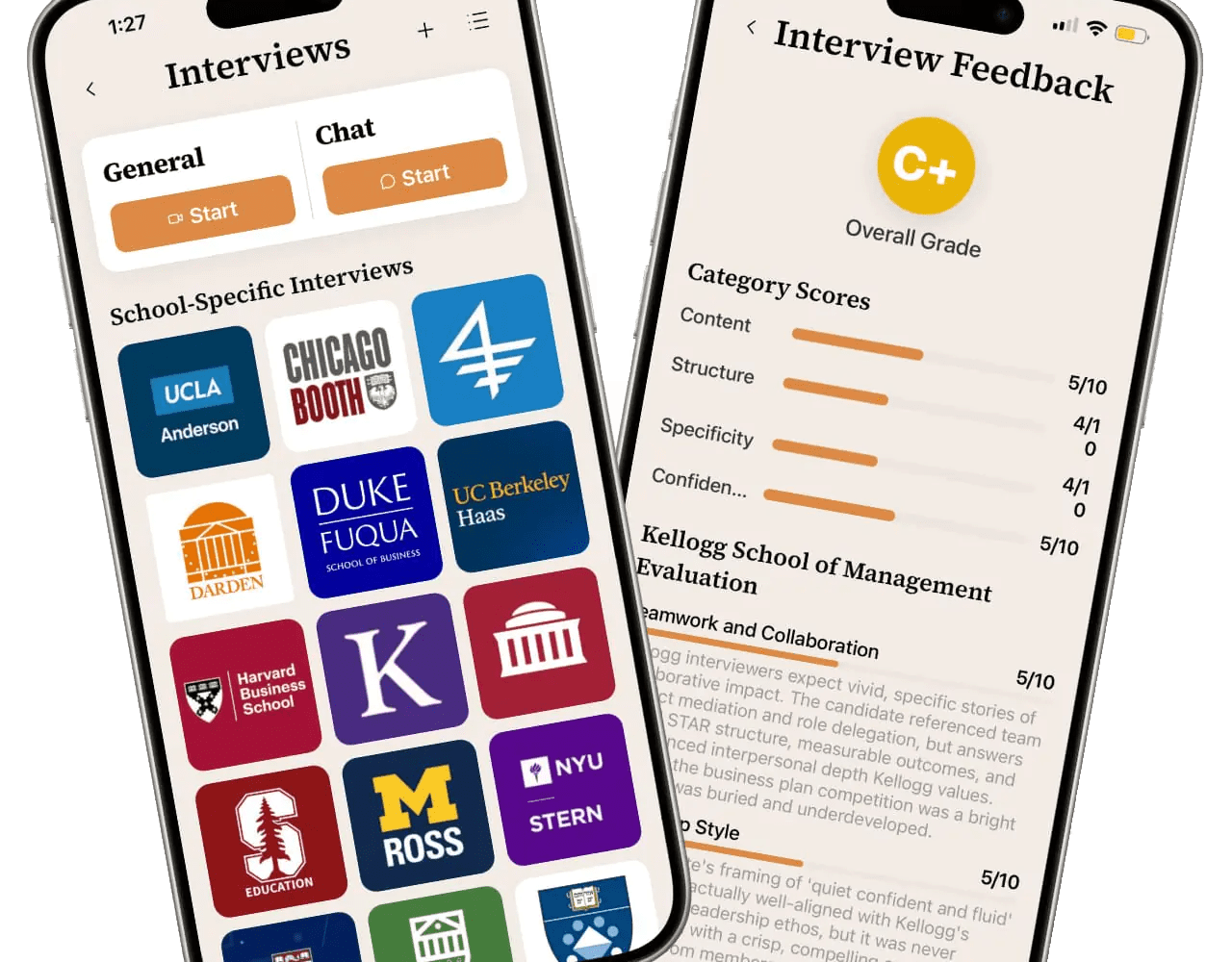
Don’t sleep on our latest product, MBA Launchpad by SBC. Our AI-powered admissions assistant is built on more than 25 years of real SBC admissions data, and it helps you practice for MBA interviews whenever you have time, 24/7. Premium features are currently free. Download it on the App Store or Google Play.
Here’s a snapshot of the caliber of expertise on our SBC team.







Ashley
Ashley is a former MBA Admissions Board Member for Harvard Business School (HBS), where she interviewed and evaluated thousands of business school applicants for over a six year tenure. Ashley holds an MBA from HBS. During her HBS years, Ashley was the Sports Editor for the Harbus and a member of the B-School Blades Ice Hockey Team. After HBS, she worked in Marketing at the Gillette Company on Male and Female shaving ...
×Pauline
A former associate director of admissions at Harvard Business School, Pauline served on the HBS MBA Admissions Board full-time for four years. She evaluated and interviewed HBS applicants, both on-campus and globally. Pauline's career has included sales and marketing management roles with Coca-Cola, Gillette, Procter & Gamble, and IBM. For over 10 years, Pauline has expertly guided MBA applicants, and her clients h ...
×Laura
Laura comes from the MBA Admissions Board at Harvard Business School (HBS) and is an HBS MBA alumnus. In her HBS Admissions role, she evaluated and interviewed hundreds of business school candidates, including internationals, women, military and other applicant pools, for five years. Prior to her time as a student at HBS, Laura began her career in advertising and marketing in Chicago at Leo Burnett where she worked on th ...
×Andrea
Andrea served as the Associate Director of MBA Admissions at Harvard Business School (HBS) for over five years. In this role, she provided strategic direction for student yield-management activities and also served as a full member of the admissions committee. In 2007, Andrea launched the new 2+2 Program at Harvard Business School – a program targeted at college junior applicants to Harvard Business School. Andrea has also served as a Career Coach for Harvard Business School for both cu ...
×Jennifer
Jennifer served as Admissions Officer at the Stanford (GSB) for five years. She holds an MBA from Stanford (GSB) and a B.S. in Chemical Engineering from University of Illinois Urbana-Champaign. Jennifer has over 15 years experience in guiding applicants through the increasingly competitive admissions process into top MBA programs. Having read thousands and thousands of essays and applications while at Stanford (GSB) Admiss ...
×Davina
Davina received her MBA from Stanford's Graduate School of Business (GSB), with a certificate in Public Management, and her BA in Psychology from UC Berkeley. Davina is an experienced strategic planning leader, facilitator, and business case writer who spent more than 15 years building culture, entrepreneurship, and leadership initiatives across Stanford University and the Stanford Graduate School of Business. She designed ...
×Erin
Erin served in key roles in MBA Admissions--as Director at Haas School of Business at UC Berkeley and Assistant Director at Stanford's Graduate School of Business (GSB). Erin served on the admissions committee at each school and has read thousands of applications in her career. At Haas, she served for seven years in roles that encompassed evaluation, outreach, and diversity and inclusion. During her tenure in Admissions at GSB, she was responsible for candidate evaluation, applicant outreach, ...
×Susie
Susie comes from the Admissions Office of the Stanford Graduate School of Business where she reviewed and evaluated hundreds of prospective students’ applications. She holds an MBA from Stanford’s GSB and a BA from Stanford in Economics. Prior to advising MBA applicants, Susie held a variety of roles over a 15-year period in capital markets, finance, and real estate, including as partner in one of the nation’s most innovative finance and real estate investment organizations. In that r ...
×Dione
Dione holds an MBA degree from Stanford Business School (GSB) and a BA degree from Stanford University, where she double majored in Economics and Communication with concentrations in journalism and sociology. Dione has served as an Admissions reader and member of the Minority Admissions Advisory Committee at Stanford. Dione is an accomplished and respected advocate and thought leader on education and diversity. She is ...
×Anthony
Anthony served as the Associate Director of MBA Admissions at the Wharton School at the University of Pennsylvania, where he dedicated over 10 years of expertise. During his time as a Wharton Admissions Officer, he read and reviewed thousands of applications and helped bring in a class of 800+ students a year. Anthony has traveled both domestically and internationally to recruit a ...
×Meghan
Meghan served as the Associate Director of Admissions and Marketing at the Wharton MBA’s Lauder Institute, a joint degree program combining the Wharton MBA with an MA in International Studies. In her role on the Wharton MBA admissions committee, Meghan advised domestic and international applicants; conducted interviews and information sessions domestically and overseas in Asia, Central and South America, and Europe; and evaluated applicants for admission to the program. Meghan also managed ...
×Amy
Amy comes from the Wharton School of the University of Pennsylvania where she was Associate Director. Amy devoted 12 years at the Wharton School, working closely with MBA students and supporting the admissions team. During her tenure at Wharton, Amy served as a trusted adviser to prospective applicants as well as admitted and matriculated students. She conducted admissions chats with applicants early in the admissions ...
×Ally
Ally brings six years of admissions experience to the SBC team, most recently as an Assistant Director of Admission for the full-time MBA program at Columbia Business School (CBS). During her time at Columbia, Ally was responsible for reviewing applications, planning recruitment events, and interviewing candidates for both the full-time MBA program and the Executive MBA program. She traveled both internationally and dome ...
×Emma
Emma comes from the MBA Admissions Office at Columbia Business School (CBS), where she was Associate Director. Emma conducted dozens of interviews each cycle for the MBA and EMBA programs, as well as coordinating the alumni ambassador interview program. She read and evaluated hundreds of applications each cycle, delivered information sessions to audiences across the globe, and advised countless waitlisted applicants. ×
Dana
Dana served as Assistant Director of Admissions at Columbia Business School for the Full-Time MBA program and has over 10 years of experience working in higher education. Known as a scrupulous file reader, Dana reviewed countless applications and assisted in rendering final decisions for the Admissions Committee at CBS. While leading information sessions at Columbia and on the road, Dana met and advised myriad applicants� ...
×Holly
Holly worked as a member of the NYU Stern MBA Admissions team for seven years and holds an MBA from NYU Stern. In her tenure as Director of NYU MBA Admissions, Holly worked closely with admissions teams from Columbia, Michigan Ross, UVA Darden, Cornell Johnson, Berkeley Haas, Yale SOM, and Duke Fuqua on recruiting events domestically and internationally. On the NYU Stern admissions committee, Holly conducted interviews, planned and hosted events, and trained staff on reading and interviewi ...
×Written by Yvonne Milosevic. Reviewed by Stacy Blackman. Learn more about our former admissions officers on the SBC admissions team page.
Header photo: “Booth School of Business from above” by Catarina Oberlander, licensed under CC BY 2.0. Modified with text overlay.