How to Get Into HBS and Stanford: Advice from Two Dual Admits
To get into both HBS and Stanford GSB, meet or beat each school’s academic stats, start building leadership and impact at least a year before you apply, and write a separate application tailored to each school. The two schools look for similar profiles, but Stanford adds a sharper focus on purpose and candid, vulnerable essays.
Quick Summary
- Treat them as two different schools. HBS and Stanford share a similar academic bar, but their values differ, so write every application for that school alone.
- Start a year early. Both schools weigh your profile as heavily as your essays, and leadership and impact take time to build.
- Lead with purpose and candor. A lighter touch on purpose can work at HBS, but a Stanford admit is much harder to earn without a clear sense of why.
This advice comes from SBC consultant Dawn and Chandler, who were each admitted to both schools. Dawn graduated from Harvard Business School as a PepsiCo scholar and has coached HBS and Stanford applicants for more than 15 years. Chandler turned down HBS for Stanford GSB, has since celebrated his 20-year GSB reunion, and hosted the three-part B-Schooled series on getting into the two schools, where they shared these insights.
Both start from the same premise: there’s no formula. “Very few people will have all the elements of both schools,” Dawn says. For more on the profiles that succeed, see our advice on how to get into HBS and Stanford and the lessons from SBC’s study of HBS and Stanford GSB dual admits. For a full head-to-head comparison of the two programs, read our Harvard HBS vs. Stanford GSB guide.
How do you get into both HBS and Stanford?
The biggest mistake multi-school applicants make is treating the schools as interchangeable. Here’s how Dawn and Chandler advise M7 applicants who are targeting more than one program.
Learn each school thoroughly. Many applicants assume HBS and Stanford want the same thing. Their class profiles look alike on paper, but their value systems differ, and so does daily life on campus. HBS enrolls more than 900 students per class, organized into sections. Stanford’s class is less than half that size, at about 430 students, and most students know nearly everyone in their class.
Start early. Both schools evaluate your profile as much as your application. “I wish I had known that a year before” is a line Dawn hears often. Starting early leaves time to take on leadership and create impact you can point to when you apply.
Meet or beat each school’s stats. With admit rates this low, clearing the academic bar at every school on your list frees the rest of your application to make your case.
Show passion and purpose. Dawn calls this the area that “seems touchy-feely to the hardcore people, but is so central.” You may get by at HBS with a lighter touch, she says, but it’s much harder to earn a Stanford admit without a clear sense of purpose.
Never copy and paste. “Approach each application as though you are not applying to the other program,” Dawn says. Admissions committees can tell when an essay was written for another school.
How do the HBS and Stanford MBA essays differ?
The two schools ask for very different things, and the format alone shows it. HBS requires three short essays (business-minded, leadership-focused, and growth-oriented, at 300, 250, and 250 words), plus a career-goals short answer capped at 500 characters. Plenty of applicants read that limit as a word count. “It turns out to be about three sentences,” Dawn says, yet she regularly receives 500-word drafts. HBS also limits how many activities you can list. Our HBS essay tips break down each prompt.
The GSB’s “Why Stanford” essay gives you room to expand on your goals and the purpose behind them. Its activities section also leaves more space for volunteer work. For strategy on both essays, see our Stanford MBA essay tips.
Stanford’s “What matters most to you and why?”
In Dawn’s view, Stanford’s signature prompt is the only major essay at a top school that has nothing to do with accomplishments. She calls it “a journey into the soul.” Chandler has a simple test for a draft:
“If your essay doesn’t scare you a little bit in terms of the vulnerability and authenticity and candor that you are laying out there for the admissions committee, I think you should probably rethink your answer.”
—Chandler, Stanford GSB MBA
The question stays with students long after admission. First-year GSB students host “What Matters Most” dinners where they read each other’s essays anonymously, and it came up again at Chandler’s 20-year reunion. Dawn has advice for applicants who dislike the prompt: “If you hate the question that a school is asking, take a step back and figure out if you want to be at that school.”
How do HBS and Stanford compare by the numbers?
Stanford is smaller and more selective than HBS, which enrolls more than twice as many students. Class profile figures are for the Class of 2027 as each school reports them. Acceptance rates and ranks come from the 2026 U.S. News MBA rankings.
| HBS | Stanford GSB | |
|---|---|---|
| Applications (2024-2025) | 9,409 | 7,259 |
| Enrolled, Class of 2027 | 943 | 434 |
| Acceptance rate (U.S. News 2026) | 11% | 7% |
| GMAT | 730 median | 738 average |
| GMAT Focus | 685 median | 689 average |
| GRE (V/Q) | 164/164 median | 164/164 average |
| Average GPA | 3.76 | 3.77 (Class of 2026) |
| Women | 44% | 45% |
| International | 37% | 38% |
| Avg. work experience | 4.9 yrs | 5.3 yrs |
| U.S. News 2026 rank | 4 (tied) | 1 |
Would you like feedback on your admit chances for Stanford and/or HBS? Request a free MBA advising session here.
What is the culture like at HBS vs. Stanford?
HBS is more open about competition and networking, while Stanford prizes candor about struggle. Chandler suggests the typical HBS and Stanford student differ in only about 10% of their wiring, and that 10% shows up everywhere from the classroom to the weekend. Asked to describe each school as a meal, a Saturday, and a party, the two dual admits answered this way.
| HBS | Stanford GSB | |
|---|---|---|
| Meal | Caviar and lobster: the best of the best | “What Matters Most” dinners, reading classmates’ essays anonymously |
| Saturday | Lunch with networking, or sleeping off the case workload | Outdoors: walking the Dish, biking, a trip to Half Moon Bay |
| Party | Black tie | Costume party, including a famous trip to Las Vegas |
In the classroom
The classroom differs too. HBS runs on the case method and cold calls, so students must be ready to debate at any moment. Stanford uses cases in some classes, but discussion more often turns to how a decision would feel to you personally. Chandler also points to Stanford’s grade non-disclosure norm, which encourages students to take hard classes without worrying about recruiters seeing their grades.
Networking and candor
Chandler compares GSB students to ducks on a pond. “A lot of people at Stanford are working like crazy behind the scenes, but projecting an image of relaxed calm,” he says. Networking happens there, but it tends to grow out of friendships. At HBS, Dawn says, students talk openly about how relationships lead to opportunities, and a Saturday lunch often doubles as networking. The heavy case workload means some weekends are simply for sleep.
Vulnerability lands differently on each campus. “When I’m on Stanford’s campus, people are open about, ‘Oh, I’m not doing as well here,’ and then other people chime in to help,” Dawn says. In her experience, HBS students keep their weaknesses closer to the vest. Even the dress code differs. As an HBS student, Dawn once went to a Halloween event dressed as a Stanford student, in a T-shirt and flip-flops in a freezing October. Her classmates got the joke immediately.
After graduation
Whichever school you choose, the degree is where the work begins. Drawing on her experience as an executive coach, Dawn notes that neither school’s name opens doors forever. Graduates still have to prove what they can do, which is why she urges applicants to choose the school that matches who they are.

How can you test your fit before you apply?
Chandler’s first piece of advice is to question your assumptions. He wants applicants to choose a school for their own reasons, and he has known people who picked Stanford or Harvard because of family pressure or because everyone around them was applying there.
Dawn uses a simple exercise with clients: she describes programs without naming them and asks which one appeals. One prestige-focused client found he gravitated toward a European program. He enrolled there and believes it has helped his career. Try it with your own list of M7 MBA programs.
What final advice do the two dual admits give?
Dawn frames the overlap between the two schools this way:
“Everything that HBS wants from a profile point of view, Stanford will want and will also add on a number of key values.” —Dawn, HBS MBA
Her formula: “Dream big, understand the steps, execute with excellence and integrity.” Chandler’s is shorter: “Do your homework and be boldly authentic.”
Chandler adds that the applicants who struggle most with a rejection usually fall into two groups. Some submitted work they knew wasn’t their best. Others pulled punches and weren’t as candid as they could have been. Applicants who give their best, most authentic effort, he says, find it far easier to move on, whatever the outcome.
Listen: Hear the full conversation in the three-part B-Schooled series on getting into HBS and Stanford: Episode 1, Episode 2, and Episode 3.
Frequently Asked Questions About Getting Into HBS and Stanford
Can I adapt my HBS essays for my Stanford application?
Start each application from a blank page. HBS and Stanford ask different questions because they value different things, and readers at both schools can spot an essay built for another program. You can draw on the same experiences, as long as you frame them around what each school is looking for.
How much should I write for the HBS career goals question?
Plan on about three sentences. HBS caps the answer at 500 characters, and applicants who draft 500 words end up cutting nearly everything. Use the space to name your immediate post-MBA target and the longer-term impact you’re working toward.
Should rankings decide whether I choose HBS or Stanford?
Rankings shift every year, and the gap between these two schools is small. Stanford ranked No. 1 in U.S. News 2026 and HBS tied for No. 4, yet the differences that will shape your two years are size, teaching method and culture. Pick the classroom and community where you’ll do your best work.
Do I need a finance or consulting background to get into HBS or Stanford?
Consulting, finance, and tech still supply the largest groups at both schools, and each class also includes students from nonprofits, government, healthcare, the military, and other fields. What carries your application is the leadership and impact you’ve shown wherever you work.
Ready to build two applications that each stand on their own? Contact us to work with an SBC team that includes former HBS and Stanford GSB admissions officers.
MBA Launchpad
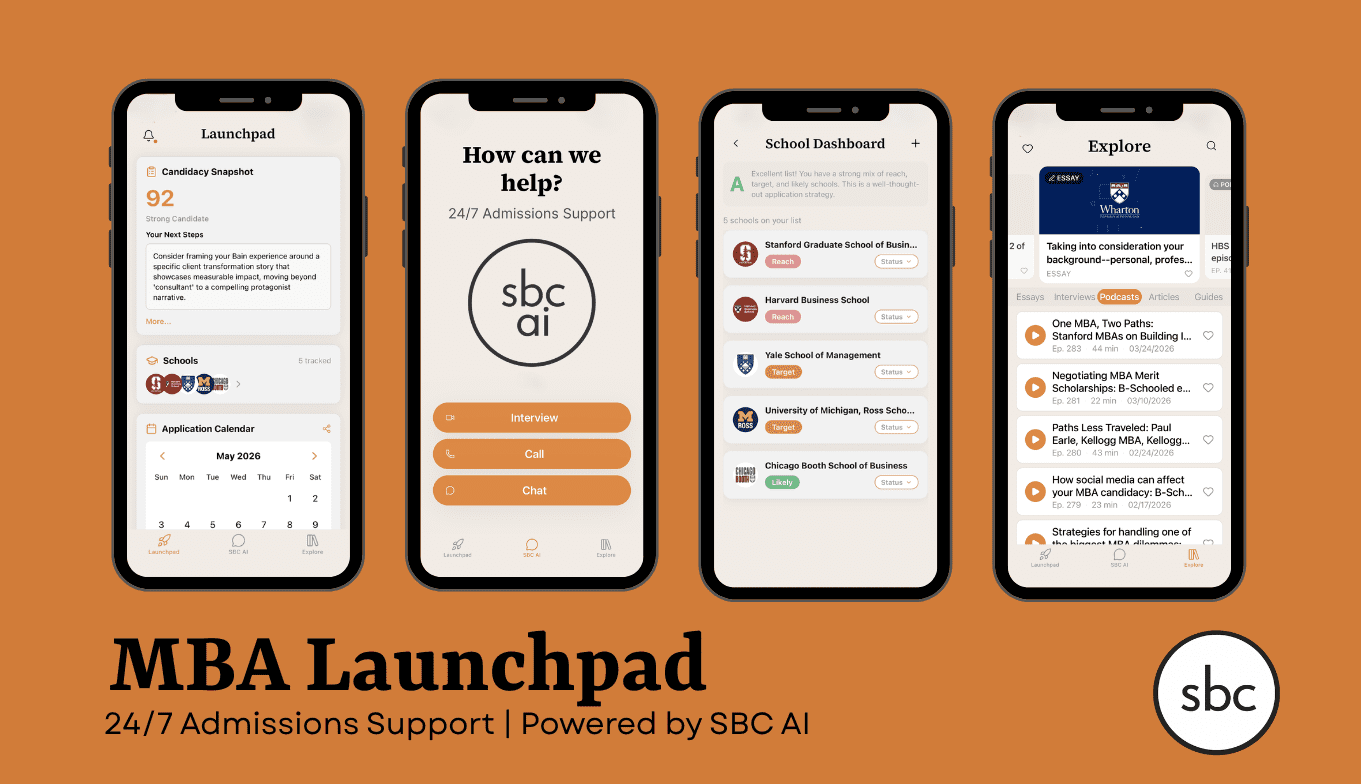
Don’t sleep on our latest product, MBA Launchpad by SBC! Our AI-powered admissions assistant is built on 25+ years of real SBC admissions data, and it lets you compare HBS, Stanford, and other top programs on class size, admit rate, average GPA and test scores, teaching style, culture, and more. Once you’re applying, it can also help you practice for your HBS interview. Premium features are currently free. Download it on the App Store or Google Play.
Here’s a snapshot of the caliber of expertise on our SBC team.













Ashley
Ashley is a former MBA Admissions Board Member for Harvard Business School (HBS), where she interviewed and evaluated thousands of business school applicants for over a six year tenure. Ashley holds an MBA from HBS. During her HBS years, Ashley was the Sports Editor for the Harbus and a member of the B-School Blades Ice Hockey Team. After HBS, she worked in Marketing at the Gillette Company on Male and Female shaving ...
×Pauline
A former associate director of admissions at Harvard Business School, Pauline served on the HBS MBA Admissions Board full-time for four years. She evaluated and interviewed HBS applicants, both on-campus and globally. Pauline's career has included sales and marketing management roles with Coca-Cola, Gillette, Procter & Gamble, and IBM. For over 10 years, Pauline has expertly guided MBA applicants, and her clients h ...
×Laura
Laura comes from the MBA Admissions Board at Harvard Business School (HBS) and is an HBS MBA alumnus. In her HBS Admissions role, she evaluated and interviewed hundreds of business school candidates, including internationals, women, military and other applicant pools, for five years. Prior to her time as a student at HBS, Laura began her career in advertising and marketing in Chicago at Leo Burnett where she worked on th ...
×Andrea
Andrea served as the Associate Director of MBA Admissions at Harvard Business School (HBS) for over five years. In this role, she provided strategic direction for student yield-management activities and also served as a full member of the admissions committee. In 2007, Andrea launched the new 2+2 Program at Harvard Business School – a program targeted at college junior applicants to Harvard Business School. Andrea has also served as a Career Coach for Harvard Business School for both cu ...
×Jennifer
Jennifer served as Admissions Officer at the Stanford (GSB) for five years. She holds an MBA from Stanford (GSB) and a B.S. in Chemical Engineering from University of Illinois Urbana-Champaign. Jennifer has over 15 years experience in guiding applicants through the increasingly competitive admissions process into top MBA programs. Having read thousands and thousands of essays and applications while at Stanford (GSB) Admiss ...
×Davina
Davina received her MBA from Stanford's Graduate School of Business (GSB), with a certificate in Public Management, and her BA in Psychology from UC Berkeley. Davina is an experienced strategic planning leader, facilitator, and business case writer who spent more than 15 years building culture, entrepreneurship, and leadership initiatives across Stanford University and the Stanford Graduate School of Business. She designed ...
×Erin
Erin served in key roles in MBA Admissions--as Director at Haas School of Business at UC Berkeley and Assistant Director at Stanford's Graduate School of Business (GSB). Erin served on the admissions committee at each school and has read thousands of applications in her career. At Haas, she served for seven years in roles that encompassed evaluation, outreach, and diversity and inclusion. During her tenure in Admissions at GSB, she was responsible for candidate evaluation, applicant outreach, ...
×Susie
Susie comes from the Admissions Office of the Stanford Graduate School of Business where she reviewed and evaluated hundreds of prospective students’ applications. She holds an MBA from Stanford’s GSB and a BA from Stanford in Economics. Prior to advising MBA applicants, Susie held a variety of roles over a 15-year period in capital markets, finance, and real estate, including as partner in one of the nation’s most innovative finance and real estate investment organizations. In that r ...
×Dione
Dione holds an MBA degree from Stanford Business School (GSB) and a BA degree from Stanford University, where she double majored in Economics and Communication with concentrations in journalism and sociology. Dione has served as an Admissions reader and member of the Minority Admissions Advisory Committee at Stanford. Dione is an accomplished and respected advocate and thought leader on education and diversity. She is ...
×Anthony
Anthony served as the Associate Director of MBA Admissions at the Wharton School at the University of Pennsylvania, where he dedicated over 10 years of expertise. During his time as a Wharton Admissions Officer, he read and reviewed thousands of applications and helped bring in a class of 800+ students a year. Anthony has traveled both domestically and internationally to recruit a ...
×Meghan
Meghan served as the Associate Director of Admissions and Marketing at the Wharton MBA’s Lauder Institute, a joint degree program combining the Wharton MBA with an MA in International Studies. In her role on the Wharton MBA admissions committee, Meghan advised domestic and international applicants; conducted interviews and information sessions domestically and overseas in Asia, Central and South America, and Europe; and evaluated applicants for admission to the program. Meghan also managed ...
×Amy
Amy comes from the Wharton School of the University of Pennsylvania where she was Associate Director. Amy devoted 12 years at the Wharton School, working closely with MBA students and supporting the admissions team. During her tenure at Wharton, Amy served as a trusted adviser to prospective applicants as well as admitted and matriculated students. She conducted admissions chats with applicants early in the admissions ...
×Ally
Ally brings six years of admissions experience to the SBC team, most recently as an Assistant Director of Admission for the full-time MBA program at Columbia Business School (CBS). During her time at Columbia, Ally was responsible for reviewing applications, planning recruitment events, and interviewing candidates for both the full-time MBA program and the Executive MBA program. She traveled both internationally and dome ...
×Emma
Emma comes from the MBA Admissions Office at Columbia Business School (CBS), where she was Associate Director. Emma conducted dozens of interviews each cycle for the MBA and EMBA programs, as well as coordinating the alumni ambassador interview program. She read and evaluated hundreds of applications each cycle, delivered information sessions to audiences across the globe, and advised countless waitlisted applicants. ×
Dana
Dana served as Assistant Director of Admissions at Columbia Business School for the Full-Time MBA program and has over 10 years of experience working in higher education. Known as a scrupulous file reader, Dana reviewed countless applications and assisted in rendering final decisions for the Admissions Committee at CBS. While leading information sessions at Columbia and on the road, Dana met and advised myriad applicants� ...
×Holly
Holly worked as a member of the NYU Stern MBA Admissions team for seven years and holds an MBA from NYU Stern. In her tenure as Director of NYU MBA Admissions, Holly worked closely with admissions teams from Columbia, Michigan Ross, UVA Darden, Cornell Johnson, Berkeley Haas, Yale SOM, and Duke Fuqua on recruiting events domestically and internationally. On the NYU Stern admissions committee, Holly conducted interviews, planned and hosted events, and trained staff on reading and interviewi ...
×Written by Yvonne Milosevic. Reviewed by Stacy Blackman. Learn more about our former admissions officers on the SBC admissions team page.